
In the modern landscape, marketing, sales, and customer success leaders are facing a challenge where they are surrounded by more technology and information than ever before, yet siloed data and complex stacks often feel like an obstacle course rather than a growth engine. Most leaders feel that their technology is underperforming, but at the same time, there is a significant portion getting unused. The hard truth is that the issue is rarely the technology itself. Instead, the roadblock is usually rooted in the strategy, how the tool is used, and the level of adoption. Turning systems into a growth engine requires a shift in mindset, where leaders use a strategic approach and change enablement for technology that drives measurable business impact.
To get the highlights on how to approach this, continue reading below. To get the full deep dive, watch Part VI, Tech That Grows With You (Not Against You), of the Built to Buy Series.

The Challenge: Complex tech stacks falling short
Over the years, growth leaders have been in a cycle of “Have a problem? Buy a solution.” Over time, this has led to fragmented systems, manual workarounds, and disconnected data, leaving teams drowning in clicks and frustration. The average large enterprise has over 600 applications (WalkMe Inc.). Leading to tech stack bloat, underutilization, and underperformance.
- 55% of organizations fail to manage their full portfolio of tech projects, along with their interdependencies (Boston Consulting Group).
- 54.9% of companies shared that their technology underperforms according to their expectations (The CMO Survey).
- 44% of marketing technology gets underutilized (Deloitte).
- Only an average of 33% of martech stack capabilities get used (Gartner).
Historical technology purchases were made with the best intentions. The team member, team leader, or the buyer would identify a real pain point, see a promising new tool, and genuinely believe, “This solution is going to help solve it.” Based on the level of investment of time, money, and organizational energy required, they moved forward, implemented the system, and added it to their tech stack, eager for the promised returns.
Which begs the question: how did organizations get to a place where that initial optimism was replaced by daily frustration? How did this technology, meant to empower them, feel more like a roadblock, with systems that are not meeting the expectations of the people using them, and are not maximized to their full capabilities?
Root causes of technology underperformance and underutilization
There are a few root causes for technology falling short, and most of the time, it is not the technology itself, but rather how it is approached and then rolled out to teams.
1. Missing a strategic approach that considers the bigger picture
When technology is approached as a point solution to fix one singular challenge, there is a lack of strategic planning that considers how the technology fits into the bigger picture of the organization. Such as:
- How will this technology align with the business strategy?
- How will it contribute to the desired end experience we want to give to our customers?
- What are the goals that we want to achieve with this solution?
- How will it fit with how our people operate?
- How will it integrate into our data strategy?
- How will this technology work with the other systems we already have?
A symptom of technology not being aligned with the business strategy was a trend found in the 2025 Trilliad Sustainable Growth Study. The study surveyed 350+ growth leaders, and 1 in 3 admitted that their alignment strategy stops at the planning phase. Meaning that their strategy for cross-team collaboration throughout the customer lifecycle is not consistently being executed on, because the technology that marketing, sales, and customer success use daily does not reflect the strategy.
Without the critical step of strategic alignment of both the broader business aspects and the human impacts, the system will often fail to meet expectations and become another silo.
2. Lacking effective change enablement for the people
Successful technology transformations are not just about the tech itself, but about ensuring people are motivated to adopt the changes. Without effective change enablement that considers how people operate today, how the technology will impact their processes, and provides the tools, guidance, and support needed to ensure sustained, successful adoption, then technology will continue to be underutilized, leading to underperformance.
Without effective change enablement that considers how people operate today, how the technology will impact their processes, and the training and communication needed to ensure sustained, successful adoption, then technology will continue to be underutilized, leading to underperformance.
An example of this is now being seen with AI projects. Up to 90% of AI projects are failing to scale beyond the pilot phase (Forbes), which would also cause 80% of organizations to say that there is no tangible enterprise-level EBIT impact from AI investments (McKinsey & Company). A major factor is a lack of effective change enablement for the people. 70% of AI project failures are organizational (Adaptovate).
Even the best ideas or technologies can fail if people don’t embrace them. When people are not enabled to effectively use the technology, there is a lack of communication in the plan and value behind it, or it turns into more of a roadblock for how they operate, they will resort back to what they know because “It just works.” Causing an overall lack of sustained adoption.
A customized, human-centric Change Enablement approach that guides the teams through the transformation with persona-specific communications delivered in a variety of ways, advocacy activities to encourage peer engagement, information and support leaders need to guide their teams, and robust role-based training and post-launch support ensure all stakeholders are aligned and actively driving toward a lasting impact.
Stopping the cycle of disparate systems that underperform and are underused requires a mindset shift for maximizing the technology already in place and continuing to evolve platforms with the latest solutions available.
The Solution: Implementing a strategic approach and change enablement for technology that drives growth
To effectively approach technology, it needs to be thought of as a growth engine rather than just mere overhead. This mindset shift guides leaders toward considering the big picture and the people involved to get the most out of the systems they currently have, and when evolving technology.
Maximizing systems: The strategy for assessing current technology
To maximize technology in place, it first needs to be evaluated to identify gaps. Where is it currently not meeting expectations, where it is being underutilized, and what areas need advancing to enable people to be as effective as possible with engaging our customers and building lasting connections?
There are four areas in which technology should be assessed to help guide teams toward effectively maximizing what they need.
- People & Adoption: How are your people using the technology? Do you have enablement in place to support your teams and ensure sustained and effective adoption? Are you continuously listening to your users to determine system effectiveness?
- Strategy: Is your technology aligned with your strategy? Do you have a plan in place for how the technology will be used and how it will drive business value?
- Capabilities: Is the technology being used to its full potential? Does the technology do what we need it to for our people and our customers today? If yes, what about six months from now?
- Data & Integration: Is the system’s data locked in a silo? Is the data being used, and how so? To what level would you say that the data in the system is accurate and reliable?
For a full list of questions to consider in each area and to start applying this strategic approach for assessing technology at your organization, download our Technology Assessment Guide.
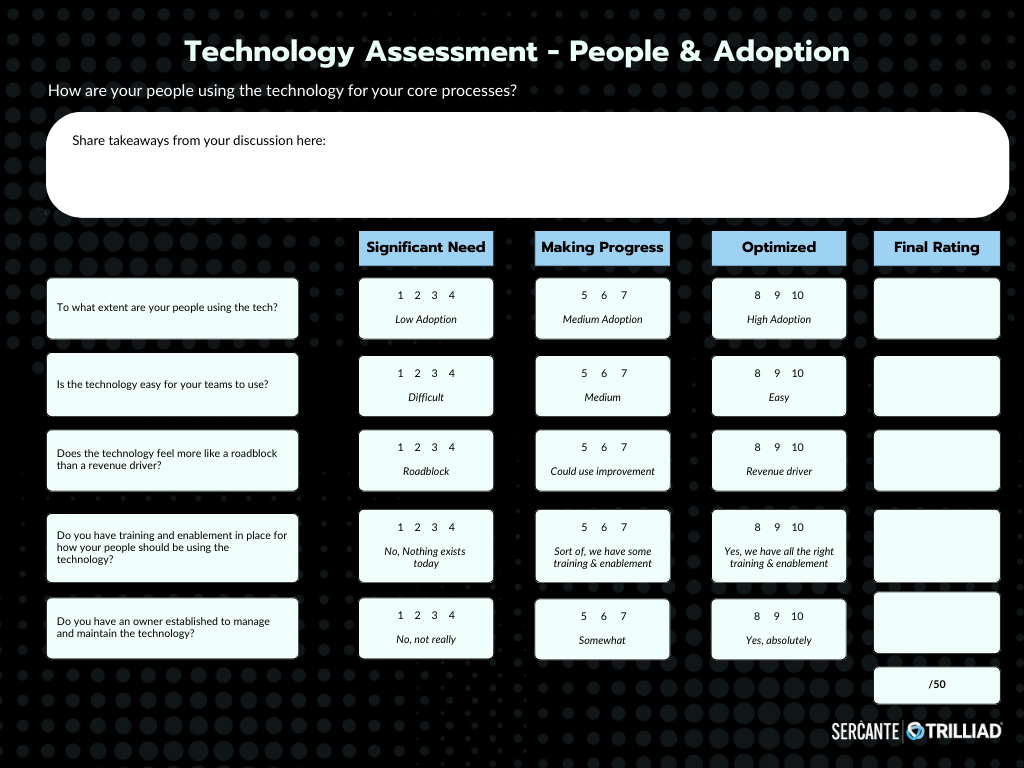
Answering these questions will help growth teams define the biggest areas of need with their technology, and start to define the system optimization projects they want to pursue to actually maximize what they have.
Prioritizing technology optimization with an actionable roadmap
After completing the technology assessment, teams can often feel overwhelmed when looking at the long list of needs within their tech stack. The key to gaining momentum is not to try and fix everything at once, but to prioritize projects based on a balanced scorecard of business impact, effort to execute, organizational impact, and the dependencies involved.
By categorizing your initiatives, you can create a roadmap that balances quick wins with long-term strategic transformations:
- Business Impact: Tying projects to business impact ensures that efforts are focused on high-value initiatives. Ask: Will this move the needle on revenue, customer retention, or lead conversion? If the project can’t be tied back to a core KPI, it might be a vanity project rather than one that should be prioritized for the growth engine.
- Level of Effort: Evaluate the resources required. Is this an out-of-the-box configuration change (low effort) or a custom API integration that requires months of development (high effort)?
- Organizational Impact: Consider how many people this affects. A change to the CRM affects every seller, while a change to a niche social listening tool may only affect a small subset of marketing.
- Dependencies: Identify the “domino effect.” Does the new lead scoring model depend on a data cleanup project that hasn’t started yet? Mapping these interdependencies prevents projects from stalling mid-execution.
Take a deeper dive into the considerations for building your technology roadmap, with this example of how the Sercante experts apply this approach for AI in this on-demand webinar. To get support with creating your AI roadmap, reach out to the Sercante team.

Strategically evolving technology to enhance experiences at scale
The latest developments happening in the technology landscape with data and AI are making it possible for growth teams to converge solutions and be more effective at what they do. It poses a great opportunity for organizations to embrace innovation and meet their buyers where they are through emotionally resonant experiences that drive growth in ways that have never been done before. However, evolving technology shouldn’t just be about adding “the next big thing”. It should be thought of through an impact-driven lens that asks:
- Does this solution specifically remove friction from the buyer’s journey?
- Does it empower the team to impactfully engage buyers at scale?
- Does it enable smarter decision-making with actionable insights?
If the answer is yes to any of the above, then it should be considered, but further grounded with a view of the big picture: how it aligns with the business strategy, integrates with core processes, fits with the people and buyers, and how it connects to the data strategy and the current systems in place.
Implementing effective change enablement for sustained adoption
Even the most sophisticated technology will fail if teams do not actually use it. This is why change enablement is critical when shifting how a process is done in a current system, or new technology is being added to what growth teams use to continue to evolve capabilities.
Effective change enablement requires understanding what success looks like, how the technology is currently being used, and what skills might need to be developed to create tailored training and documentation by role to close any gaps and ensure sustained success. In addition, it requires clear and transparent communication with the end users. The teams involved need to understand what the intended goal is for the rollout of the solution and how it will drive value for the organization.
To ensure tech initiatives result in sustained adoption, follow this Change Enablement Checklist:
- Identify & Respond: Start by listening. What are the specific pain points your team faces? When end-users are involved early, it reduces the “fear of the unknown” and builds internal champions.
- Define & Design: Clearly define the new process before building the technical solution. Technology should automate a well-defined process, not just try to fix a broken one.
- Listen & Inform: Maintain a continuous feedback loop. Communication shouldn’t be a one-time email on launch day. It should be a steady stream of updates that explain the why behind the change.
- Prepare & Sustain: Provide tailored training that meets people where they are. Since most people only retain about 34% of what they were taught within 24 hours (Harvard Business Review), ongoing support, documentation, and “office hours” are recommended to reinforce the new way of working.
Learn more about how this change enablement checklist is applied with AI initiatives, with this on-demand MarDreamin’ session, Empowering Your People: Nailing Change Enablement for AI Rollouts. To get support with creating and executing an effective change enablement strategy, reach out to the Sercante team.

Approaching technology as a growth engine
The difference between technology that feels like an obstacle course and technology that acts as a growth engine is often not rooted in the technology itself, but rather the strategy and change enablement applied to ensure it is aligned with high-value business outcomes and successfully adopted for long-term success. It requires a commitment to ongoing evaluation and advancement through a roadmap that prioritizes impact. Applying this mindset will guide growth leaders to overcome the challenges of their complex tech stack and empower their people to do what they do best: build meaningful connections with their buyers that drive sustainable growth.