Category

Pro Tips

ChatGPT Welcome to Ads Manager Beta message

In case you missed it, last week OpenAI announced that their ad network is now open for a public beta.

If you’re a ā€œbleeding edgeā€ type, you probably already signed up for an Ads Manager Beta account.  If you’re more of ā€œan early middleā€ type, perhaps you’re taking a wait-and-see approach.

I would strongly advocate for early experimentation with this – it is most certainly going to become a core part of the B2B marketing mix over the next 12 months.  Early learnings can help you determine quickly if/how you pivot your marketing spend and focus for the balance of 2026.

What’s on offer from OpenAI

Back in February, OpenAI announced it was trialing ads with a few select partners. On May 5, 2026, OpenAI announced it was making a self-serve advertising platform available for public beta, with no minimum spend requirement.

This is welcome news to any B2B marketers who have seen traffic dip as a result of LLMs cannibalizing click-through traffic from Google.

Capabilities of ChatGPT Ads

This ad platform is early, and we should expect that it will evolve rapidly.  Think early days of Google and Facebook. 

The rules will change, and the best practices will change, it is the definition of a moving target.  But for now, here’s what we’re working with:

Audience

Through the news Ads Manager Beta, advertisers can reach logged-in users over the age of 18 in the US, Canada, Australia, and New Zealand.  Ads will be shown to Free users and ā€œGoā€ tier users (lowest tier of paid accounts). All other paid accounts will not be shown ads.

Targeting

You can target based on ā€œcontext hintsā€ or descriptive phrases of the type of conversations you’d like to be placed in.  OpenAI will use these hints as matching signals alongside the content of your landing page and ad copy.

Certain sensitive topics (health, mental health, politics) are excluded from targeting.

Ad Format

Ads can contain:

  • Your brand name
  • Favicon
  • Headline
  • Description
  • Image
  • Link

Here’s a rough mockup of what that would look like for a user:

ChatGPT Ad mockup

Pricing

ParameterDetail
CPC (Cost Per Click)Clicks objective. Recommended starting max bid: $3-5 USD. Custom max bids available. B2B campaigns may see higher CPCs ($8-15) due to audience depth.
CPM (Cost Per Thousand)Reach objective. Default max bid: $60 CPM. Suitable for brand awareness and early-funnel exposure.
Auction typeRelevance-weighted second-price auction. Winning ad pays just above the second-highest relevant bid.
Minimum budgetNo published minimum as of self-serve launch. Recommended test budget: $2,000-5,000 per month for meaningful data collection.

Measurement

In-platform metrics include:

  • Impressions
  • Clicks
  • Spend
  • CTR
  • Average CPC/CPM, conversions

UTM parameters persist through ad clicks. Remember to set utm_source=chatgpt before launching ads—retroactive attribution is impossible!

What’s NOT Possible with ChatGPT Ads

Demographic Targeting

You cannot target ads based on demographics.  This is a tough pill to swallow in B2B when potential buyers often fit a defined set of criteria, or when you are focused on an ABM strategy.

A lot of B2B marketing starts with asking: “Who is our buyer?”

With ChatGPT Ads, we need to ask: “What question does our best buyer ask right before they need us?ā€

Agency Managed Accounts

Every business that wants to run ads on ChatGPT needs to sign up for its’ own account at: https://ads.openai.com/.  You can add users from your agency after the account is approved and provisioned.

Integration

As of this publish date, ChatGPT Ads does not have connectors with any CRM or marketing analytics platforms.

Advanced Measurement

I can’t stress this enough: the platform is early.  It’s basic.  There is data you can get from other platforms that you will not get yet with ChatGPT Ads.  But OpenAI has a vested interest in getting this feature stood up – the more you can measure the path to revenue, the more advertisers are going to be willing to pour money into a channel.

Predictability

ā€œInventory ceilingsā€ are likely going to be an issue for early movers. I would estimate about 20-25% of all ChatGPT users meet the criteria to be shown ads through this beta.  What percentage of those users are B2B decision makers with intent for your particular product?  It’s impossible to get a precise estimate of that with the tools OpenAI has made available today. 

You may find yourself allocating $20K to a pilot and only spending $12K based on how often users are looking for what you’re promoting – but that in and of itself is a valuable insight that can tell you how to prioritize this in your marketing mix.

What are the other LLMs & AI Platforms doing?

Google / Gemini

Not really in the AI ad game yet. Traditional Google Ads placements are sometimes surfaced in Google Search AI overviews. No native conversational ads in Gemini – yet.

Microsoft Copilot

Already selling ads. Ads appear within Copilot responses and other AI surfaces (Bing, Edge) through existing Microsoft Advertising inventory, including Performance Max, Multimedia, and Search campaigns.

Claude

Staunchly anti-ad.  So much so that they made a Super Bowl commercial about it.

Meta AI (Consumer Chat)

No built-in ad slots in chatbot outputs, though Meta uses AI signals to inform ads across its properties.

Perplexity AI

Focused on subscriptions and business features. No current in-chat ads.

What should you do next with ChatGPT Ads?

I would recommend leaning in and experimenting with this early.  Costs at this stage will be lower (with less competition for clicks and impressions), and the early learnings are extremely valuable.

To do a meaningful test, I would suggest a budget of $2K+ per month over a 60-90 day window.

Because this is brand new, you’re not going to find team members or agencies with ā€œyears of experienceā€ implementing this strategy…. so you should pick someone to manage it that has a data-driven mindset, is agile/iterative, and has the bandwidth to actively manage this and ensure it is successful.

I suspect that the biggest learning curve is going to be how to write ā€œcontext hints.ā€  There’s going to be a little bit of art here since it’s different from how other platforms operate.  Context hints should be written in the user’s language, with the right specificity, mapped to the decision stage you want to capture your audience in – it’s going to take a high degree of user empathy to get this right.

Just Global is actively sharing their early learnings on ChatGPT Ads.  If you’re ready to dive into the ā€œhowā€ and initial best practices, check out their e-book!

Just Global l Trilliad Life on the Edge: B2B Growth in the Age of AI Download Ebook

With the upcoming June 2026 updates Salesforce has just announced, Salesforce is once again raising the bar for platform security. While these updates are designed to keep your data safer than ever, they do require some proactive heavy lifting from admins to ensure integrations don’t break and user access remains seamless.

In line with the messaging we’ve seen from Salesforce recently—focusing on the intersection of AI, Data, and Trust—these enhancements are mandatory. We want to make sure you’re ahead of the curve. Let’s dive into the core security requirements and what you need to do to prepare.

Email Domain Verification 

  • What is changing: Salesforce now strictly requires all outbound email-sending domains to be verified. To verify a domain, you must establish ownership using either DKIM key (recommended) or a verified entry in the authorized email domains list. As part of this change, Salesforce will no longer deliver emails from unverified domains, even if the specific sender’s individual email address was previously verified.
  • Why it matters: Email deliverability is becoming stricter globally, with major mail providers increasingly filtering or rejecting unauthenticated domains. If your organization attempts to send an email from an unverified domain, the delivery will fail and the email will be silently dropped. It won’t generate a bounce notification or an error message for your automations.
  • Who is impacted: Any emails sent directly from the Salesforce platform, which includes emails sent via the Email Composer, Apex email, Flow-triggered emails and even system-generated emails like notifications of a new Lead or Opportunity assignment.
  • Timeline: Enforcement began rolling out to sandboxes in March 2026, and production orgs in April 2026. 
  • How to prepare: 
    • You can check the verification status in your org by going to Deliverability settings in Setup and enter your domain in the Check Domain Verification section.
    • Ensure your email sending domains are verified using one of the following methods:
    • Enable a Safety Net: To minimize immediate business disruption while waiting for domain verification, enable ā€œUse a substitute email address for unverified domainsā€ on the Deliverability Setup page. 
Domain verification section

MFA Mandatory for All Users

  • What is changing:  While Multi-Factor Authentication (MFA) has been a contractual “requirement” for some time, Salesforce is moving toward technical enforcement for all UI logins (i.e. the login.salesforce.com page). This means any user logging into the Salesforce UI must use Multi-Factor Authentication. The ability to toggle this off for specific profiles or bypass it via legacy settings is being deprecated.
  • Why it matters: Data breaches are commonly linked to compromised credentials. Making MFA a technical requirement for every single user, ensures that even if a password is compromised via social engineering, your org remains protected.
  • Who is impacted: All users logging into Salesforce (direct UI or SSO logins) in production or sandbox orgs and do not have one of these permissions: System Administrator profile, Modify All Data, View All Data, Customize Application, or Author Apex. (Users with these permissions are considered “privileged” and have their own MFA requirements, see the next section)
  • Timeline: Enforcement is rolling out in waves, starting in Sandboxes on June 22, 2026, and production orgs starting July 20th.
    • Ahead of enforcement, orgs that have the setting ā€œRequire multi-factor authentication (MFA) for all direct UI logins to your Salesforce orgā€  disabled may start seeing this pop-up message as a heads-up on the upcoming enforcement.
    • Orgs with that have been updated will see the ā€œRequire multi-factor authentication (MFA) for all direct UI logins to your Salesforce orgā€ setting (under Setup > Session Settings)  enabled and greyed out.
MFA Reminder pop-up message
  • How to prepare:
    • Audit users still not using MFA to assess who will be impacted. Use the ā€œIdentity Verification Methods Reportā€ to view the methods being used by your organization.
    • Identify users relying on the “Waive Multi-Factor Authentication for Exempt Users” permission. To restore this exemption for valid use cases (e.g., automated testing tools), you can contact Salesforce Support for approval.
    • Identify the MFA methods available for your users and determine how they choose a method during initial registration.
    • If you are using Single Sign-On (SSO) through another identity provider (e.g. Okta, Entra), make sure that provider is using MFA and sending valid signals to validate MFA was used (for more information, see Salesforce’s breakdown of signal requirements).
    • Ensure users are prepared for the change and how to register their MFA method.  
  • More information: Prepare for MFA Enforcement for All Employee Users

Phishing-Resistant MFA for Admins or Privileged Users

  • What is changing: Salesforce is introducing a requirement for phishing-resistant MFA for users with “privileged” access. This means moving away from verification codes and toward FIDO2/WebAuthn-based passkeys, hardware security keys (e.g. YubiKeys) or built-in authenticators (e.g. Windows Hello or FaceID) that use FIDO2/WebAuthn standards.
  • Why it matters: Admins hold the keys to the kingdom. Phishing-resistant methods ensure a stronger protection against identity-based threats, and ensures access is tied to authorized users. 
  • Who is impacted: 
  • This change affects all users logging into Salesforce (direct UI or SSO logins) in production or sandbox orgs who meet any of the following conditions:
    • Users assigned with the System Administrator profile
    • Users assigned with any one of these privileged permissions: Modify All Data, View All Data, Customize Application, or Author Apex
  • Once in effect, users will be prompted to register their phishing-resistant MFA method on their next login. 
What it will look like to register the phishing-resistant MFA method on the next login.
  • Timeline: This change will be introduced in sandboxes starting June 22, 2026, and in production orgs starting July 1, 2026
  • How to prepare:

Containment for ā€œHigh Riskā€ Connections

  • What is changing: Salesforce will automatically detect and contain traffic that:
    • Are from “High-Risk” connections through Connected App or API usage.
      • Examples of ā€œhigh riskā€ connections include anonymizing VPNs (e.g. NordVPN, ExpressVPN, Surfshark, or ProtonVPN), Proxies (e.g. HideMyAss or KProxy) or high-risk IP addresses (e.g. public wifi, blocklisted IPs)
      • Connected App or API usage may include integrations, plugins (e.g. Salesforce Inspector Reloaded) or use of CLI tools.
    • Are significant, novel deviations from typical user login activity based on network, client, authentication events, and geolocation. (detected through an AI-driven monitoring system)
    • If a high risk connection is identified, the following actions will be taken:
      • The affected user account will be frozen.
      • All OAuth refresh tokens granted to the user will be revoked.
      • An email will be delivered to org admins from Salesforce Security (See Administrator Notifications below).
      • The affected user will need to contact their org admin to restore access to their account.
  • Why it matters: This enhancement is aimed at protecting against suspicious activity via anonymizing VPNs, proxies, or high-risk IP addresses; credential harvesting; and token theft. 
  • Timeline: This change started April 24, 2026
  • How to prepare:
    • Ensure users running integrations, plugins or connects are not doing so from high-risk sources
    • If automated containment affects a user, review their session and restore access by unfreezing their user
    • Users will need to avoid connecting from high-risk connections to prevent re-containment. They will also need reauthorize any connected apps
    • If your only admin account is locked out, contact Salesforce Support by phone to have your account reactivated  
  • More information: Preventing Connections from Anonymizing VPNs, Proxies and High-Risk IP Addresses

Step-Up Authentication for Reports

  • What is changing: Salesforce is introducing “Step-Up Authentication.” Even if a user is already logged in, they will be prompted to re-verify their identity (via MFA) when they attempt to run or view reports if a configurable amount of time has passed since their last step-up challenge.
What it looks like when a user is prompted to re-verify their identity (via MFA)
  • Why it matters: This change is intended to prevent malicious data breaches or unauthorized transfer of data to external locations. Given that report views and exports can be susceptible to scraping or unauthorized external use, the step-up authentication ensures these actions require a stronger authentication challenge.
  • Who is affected: This change impacts all users (direct login or SSO) who run or export reports.
  • Timeline: Sandboxes will see this available starting May 27, 026 and enforced starting June 3, 2026. Production orgs will see this available starting May 27, 026 and enforced starting June 10, 2026. 
  • How to prepare:
    • Ensure all users (especially SSO users) have a registered Salesforce MFA method, a valid email, or an SMS phone number, as they will need this to pass the challenge.
    • Review and Configure the Policy: In Setup, go to Identity Verification settings and adjust the cool-down period threshold if your business requires a timeframe different from the 120-minute default.

The Bottom Line

June 2026 is right around the corner. By leaning into preparing for these enhancements now, you’re not just racing to a deadline—you’re hardening your business against the next generation of digital threats.

As you prepare for the rollout, keep these three steps top of mind:

  • Audit: Identify which users will be impacted by the permission changes.
  • Test: Run your critical processes in a Sandbox environment.
  • Educate: Ensure your stakeholders understand the ‘why’ behind the new security protocols.

With a clear plan in place, the transition to a more secure Salesforce platform will be a seamless one.Need a hand getting your security posture ready for 2026? The Sercante team is ready to help you audit and prepare your org for these upcoming changes and your overall security posture. Reach out today!

The B2B sales engine is at a tipping point. While revenue leaders have more access to technology and data than ever, the majority of a seller’s time is still lost to non-selling tasks. Even when sellers do engage, traditional training often fails to stick under the pressure of real-world conversations. In response, many teams have deployed siloed AI point solutions, yet these efficiency plays rarely impact the bottom line. To move the needle, leaders must shift from mere activity to true AI seller effectiveness, transforming AI from a basic writing assistant into a strategic co-pilot that expands revenue capacity and win rates.

This critical shift in approach was also identified as a must for leaders to make this year, in Trilliad’s 2026 Growth Imperatives. The traditional sales development playbook isn’t working. Therefore, it’s time to adjust to a strategy that holistically creates a sales performance system.

Unlock your data
The Era of Precision Growth in B2B
Trilliad Growth Imperatives 2026
Download eBook

The State of AI in Sales

The pursuit of AI efficiency in 2025 often led to simply accelerating unchanged, low-yield sales behaviors. To avoid this, organizations must recognize where the true value of intelligence lies:

  • Selling vs. Shuffling: Only 29% of a seller’s time is actually spent selling, with the rest lost to administrative tasks, manual data entry, and prospecting (Salesforce).
  • The Pilot Problem: A staggering 87% of AI projects fail due to poor data quality (RAND), while 70% fail due to a lack of operational enablement (ADAPTOVATE).
  • Systemic Intelligence: When asked where the most untapped ROI for AI exists, 42.4% of leaders pointed to system-level AI, tools built to enhance organizational intelligence, compared to only 5.3% who prioritized seller-level productivity tools (Varicent).
The State of AI in Enterprise
Closing the Gap Between Investment and Impact
Why 95% of AI pilots fail to deliver results
The 4-pillar playbook to fix it
Download Report

Unlocking true AI seller effectiveness goes beyond singular tools. It requires a holistic view of how intelligence empowers the entire revenue organization.

“Last year was the year of efficiency. This is the year of effectiveness. If sellers can do more of the same bad behaviors faster, that does not drive growth. Effectiveness is what turns efficiency into real results.” 

–  Seth Marrs, Chief Strategy Officer, Sandler, 2026 Growth Imperatives

By shifting the mandate to effectiveness, leaders ensure that every efficiency gain is anchored in better outcomes, not just faster cycles.

Shifting from Episodic Sales Development to Durable Performance Systems

For too long, B2B organizations have treated sales development as a series of episodic events, one-time workshops, or annual resets that decay as soon as the team returns to the field. To drive lasting growth, sales performance must be engineered as an always-on system that operates with the same analytical rigor as forecasting or finance.

The most critical hurdle to this transition is the Ebbinghaus Forgetting Curve. Without intentional reinforcement, humans forget 75% of new information in just six days (Harvard Business Review) and up to 84% within 90 days (Ardent Learning). In the context of 2026, training decay isn’t just an educational hurdle it is a strategic business risk that directly threatens sales revenue stability.

Just as Sercante builds change enablement plans focused on continual reinforcement to ensure technology adoption, sales leaders must move toward a mindset of performance engineering. This ensures that your investment in a sales methodology actually sticks when a seller is facing a high-stakes negotiation.

Unlocking AI Seller Effectiveness

The path to seller excellence is paved with data. By prioritizing an integrated data layer, organizations can identify top-performing behaviors and fuel AI that personalizes reinforcement at scale.

Establishing your data foundation

Modern revenue organizations are often drowning in data but starving for insight. Despite managing an average of over 600 applications (WalkMe Inc.), sellers frequently lack the deep buyer context, such as specific pricing views or topics consumed, needed to lead high-value conversations.

The solution isn’t to connect every disparate system at once. That pursuit of “data perfection” only stalls progress. Instead, focus on untrapping the right data for the right outcome. Start by defining the desired end-experience: What data would empower your sellers to lead with insight tomorrow? This customer-centric lens serves as the ultimate filter for your sales AI roadmap.

Discover what's possible with the AI Roadmap
Learn More

Using AI to scale personalized sales development

With a solid data foundation, sales leaders can move from subjective coaching to evidence-based interventions. AI can monitor actual customer interactions in real-time to identify skill gaps and trigger personalized support for sellers. Some examples of what that could look like are: 

  • Real-Time Behavioral Monitoring: AI detects the moment a seller stops setting upfront contracts or skips deep pain discovery.
  • Triggered “Just-in-Time” Reinforcement: If a seller struggles to articulate value against a specific competitor, the system automatically pushes a relevant AI role-play scenario to their dashboard.
  • Exemplar Pattern Matching: Technology identifies the unique behaviors of top-performers and codifies them into the training system for the entire team.
  • Evidence-Based Coaching: Managers focus their energy only on the specific areas where data shows a seller is struggling, replacing generic sessions with precision coaching.

This shift turns the sales process into a self-optimizing, sales training reinforcement loop, closing the execution gap in real-time.

Sandler seller training reinforcement loop

(Source: Sandler)

“Technology now allows us to have an always-on view of sales performance. That means we can move from point-in-time training events to sustained sales performance systems that reinforce, measure, and improve performance over time.” 

– David Braun, President, Sandler, 2026 Growth Imperatives

When AI Seller Effectiveness Impacts the Bottom Line

Focusing on AI-powered effectiveness rather than just efficiency creates a 15% growth in revenue capacity per seller (Sandler). By automating non-selling tasks and reinvesting that time into high-yield, reinforced selling behaviors, organizations achieve significant revenue expansion.

Furthermore, systematic reinforcement leads to 10% higher win rates (Sandler). When training moves from an activity checkbox to constant feedback loops, sellers are empowered to handle larger quotas with evidence-based precision.

Shifting your mindset: Critical questions for sales leaders

To guide your transition to a progressive sales performance system, move beyond asking “Did we train them?” and instead ask:

  • Behavioral Clues: Which specific selling behaviors correlate with our highest-win-rate deals?Ā 
  • Data Visibility: Can our sellers easily access the customer data they need to understand buyer pain points?Ā 
  • Risk Identification: Where exactly is training decay occurring before it impacts the quarterly forecast?Ā 
  • Resource Allocation: Is our development spend personalized to individual skill gaps or wasted on generalization?Ā 
  • Performance Measurement: Can we connect our performance investment to measurable financial outcomes for the CFO?

Answering these questions not only starts to guide the team toward shifting its mindset. The exercise can also help to prioritize the data that will need to be unlocked and the AI initiatives to prioritize first to reach the most impactful sales goals.

Taking your next steps

Unlocking AI seller effectiveness requires a fundamental shift from episodic workshops to durable sales performance systems. It mandates an integrated data layer that provides sellers with context, identifies exemplar behaviors, and proves ROI to the highest levels of the organization. Getting started requires taking a step back to consider: What data can your team access today? Where is training decay hurting your win rates? Then get started by prioritizing the right data to access and the most impactful AI to set up for your sales goals.

If you’d like support with making the transition from siloed AI efficiency to AI seller effectiveness, reach out to the Sercante team. We partner with growth leaders daily to optimize CRM environments and technology stacks that empower sellers to expand their revenue potential. 

Unlock sales growth with an optimized CRM seller experience
Contact Us

Agentforce Marketing (aka: Marketing Cloud Next) introduced marketing teams to Salesforce Flow for the first time. While flows provide increased capabilities over tools like Engagement Studio in Account Engagement and Journey Builder in Marketing Cloud Engagement, building them can be time-consuming and even intimidating to new users.

In this post, we’ll explore how to create and use templates to increase efficiency while taking full advantage of the power of Flow.

Non-Admin Flow Types

ā€œNon-adminā€ flows power Agentforce Marketing and allow marketers to automate key processes without needing administrator-level permissions. Common use cases include sending emails, delivering SMS messages, and creating Salesforce records.

There are two primary Flow types within Agentforce Marketing:

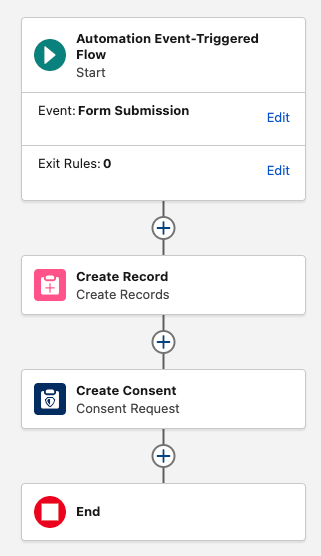
  • Form-Triggered: These have a 1-to-1 relationship with a marketing form. They are used to create or update Salesforce records, manage consent, and handle immediate post-submission tasks.
  • Segment-Triggered: These are primarily used to send individual or a series of emails and SMS messages. They also power Path Experiment (available in the Advanced Edition) and provide access to additional flow elements allowing marketers to build customized journeys.

Flow is extremely powerful, but getting started can be tough. The Flow canvas is a “blank slate” that requires thought and configuration.

Let’s take a look at how marketers can simplify and scale their efforts using flow templates with a real-world scenario.

Example Scenario

The marketing team has a high volume of assets that they would like to gate on the website using Agentforce Marketing forms. They need to ensure that existing contacts or leads are updated when a form is submitted before creating any new lead records. Additionally, they must generate consent records whenever a user opts in to marketing communications and add them to the correct Salesforce campaign for tracking purposes.

User Setup and Permissions

To replicate the experience of a marketing user, all flows and images in this post were created with a Salesforce user with the following profile and permissions. These are reflective of a standard marketing user.

  • Profile
    • Standard User
  • Permission Sets
    • Marketing Cloud Admin
    • Tableau Next Included App Business User (This provides access to the Marketing Performance Dashboards)
  • CMS Contributor Role
    • Content Manager
Permission Set Assignments

Form and Flow Templates

The first step is determining the fields that need to be included on the form. The best approach is to take a minimalistic approach and only ask for information that will be used or is needed for lead routing.

Hidden fields on forms are very useful for capturing form-specific data for use in your flow. For example, you can use them to automatically pass the Campaign ID and Campaign Member Status.

Creating the Form Template

  1. Select the ā€œMarketingā€ app from the App Launcher.
  2. Click the ā€œContentā€ tab to enter the Salesforce CMS.
  3. Click on the ā€œContent Workspace for Marketing Cloudā€ workspace.
  4. Click the ā€œAddā€ button and select ā€œContentā€.
  5. Choose the ā€œFormā€ CMS content type.
  6. Add Data Source as ā€œLeadā€.
Adding a Data Source
  1. Drag the input fields into the form, and configure the labels, unique names, and determine if the field should be required or hidden.
  2. Set the desired action at form submission (show thank you message or redirect).
  3. Add a title, API Name, and description and then save.


Here’s an example of my form. Note that all fields have been set to required (with the exception of the opt-in checkbox). It’s important to know that Flow will overwrite data in Salesforce if a submission is received with blank data. If optional fields are needed, formulas can be created in the flow to protect data.

Example of a form

Creating A Flow

  1. From the form you just created, click ā€œNew Flowā€ in the flow section.
  2. Select ā€œOpen Flow in Flow Builderā€.
Open flow in flow builder
  1. Customize the flow as needed and save.

Customizing the Flow

The flow needed to meet our requirements is a little complicated, but that’s the whole point of this post. We don’t want the marketing team building this logic repeatedly.

This flow was built by a user with the ā€œMarketing Cloud Adminā€ permission set. The ā€œMarketing Cloud Managerā€ role lacks access to certain required elements. If you’d prefer, your Salesforce Administrator can also set up this template for you.

An example of a flow

Flow Summary 

Here’s a summary of the actions being performed in the flow.

  • Creates an opt-in consent record if the consent box on the form is checked.
  • Finds existing Salesforce contacts based on the email address and last name in the form submission.
    • Updates existing contact records, if found.
  • Finds existing Salesforce leads based on the email address and last name in the form submission.
    • Updates existing lead records, if found.
    • Created new leads, if matching records are not found.
  • Retrieves campaign members based on the CRM ID of the person who submitted the form and the campaign ID included in the hidden field on the form.
    • Updates the campaign member status of existing members to the value included in the Campaign Member Status hidden field from the form.
    • Created new campaign members using the hidden fields from the form.

Saving the Flow as a Template

We can now complete the creation of the flow template.

Save As Template  

  1. From the Flow tab, open the latest version of the flow.
  2. Delete the associated form from the ā€œStartā€ element.
    • Click ā€œEditā€ next to ā€œEvent: Form Submissionā€.
    • Click the ā€œXā€ to delete the form.
Steps to delete a form
  1. Click ā€œSave As New Flowā€.
    • Add the flow label and a detailed description of what the flow does and when it should be used. The API Name will automatically populate based on the flow label.
Example of how to add a flow label and form description
  • Note: You may run into an issue saving due to the presence of the Consent Request element. If this happens, delete the field reference in the Contact Point value and save. 
How to solve the issue of being unable to save
  1. Click ā€œSave As New Versionā€.
    • It’s important to create a new version of the flow before saving as a template. The initial version of the flow will be v0.
    • Saving a new version will increment the version number and ensure your updates are available in the flow template. 
  2. Click the dropdown to the right of the ā€œSave As New Versionā€ button and select ā€œSave as Templateā€.
  3. Confirm that the template has been created by completing the following steps:
    • Click the Flows tab.
    • Click the ā€œNewā€ button.
    • Enter the template name in the search box.. 
How to confirm that a template has been created

Using Your Templates

Now that all the heavy lifting is done, you or your team can use your form and flow templates to quickly support additional assets. Here’s how.

Repeat the following steps for all new assets

  1. Create the Salesforce campaign that will be used for the form and the campaign members.
    • When creating the campaign from the Marketing App, do not select a campaign template.
    • Selecting a template will result in an additional flow being created.

Do not select a template at the following screen.

Do not select a campaign template when creating the campaign from the marketing app
  1. Navigate to the form template in the CMS.
  2. Select the ā€œCloneā€ from the dropdown menu to the right of the form name.
How to clone a form
  1. Name the new form based on the asset name.
  2. Update the Campaign ID and Campaign Member Status (hidden field values) and Form Submission action.
How to update the campaign ID and campaign member status
  1. From the Flow tab, click the ā€œNewā€ button.
  2. Search for and select the gated content template.
  3. Click ā€œEditā€ next to ā€œEvent: Form Submissionā€ and select the cloned form.
  4. Update the Contact Point value in the Consent Request element to reference the email address from the associated form.
  5. Click ā€œSaveā€ and name the new flow.
    • Click “Show Advanced” and delete the value in the “Source Template” field.
      • Non-admin users will not be able to activate the flow if this step is omitted.
Save the flow screen, highlighting the Source Template field.


  • The Consent Request element can be a bit finicky. If you see an error after updating the Contact Point, just delete the element and add it back.
  1. Exit the flow details page and associate the flow to the correct campaign using the ā€œAssociated Recordā€ lookup.
How to associate the flow to the correct campaign using the "Associated Record" lookup
  1.  Return to the CMS and publish the form (this will also activate the flow).
  2. Add the embed code to the web page promoting the asset.

Save Time and Increase Efficiency with Templates

Building the initial form and flow template featured in this post took approximately one hour. Because the logic is quite involved, I spent a portion of that time testing to ensure everything functioned exactly as intended.

Once the templates were ready, I put them to the test with a stopwatch. While the steps in the ā€œUsing Your Templateā€ section might look detailed, I was able to create a brand-new form and flow in just 4 minutes and 1 second. That is a massive 93% time savings!

Beyond just saving time, templates ensure accuracy and process consistency. Asking multiple people to manually replicate the complex requirements stated in this post would almost certainly result in errors.

If you frequently build forms and flows with similar structures, do yourself a favor and templatize. Your future self (and coworkers) will thank you.

Sercante is recognized as a Marketing Cloud Growth and Advanced Implementation Expert and has the expertise to support your Agentforce Marketing needs. If you’re interested in support with Agentforce Marketing, reach out to us and let us know how we can help.

The traditional B2B search journey is undergoing a shift, moving away from static search engine results pages toward fluid, conversational AI interfaces. As buyer behavior evolves, AI answer engine optimization (AEO) has emerged as an imperative for brand visibility, serving as the new entry point for the modern buyer. To ensure brands stay top of mind during the critical buyer research, discovery, and evaluation phases, industry leaders in Trilliad’s 2026 Growth Imperatives have identified integrating a Generative Engine Optimization (GEO) strategy into the marketing mix as no longer optional, but a competitive necessity.

Unlock your data
The Era of Precision Growth in B2B
Trilliad Growth Imperatives 2026
Download eBook

AI is the New Entry Point for Modern Buyers

The way buyers discover solutions has been fundamentally reshaped by AI answer engines, with up to 80% of users now relying on AI-generated summaries to distill complex information (Bain & Company). This efficiency has led to a zero-click reality, where 60% of searches end without a single click to a third-party website because the AI provides the answer directly (Search Engine Land). For B2B brands, this creates the danger of ā€œAI Invisibilityā€. If you aren’t cited in the AI’s synthesis, you can be excluded from the buyer’s journey before human evaluation even begins.

Brands that fail to optimize for generative engine visibility risk a slow decay in market share as AI assistants become the primary tool for synthesizing vendor lists and evaluation criteria. 

“The front door has shifted. Your website is no longer the first place buyers meet your brand. AI search platforms are now the front door, and if you are not showing up there, you are not even being considered.”Ā 

Marcus Hiles, SVP Strategy, Just Global, 2026 Growth Imperatives

To ensure brand visibility in AI answer engines, marketers must adopt a framework built for Large Language Models (LLMs) in addition to their traditional search engine strategy.

AI Answer Engine Optimization

Just as brands spent decades perfecting SEO strategies to appease Google’s crawlers, they must now develop a GEO strategy to ensure their brand is picked up by AI answer engines. LLMs look for authoritative, structured, and contextually relevant data that can be easily synthesized into a conversational response.

To improve your LLM visibility, focus on how your content is structured to answer the questions that the audience will be asking and the schema of the page.

Content Optimization for LLM Visibility Checklist

  • Schema: Use an FAQPage or QAPage to provide clear, structured answers that AI can easily parse.
  • Formatting: Use short, declarative, factual paragraphs along with bullets, numbered steps, and tables for clarity. Incorporate statistics, unique insights, and expert quotes that AI engines are likely to reference as primary sources.
  • Optimize for Intent: Structure content around “How-to” and “What is” queries that address specific pain points in the buying cycle.
AreaKey action
Meta DataAnswer the buyer’s question in your meta descriptionāœ”
URLsUse a natural prompt-style slugāœ”
H1/H2Write as questions or declarative answersāœ”
IntroBegin each section with a 30-80 word ā€œanswer blockā€āœ”
SchemaUse FAQPage or QAPage + Article schemaāœ”
ContentShort, declarative, factual paragraphsāœ”
ListsAdd bullets, numbered steps, or tables for clarityāœ”
Internal LinksDescriptive anchors between topical pagesāœ”
VisualsAlt text answers a sub-questionāœ”
RecencyDisplay and maintain ā€œlast updatedā€ datesāœ”

(Source: Trilliad 2026 Growth Imperatives)

By checking these boxes, you ensure your data is machine-readable, which is the first step toward moving from a hidden data point to a featured recommendation.

Getting Started with an AI Answer Engine Assessment

The most effective way to frame your GEO strategy is to understand your current baseline: how is your brand currently showing up (or not) in AI answer engines? An assessment allows you to see the gaps in your visibility and identify which topics your competitors are dominating within AI-generated summaries. By identifying where you are missing from the conversation, you can prioritize your optimization efforts for the greatest immediate impact. This same approach for prioritizing AI initiatives by the most impactful outcome aligns with pillar one of the 4-pillar playbook of The State of AI in Enterprise Report: anchor to the business vision. When teams have a starting point of how their brand is already showing up or not showing up in AI answer engines, it guides them toward establishing a clear goal with measurable outcomes to then guide the rest of their GEO strategy and effectively measure performance.

The State of AI in Enterprise
Closing the Gap Between Investment and Impact
Why 95% of AI pilots fail to deliver results
The 4 pillar playbook to fix it
Download Report

If you’d like to get started with an AEO Assessment, reach out to the Sercante team. They offer a comprehensive AEO assessment designed to help brands audit their LLM presence and build a roadmap for discovery.

Discover your brand's LLM visibility with an AEO Assessment
Learn More

Understanding your current standing allows you to pivot your strategy toward the ultimate goal: securing a spot on the initial vendor shortlist.

Winning with GEO: Brand visibility on the Day One List

Successful GEO can increase LLM visibility for a brand by approximately 40% (Aggarwal et al., 2024). When content is optimized for AI, brands significantly increase their chances of appearing in the crucial “Day One” vendor shortlists, the initial lists formed from AI answer engines that buyers discover and then move forward with for further research and evaluation.

Incorporating a GEO strategy into the overall marketing mix is critical to ensure brand discovery with today’s modern buyers. The landscape has changed, but the goal remains the same: meet the buyers where they are.

In the current market landscape, Chief Revenue Officers and growth leaders are facing a fundamental breakdown of the traditional go-to-market (GTM) engine. As organizations scramble to gain traction by implementing AI pilots, they often hit a wall: the daunting reality of their own data. Many leaders feel overwhelmed, thinking they have to have perfect data before seeing any real progress. However, this is a myth that stalls momentum. It doesn’t take perfect data to achieve real results with AI. It takes the right data for the right outcomes. The solution to moving beyond this roadblock is a data roadmap for AI that prioritizes based on business impact.

By shifting the focus from total data readiness to targeted, phased integration, organizations can finally start building an integrated data layer, the connective tissue needed for a modern growth engine. This was the resounding theme from Trilliad’s 2026 Growth Imperatives that industry leaders shared as being a top priority for GTM leaders to focus on this year to unlock sustainable success. It is the data that serves as the foundation to power impactful AI, analytics, and workflows across the customer lifecycle to deliver the connected customer experiences modern buyers expect. Which is why it is so critical for teams to move past a notion of ultimate data readiness and start prioritizing the data that needs to be connected now to start gaining real momentum.

Download the 2026 Trilliad Growth Imperatives eBook

The AI Mandate Reality Check for a Data Foundation

Data continues to be the foundation that powers experience, but with the AI era, it has a newfound importance. Sercante’s State of AI in Enterprise report reveals that organizations are dealing with more tech than ever before, yet they have yet to see meaningful results from their AI initiatives.

  • The average large enterprise now manages a technology stack of over 600 applications, leading to unparalleled volumes of fragmented data (WalkMe Inc.).
  • Currently, 56% of executives have yet to see a true impact on the bottom line from their AI deployments (Oxygen Staff).
  • 87% of AI failures are rooted in poor data quality (RAND).

It is true that organizations need a solid data foundation to gain impactful outputs from AI. However, the belief that every one of those 600+ apps must be connected simultaneously is a recipe for gridlock. To gain momentum, leaders must identify the specific data needed for the intended outcomes and build from there.

“Uncertainty is chaos. It drains energy. It drains time. It feels out of control. Building a plan gives a sense of control. It alleviates the chaotic, stressful, anxiety-feeling that leaders feel and makes their path clear.”

  • Ā Lauren Noonan, VP of Growth & Alliances, Sercante

This sense of control with data begins when the pursuit of perfection is replaced with a disciplined, strategic roadmap.

Download The State of AI in Enterprise report

A Prioritized Data Roadmap for AI

Creating a data foundation is not an “all or nothing” technical project. It is a strategic initiative that should be grounded in measurable, targeted business outcomes. It’s not about gaining more data. It’s about unlocking the right data. It can be overwhelming for leaders to think about connecting all their systems. That’s where the roadmap comes in. It gives leaders a clear plan to move forward with to start gaining real traction with their data and AI.

“More data does not make you better at anything. You need the right data, the right activation layer, and a team and process that knows what to do with what they are seeing.”

  • Ā Andrea Tarrell, Founder & CEO, Sercante

Establishing the vision for your data

Answering the question of “what is the end goal?” is the first step in setting your vision. Without a vision to anchor your data and AI initiatives, it can feel like departments are running in several different directions, which can cause more silos and make it feel like busy activity without a lot of real results.

“Without a vision to ground your strategy, technology can feel like motion without progress.”

  • Ā Jenna Packard, Strategy Director, Sercante

By defining the end goal first and the metrics that will be used to measure success, you create a filter for prioritization. This ensures the data initiatives are aimed at enhancements that drive measurable growth.

A sequenced path for your data and AI

As Jenna Packard shared in her article, The AI Roadmap for Enterprise, “a roadmap is highly sequenced, helping organizations understand which capabilities to build first and how each piece creates a foundation for the next.” A roadmap, or vision map, captures your end goal and measurable outcomes, then organizes the technology and data required to make it happen.

When creating the roadmap and thinking about what should come first, consider the following:

  • Specific Data Sources: Which data sources must be unlocked to fuel the AI to get the results we’re after?Ā 
  • Integration Effort: What is the technical and operational burden to enable this specific capability?
  • Support Systems:Ā  What is the infrastructure needed to ensure data connections run smoothly?Ā 
  • Data Integrity: Is there anything that needs to happen first to ensure that data will be clean, accurate, and actionable?Ā 

Answering these questions will allow the team to start placing the actions that need to happen on the roadmap to unlock the right data for the intended outcome. The end result gives teams a clear path forward to gain momentum, replacing reactive data fixes with impactful strategic discipline.

Getting Started with Your Prioritized Data Roadmap for AI

Data perfection is not a realistic end goal, and waiting for it only stalls progress. It takes a disciplined approach to step back, identify the end vision with measurable business outcomes, and then let that guide your data roadmap for AI. By prioritizing the right data for the right outcomes, you unlock the ability to gain real, measurable results with AI, fuel impactful analytics, and deliver connected customer experiences that modern buyers expect.

If you’d like support with creating your vision map for data and AI, reach out to the Sercante team. We partner with go-to-market teams daily to establish strategic roadmaps and design data foundations that result in scalable, impactful AI solutions.

Learn more about the vision map for data and AI

No more posts to show