Marketing Cloud Next can make the future of marketing look like a whole new world. Agentic campaign creation, real-time data, connected journeys—the demos make it easy to imagine what your marketing team could do with more automation and fewer manual processes. The harder question comes when you start to think through: What does Marketing Cloud Next look like for us? To start answering this question, the Sercante l Trilliad Marketing Cloud Next Readiness Checklist guides marketers to self-assess their existing technology and processes and how they align with Marketing Cloud Next, to see where they could get started.
Your team already has technology, processes, data, integrations, and ways of working that aren’t going to disappear overnight. So getting started isn’t just simply about identifying the newest features you want to use. It’s also about figuring out where those capabilities could make a meaningful difference within the marketing operation you already have.
Instead of jumping straight into the platform, our Marketing Cloud Next Readiness Checklist helps teams take stock of their current environment and determine where Marketing Cloud Next deserves a closer look.
Turn Your Marketing Pain Points Into a Starting Point
To start this process, you need to stop and ask: Where is your marketing team losing time today?
Are marketers manually exporting data every time they need to build an audience?
Does important customer information live across multiple systems, making personalization harder than it should be?
Has campaign creation itself become a chain of repetitive tasks that keeps marketers from focusing on strategy?
Those pain points are clues for where to start with Marketing Cloud Next.
The Readiness Checklist helps teams connect challenges to capabilities worth exploring. It asks whether disparate data is creating segmentation challenges, whether teams want to expand into new channels, whether AI agents could support marketing and sales operations, and whether manual campaign and content creation is eating into the team’s time.
By the end of the assessment, teams will have a clearer picture of where Marketing Cloud Next could deliver value now, which capabilities deserve a closer look, and where additional planning may be needed before moving forward.
What Should Your Organization Consider Before Getting Started?
Identifying a promising use case is only one part of determining readiness. The Marketing Cloud Next Readiness Checklist also prompts marketers to think about the realities surrounding that opportunity.
The goal isn’t to create a list of reasons to wait. It’s to uncover the dependencies that could shape how your organization gets started. A promising capability becomes much easier to act on when you understand what needs to be true around it. As you evaluate your readiness, consider questions like:
Consideration
What your team should think about
Current technology
Where does your existing platform already meet your needs, and where are workarounds or integrations creating friction?
Data & integrations
How is customer data moving between systems today, and what integrations would still need to be maintained?
Channels & experiences
Which channels or customer experiences do you want to add or improve?
Feature requirements
Are capabilities your team depends on today available in Marketing Cloud Next, different from your current platform, or still on the roadmap?
Cost & infrastructure
How could consumption-based pricing, Salesforce CRM requirements, or custom API needs influence your approach?
From Marketing Friction to More Strategic Work
The friction uncovered during a readiness assessment isn’t unique to one marketing team. Across the industry, marketers are trying to deliver increasingly sophisticated customer experiences while still working around disconnected data, manual processes, and technology that doesn’t always work together.
That complexity has a real cost. 37% of leaders say organizational silos prevent efficient data sharing across marketing and operations (MarTech), while 31% of marketers cite slow execution caused by manual processes or rigid technology as their biggest barrier to delivering personalized campaigns (MoEngage).
Every hour spent exporting lists, moving data between systems, or piecing together campaign workflows is time marketers aren’t spending understanding customers, improving creative, testing new ideas, or building better experiences.
That’s the opportunity Marketing Cloud Next presents.
By bringing data, campaign execution, automation, and agentic capabilities closer together, Marketing Cloud Next creates the potential to reduce some of those operational handoffs. The guide highlights opportunities ranging from generating campaign structures and content from plain-language prompts to creating dynamic segments without manual exports and using agentic decisioning to determine next-best actions. The payoff isn’t simply faster campaign execution. It’s giving marketers back more of their creative and strategic bandwidth.
Adopting Marketing Cloud Next doesn’t have to mean moving your entire marketing operation onto a new platform at once. A more practical approach is to start with the opportunities that can create value now, learn from them, and expand as your organization is ready.
Think of it as a crawl, walk, run approach.
Crawl: Teams can use the Marketing Cloud Next Readiness Checklist to assess their current environment and identify one or two high-impact use cases worth exploring.
Walk: Teams can begin deploying those capabilities alongside existing systems, measuring what works and building confidence along the way.
Run: Teams can expand their use of Marketing Cloud Next and continue to scale alongside their existing technology as it makes sense for their business.
There’s no universal timeline for that progression. Differences in data structures, processes, team skill sets, and business goals mean some organizations will be positioned to move faster than others. The goal is to create a path that balances near-term wins with a longer-term vision for the platform.
Getting Started with Your Marketing Cloud Next Readiness Checklist
The question isn’t whether your organization can use everything Marketing Cloud Next has to offer. It’s where the platform can make the biggest difference first.
If you’d like an expert to walk through the Marketing Cloud Next Readiness Checklist with your team—or help you fast-track the next best steps—connect with Sercante | Trilliad. We’ll help you turn your questions and current challenges into a clear, practical path forward.
Accelerating Marketing Automation with Pre-Built Salesforce Flow Templates
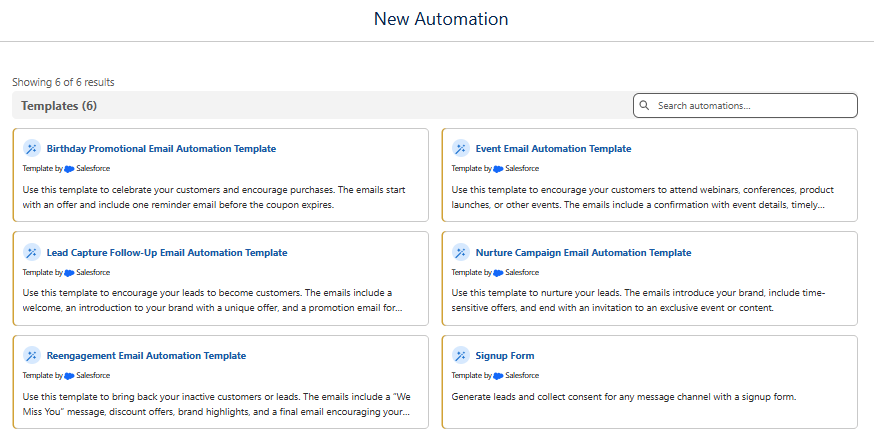
Building effective marketing automation takes time, and staring at a blank canvas can often delay your first campaign. With Agentforce Marketing (aka Marketing Cloud Next), you can bypass those early hurdles with six out-of-the-box flow templates designed to accelerate your path from idea to execution.
Instead of building common campaign patterns from scratch, you can now select a proven framework, customize it to your business needs, and launch faster. These templates don’t replace your marketing strategy—they accelerate it, providing the structure and foundational assets you need to focus on what truly differentiates your brand: messaging, personalization, and customer experience.
Why Flow Templates Matter for Marketers
Marketing automation success is not just about sending emails. It’s about creating relevant, timely experiences that guide customers through their relationship with a brand.
These flow templates help marketers:
Reduce implementation time: Launch common marketing journeys faster.
Create consistency across campaigns: Follow proven automation patterns.
Focus on what matters: Spend less time building and more time optimizing.
For organizations adopting Agentforce Marketing, these templates spark a critical shift in focus: What does this experience need to accomplish now?
Learn how to build your own Flows in Agentforce Marketing with this expert-led workshop. Register here.
How to Access the New Flow Templates
The new templates are available directly within the campaign creation experience.
To access them:
Open the Marketing app
Navigate to Campaigns
Select Add New to create a campaign
Fill out details on the campaign creation pop-up window
Enter your campaign details and check the “Active” box
Once in the campaign workspace, look to the “Let’s build your campaign” section, scroll down to “Need a faster start? Browse templates.”
Selecting Browse Templates opens up the available Salesforce-created flow templates.
From here, marketers can select the template that best matches their campaign goal and use it as the foundation for their automation.
After selecting the template, you’ll be guided through the configuration process, including automation settings within the flow template itself.
Inside the Templates: Six Salesforce-Designed Marketing Journeys
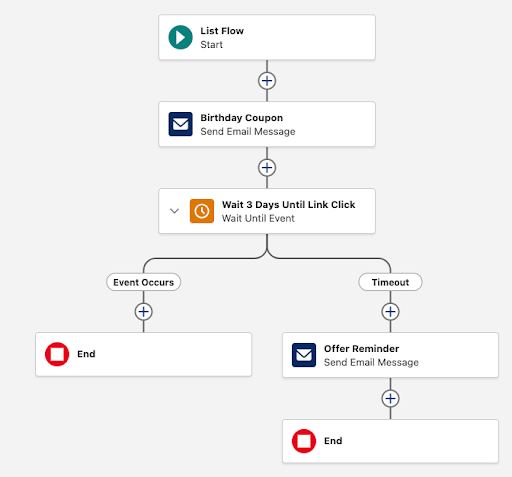
1. Birthday Promotional Email Automation Template
What It Does:
The birthday promotional email automation template helps organizations celebrate customers while encouraging repeat purchases through a personalized promotional experience.
This template for organizations looking to create a simple but effective customer engagement moment to:
Recognize a customer’s birthday
Provide an offer
Encourage action before the promotion expires
Inside the Flow:
This is a segment-triggered flow. The template includes:
Birthday offer email
Birthday offer reminder email
Why It Matters:
Birthday campaigns are great examples of personalized lifecycle marketing. They create a meaningful customer touchpoint while encouraging engagement. This template removes the need to build the basic journey structure manually, allowing marketers to focus on the offer, branding, and customer experience.
Pro-Tip: Before activating a birthday automation, validate that your customer birthday data is accurate and consistently maintained. Personalization is only effective when the underlying data is reliable.
2. Lead Capture Follow-Up Email Automation Template
What It Does:
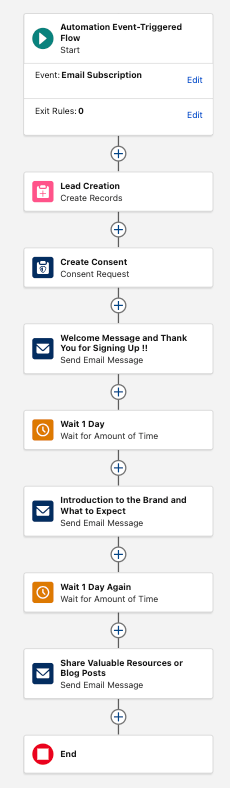
The lead capture follow-up email automation template helps organizations convert new leads into engaged prospects through an automated welcome and nurture experience. This is one of the templates I expect many B2B organizations will recognize the value of because lead follow-up is one of the most common marketing automation use cases.
Inside the Flow:
This is an event-triggered flow. The template includes:
Lead capture welcome email
Lead capture product email
Lead capture brand value proposition email
Why It Matters:
Many organizations invest heavily in generating leads but struggle with what happens next. This template creates an immediate, consistent follow-up experience by helping organizations welcome new prospects, introduce their brand, highlight products or services, and provide valuable resources.
Pro-Tip: This is one of the templates I would recommend reviewing early during an Agentforce Marketing implementation. It provides a strong foundation for lead nurturing while allowing marketers to focus on content strategy and personalization.
3. Reengagement Email Automation Template
What It Does:
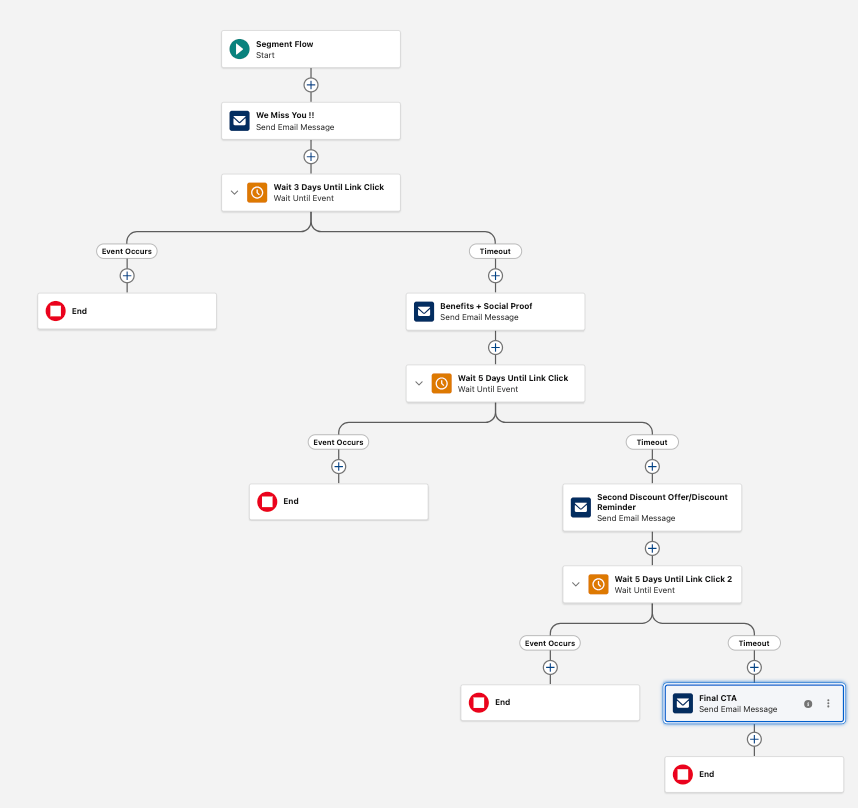
The reengagement email automation template helps organizations reconnect with inactive customers or leads. Instead of continuing to send the same messaging to disengaged audiences, this template creates an intentional journey designed to win customers back.
Inside the Flow:
This is a segment-triggered flow. The template includes:
“We miss you” email
Benefits and social proof email
Second discount offer/reminder email
Final call to action email
Why It Matters:
A mature marketing strategy is not only about acquiring new customers. It’s also about understanding and improving engagement with existing audiences. This template helps marketers reconnect with inactive contacts using incentives strategically, reduce unnecessary communication, and create clear exit paths.
Pro-Tip: Define what “inactive” means before activating the flow. A customer inactive for 30 days may require a different approach than someone who has not been engaged in over a year.
4. Event Email Automation Template
What It Does:
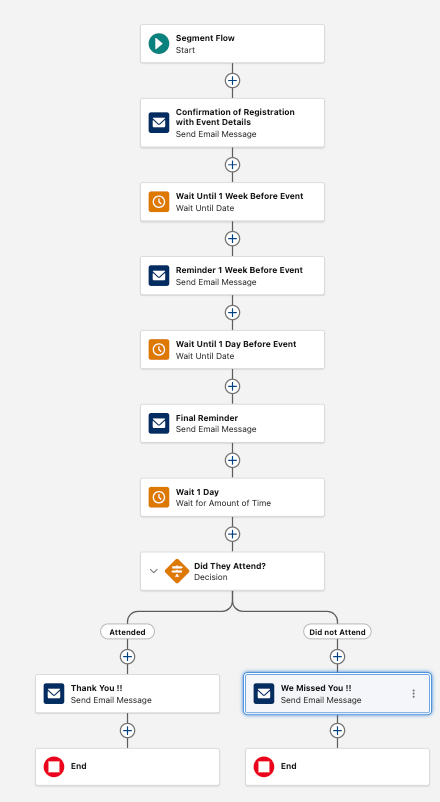
The event email automation template helps marketers manage communications before and after webinars, conferences, product launches, and other events. Successful events require more than registration emails. Customers need reminders, confirmations, and meaningful follow-up.
Inside the Flow:
This is a segment-triggered flow. The template includes:
Event registration confirmation
Event one-week reminder
Event one-day reminder
Event attended follow-up
Event did not attend follow-up
Why It Matters:
This template extends the customer experience beyond attendance. We also recommend using Campaign Member and Campaign Member Status to track attendance, creating strong alignment between marketing engagement and CRM reporting.
Pro-Tip: Many teams focus heavily on driving registrations, but underestimate the value of post-event communication. The follow-up experience is often where the strongest conversion opportunities happen.
5. Nurture Campaign Email Automation Template
What It Does:
The nurture campaign email automation template helps organizations build ongoing relationships with leads through a structured engagement journey. This is especially valuable for B2B organizations with longer buying cycles, where prospects need education and trust-building before making a decision.
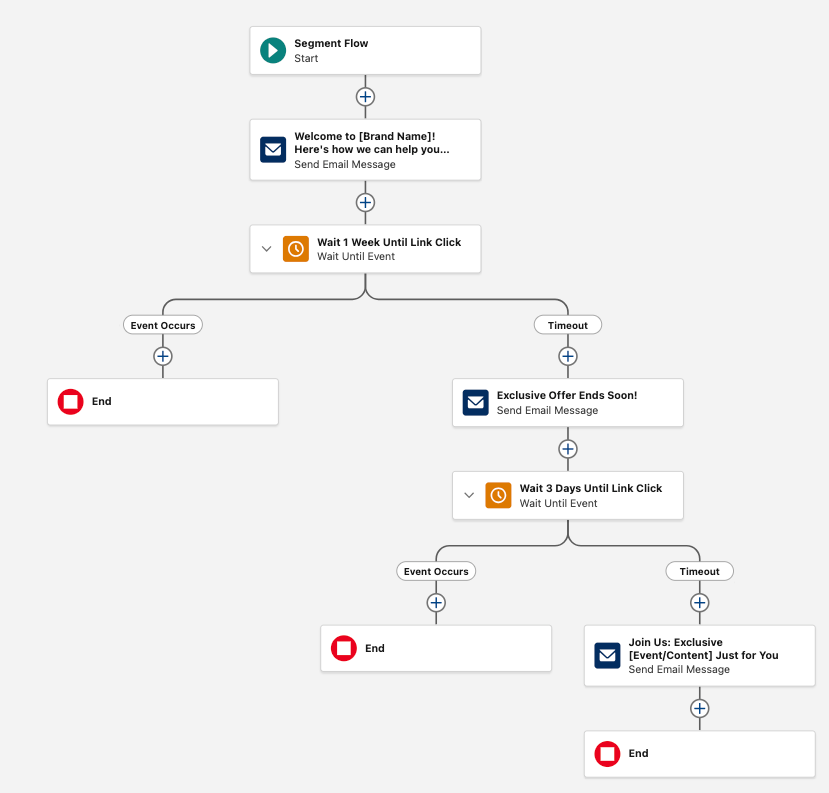
Inside the Flow:
This is a segment-triggered flow. The template includes:
Welcome to our brand
Exclusive event or content invitation
Exclusive offer ends soon
Why It Matters:
Effective nurturing is about responding to customer behavior, not just following a schedule. The built-in decision paths help ensure that engaged prospects do not continue receiving irrelevant communications.
Pro-Tip: Define your entry criteria, engagement signals, and exit strategy before launching a nurture journey. The technology enables automation, but your strategic rules drive its success.
6. Signup Form Automation Template
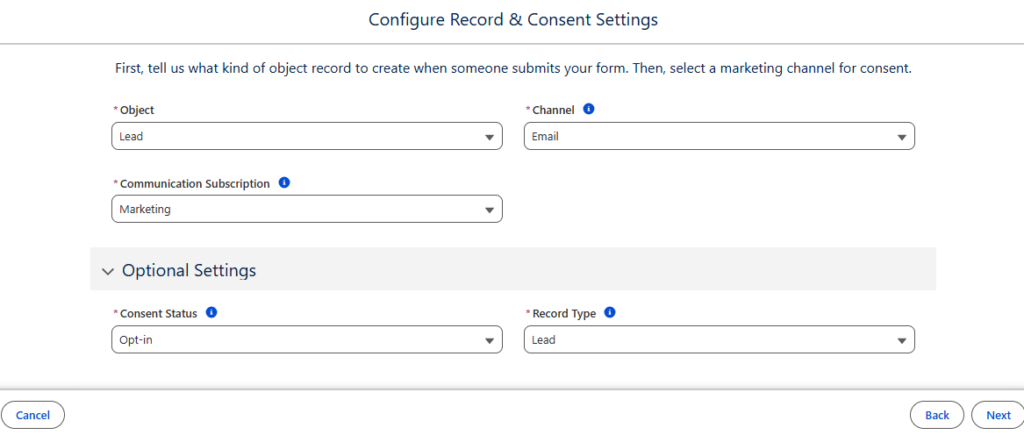
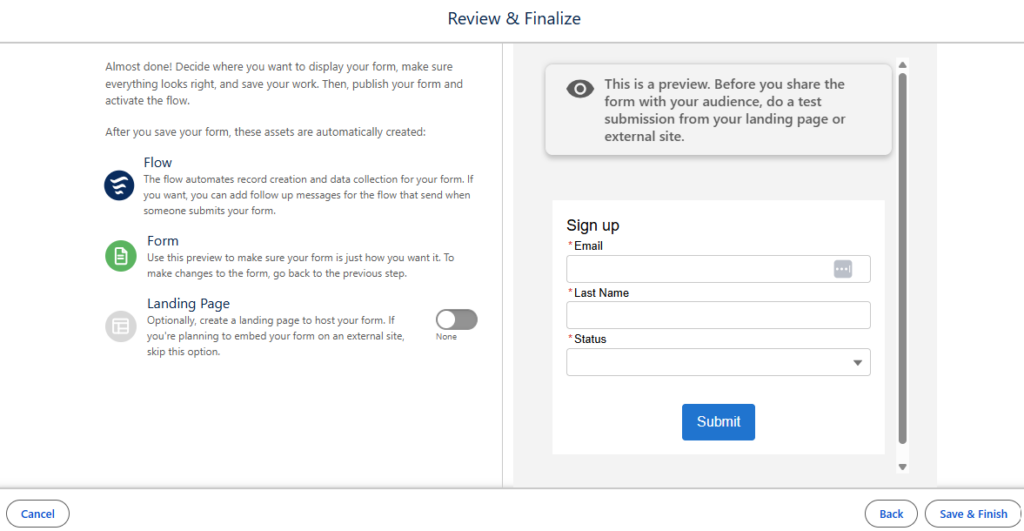
What It Does: The signup form template walks the user through what is needed to build a new form, such as Data Source, Fields, Form Content, and an optional Landing Page. This template also captures consent for communications immediately upon form submission.
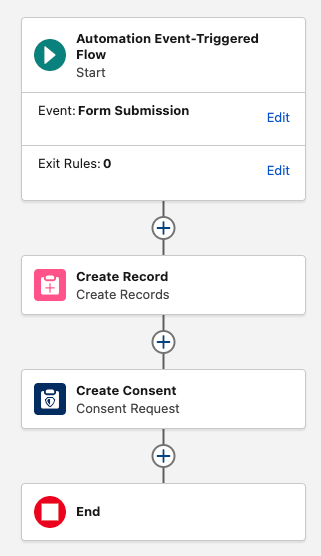
Inside the Flow: This is an event-triggered flow. The journey follows this sequence:
Customer submits form
Create record
Create consent request
End flow
During configuration, marketers define the record type created (options include Lead, Contact, or Account), the marketing channel, the communication channel (Email or SMS), the consent status, and specific record type settings.
Why It Matters: Strong marketing automation starts with strong data practices. This template connects lead generation, data creation, and consent management into one unified, automated process.
Pro-Tip: Before activating this flow, confirm your organization’s data model and consent strategy. Decide what records should be created, what information sales needs, and how communication preferences should be managed.
Celebrates customers and encourages repeat purchases with personalized offers.
Lead Capture Follow-Up Email Automation
Event
Converts new leads into engaged prospects via automated welcome and nurture journeys.
Reengagement Email Automation
Segment
Reconnects with inactive customers or leads through strategic, incentivized re-engagement.
Event Email Automation
Segment
Manages end-to-end communications for webinars, conferences, and product launches.
Nurture Campaign Email Automation
Segment
Builds long-term relationships through structured, behavior-based engagement journeys.
Signup Form Automation
Event
Captures consent and automates record creation immediately upon form submission.
Moving from Building Automation to Optimizing Experience
The six flow templates in Agentforce Marketing represent an important shift in how organizations approach marketing automation. Instead of spending hours recreating common journeys, marketers now have pre-designed frameworks that provide a strong starting point. Whether you are launching a lead nurture program, reconnecting with inactive customers, managing an event experience, or capturing new subscribers, these templates help reduce implementation effort and accelerate time to value.
The future of marketing automation is not about removing the marketer from the process. It’s about removing repetitive work so marketers can spend more time where they provide the most value: understanding customers, creating meaningful experiences, and driving business growth. Open the Agentforce Marketing app today, explore the new templates, and see how much faster you can get your next campaign live.
Need Assistance?
If you need any assistance with your Agentforce Marketing platform, please reach out to the Sercante l Trilliad team! We would be happy to help you navigate your next steps in starting to use the platform alongside your existing technology to drive better results.
Artificial intelligence and real-time data are shifting the landscape under our feet. For a long time, Salesforce Flow was considered “admin territory.” Marketers stuck to traditional journey builders and engagement programs. But things have changed. Flow is no longer just a backend automation tool for admins. It can now be directly harnessed by marketers in the Agentforce Marketing platform (also known as Marketing Cloud Next, or Marketing Cloud Growth or Advanced Edition) to streamline workflows and deliver personalized, multi-channel journeys at scale. And for marketers with Marketing Cloud Engagement or Account Engagement, they can already access these features. To start taking advantage, it’s critical to start learning Agentforce Marketing Flow fundamentals.
See how fellow marketers at Denver Public Schools are already using Flow and Agentforce Marketing features to streamline campaign workflows, deliver multi-channel campaigns, and track attribution. Register Here
The Foundation: Diving into Flow Basics
Historically, Flow Builder was seen as a tool reserved only for Salesforce Admins because of its ability to perform deep backend activities like creating records, automating heavy backend logic, or running APEX.
With the arrival of Agentforce Marketing, we now have Marketing Flows—sometimes referred to as “citizen flow”. It uses the exact same interface and requires a similar foundational skillset, but it gives marketers unprecedented control over their campaigns. Don’t worry, admins: access to Marketing Flow does not equal full admin rights. Granular control remains secure through specific user permissions.
What is Flow Builder?
Flow Builder is a drag-and-drop visual interface used to automate complex business processes, workflows, and user interactions. Think of it as the core automation engine of Agentforce Marketing. It seamlessly orchestrates your three most vital assets:
Segment: Your targeted audience.
Content: Your dynamic messaging.
Actions: Your delivery mechanisms.
What can you do with Flow?
Marketing Flows provide a massive playground of strategic options:
Send: Deploy emails, SMS, and WhatsApp messages directly through the canvas.
Wait: Pause an individual’s progress for a specific amount of time (from minutes to months) or until a specific event occurs.
Update: Dynamically push data to multiple objects or auto-create tasks for your internal team members.
Customize: Branch engagement paths using real-time data or user interactions.
Optimize: Utilize built-in Path Experiments to split-test channels, content variations, and delivery cadences.
What are the types of Flow?
There are several core marketing flow types tailored to your specific orchestration needs. Below are the most common flow types you’ll need in Agentforce Marketing:
Automation Event-Triggered: Runs quietly in the background and fires immediately when an action occurs—such as a form fill, an email click, or a new subscriber signup. These are frequently used as completion actions or to instantly route leads.
Segment Triggered (recently renamed to “Audience Flow”): Targets a specific group of people (segments, lists, campaign members, etc.) when the flow runs. It is ideal for nurturing new leads or managing ongoing communications, allowing users to exit via rules or end steps.
Data 360 Flows: Powered by Data Cloud permissions, these flows can auto-convert records or trigger automation based on calculated insights and real-time score changes.
CRM Record-Triggered Flow: This type fires the moment CRM record data changes or updates.
Autolaunched Flow: Background automation kicked off by subflows, Apex code, or REST APIs.
Elements: The Building Blocks of Flow
Every flow you build is constructed using three basic types of canvas elements:
Logic Elements: Includes options like Decisions to branch your paths, Wait Time based on a date, time, or event, and Path Experiments to test different paths.
Data Elements: Elements that let you directly Create, Get, Update, or Delete records across the platform.
Interaction Elements: The execution steps, where you can Send Email, Send SMS, Send WhatsApp, create Consent, or trigger a Subflow.
Agentforce Marketing Flow: Three Ways to Build
Building out your vision doesn’t mean staring at a blank whiteboard. Agentforce Marketing gives you three flexible onboarding paths depending on your technical comfort level and campaign complexity.
Start learning how to build your own flows with this hands-on training, Agentforce Marketing Flow Fundamentals Workshop. Learn more and sign up here.
Building Flows with Agentforce
If you are a new Flow user or simply want to quickly stand up a simple nurture, you can use the conversational Agentforce Campaign Creation interface. By providing a prompt grounded in a campaign brief, Agentforce will automatically generate a campaign preview and lay out the flow steps for you. From there, you can ask the agent to refine text tones, add messages, or alter paths using natural language.
Building Flows with Campaign Canvas
The Campaign Canvas is perfect for simple nurtures and straightforward customer journeys that do not require complex decision splits. It offers a streamlined “Quick Start” interface where you can rapidly add linear steps for your triggers, target segments, message content, and wait periods.
Using Flow Builder
When your campaign demands advanced nurtures, exit rules, behavioral decisions, or experiments, it’s time to open up the full Flow Builder. Here, you get full access to the toolbox, manager tabs, canvas layout, and the ability to cleanly cut, copy, paste, and configure every element.
You can also combine these approaches to building flow. Using Agentforce or the Campaign Canvas is a great way to start your flow structure. You can then use the Flow Builder to fine-tune the flow details and add more advanced flow logic.
Lean on Flow Templates to Save Time
You don’t have to reinvent the wheel every time you launch a new campaign. Salesforce provides over 300 out-of-the-box templates, including multiple marketing-focused options.
Furthermore, once you build a custom flow architecture that works perfectly for your brand, you can save your own flows as templates for your wider marketing team to replicate safely. Flow templates are a great way to avoid starting from scratch. Learn more about Flow Templates from Mike Morris’ blog, Saving Time with Flow Templates in Agentforce Marketing.
Getting Started with Flow & Agentforce Marketing
It’s critical for marketers to start learning Flow to take advantage of the latest automation, AI, and real-time data features in Agentforce Marketing. However, the path to not only learn Flow but also figure out the best deployment approach for your organization to start using these features alongside your current platform can feel overwhelming.
You don’t have to continue on this journey alone. Tap into the expertise of the Sercante | Trilliad team. We’ve developed a proven Marketing Cloud Convergence Path that we tailor to each marketing team’s business outcomes, ensuring you can continue maximizing your existing platform while fast-tracking your overall time to value.
Agentforce Marketing has quickly become a focal point for Salesforce Marketers. However, many Account Engagement customers are still trying to understand how this new platform operates and how it fits alongside their current tools. While Agentforce Marketing is designed to encompass all the features of Account Engagement, it introduces distinct features and a completely new lexicon. To bridge the gap, let’s dive into the Account Engagement that you know and love and how these features are translated, in name and functionality, to Agentforce Marketing.
What’s in a Name?
Let’s start with what initially trips users up – the product name. A common question I get from users is whether this new platform is called “Agentforce Marketing” or “Marketing Cloud Next” and the answer is both!
“Agentforce Marketing” appears to be the name that will stick around in the long term, but “Marketing Cloud Next” is used in most of the help articles and guides about this new platform. My guess is “Marketing Cloud Next” may be phased out as the tool grows and evolves. For the time being, both names are correct and refer to the latest Marketing Automation Tools from Salesforce.
There are also a few other names you may run into, including
Marketing Cloud Growth: This refers to the “Growth” edition of Agentforce Marketing.
Marketing Cloud Advanced: This refers to the “Advanced” edition of Agentforce Marketing.
Marketing Cloud on Core: This name was adopted by the community pre “Marketing Cloud Next”. It helped us designate a difference between OG “Marketing Cloud” (aka Marketing Cloud Engagement) and the new platform. “On Core” designates that this Marketing Platform, unlike Engagement or Account Engagement, is truly built on the core Salesforce platform.
Account Engagement +: This term is more Salesforce SKU-based and refers to Account Engagement users who are also using the Agentforce Marketing Platform alongside their Account Engagement org.
Engagement + / Marketing Cloud +: Similar to the above, this is Salesforce SKU-based and refers to Marketing Cloud Engagement customers using the Agentforce Marketing Platform alongside their Engagement org.
Features and Terminology
Prospects
In Account Engagement, a Prospect refers to an identified individual. Prospects can remain solely in Account Engagement or sync to Salesforce Leads and Contacts. The equivalent of a Prospect in Agentforce Marketing is a Unified Individual.
A Unified Individual is a consolidated record of metadata related to multiple Prospect, Lead, and Contact records for the same person. To put this in simpler terms, say you have multiple Lead and Contact records for the same individual within your CRM. Each of these records has different information about said customer and each record retains its own engagement and activity data. This disparate view of your customer gives your teams an incomplete and sometimes incorrect picture of your customer. Data 360 unites these disparate records using Identity Resolution rules and provides your team with a consolidated and complete view of each customer, the Unified Individual.
Now, a few releases ago, Salesforce also added a Prospect object to CRM. This means that marketers can create pre-lead or unqualified records directly in Salesforce to mimic the same functionality we have in Account Engagement. Currently the CRM Prospect record cannot sync with Account Engagement Prospects, but I expect functionality around the Prospect CRM object to grow and this could be something we see in a few releases.
Lists
In Account Engagement, there are two main List types:
Static Lists are built one time and only update with manual changes.
Dynamic Lists are rule-based and automatically update when a Prospect’s data changes.
The equivalent of a List in Agentforce Marketing is a Data 360 Segment.
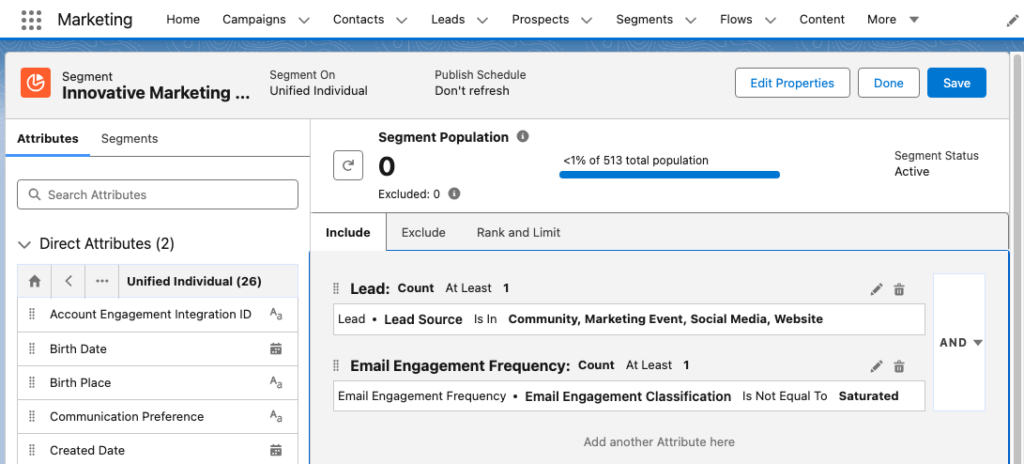
Data 360 Segments consist of Unified Individuals that match filtering rule criteria that you set. Similar to Account Engagement Dynamic Lists, you can assign multiple rule criteria to a Segment with AND/OR logic between each rule. You can also match a field against multiple values using the “Is In” operator. The image below shows an example of a Segment using multiple rule criteria in Agentforce Marketing.
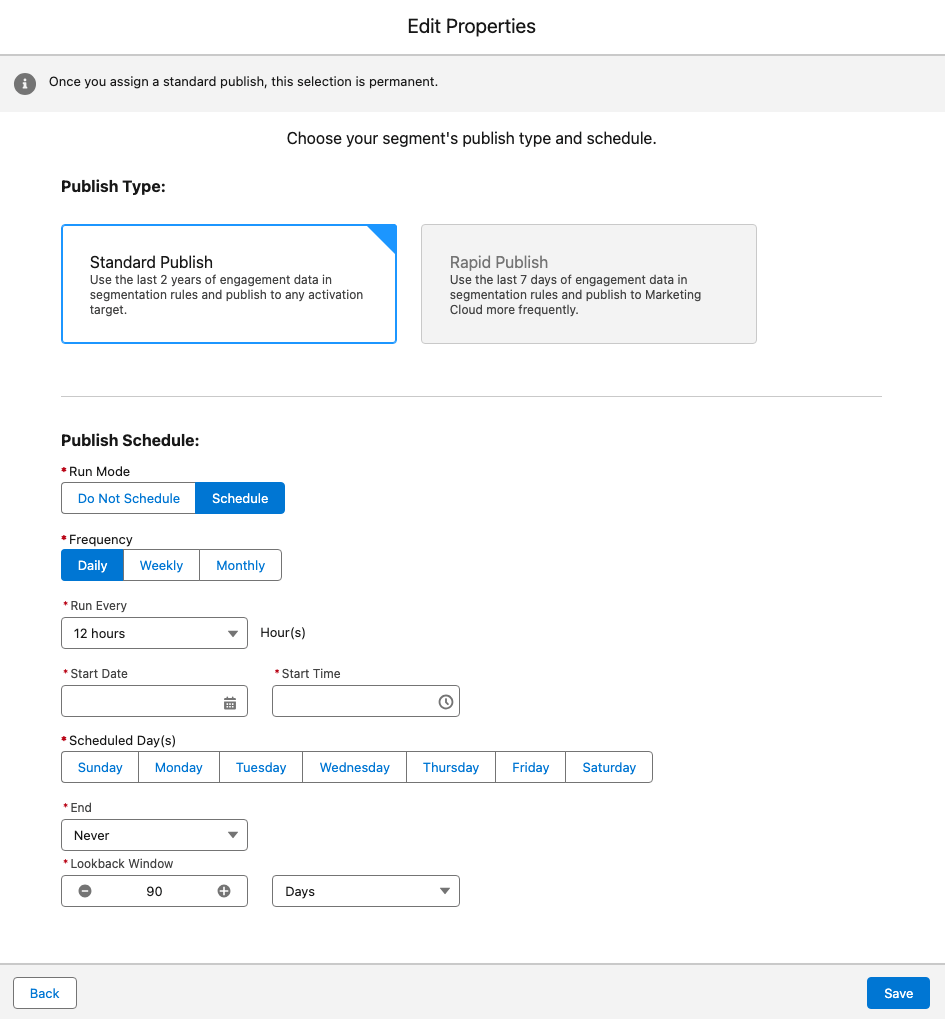
Whether a Data 360 Segment is static or dynamic depends on its publish schedule. You can set a Segment to “Do Not Schedule”, essentially making the list static, or configure a publish schedule to refresh your Segment as needed. The image below depicts the Edit Properties window in Agentforce Marketing where the publish schedule is defined.
Segments can be used in Agentforce Marketing or, with the Data 360 Connector, synced down to Account Engagement as a Dynamic List.
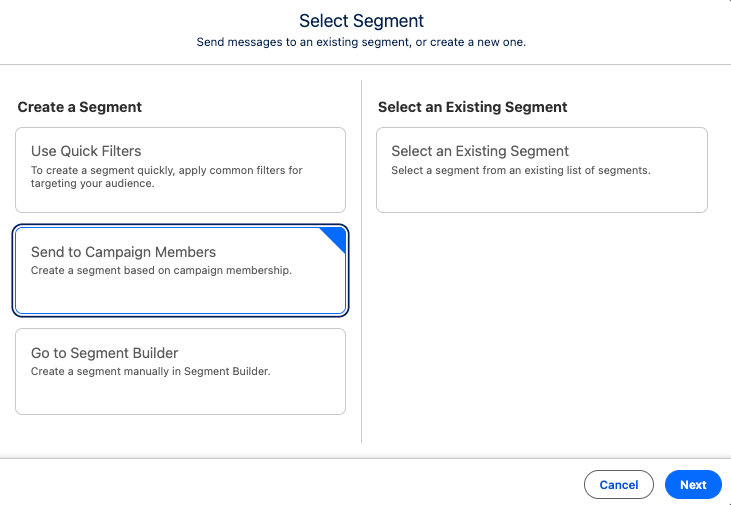
Now, if you prefer to curate your list rather than use Segment rules, you can either add Leads/Contacts to your Campaign and then create a Segment of Campaign Members:
Or, after the Summer ‘26 release, utilize the new List and Audience Flow features to circumvent the need for a Data 360 Segment.
Engagement Studio Programs enable you to automate multi-touch customer journeys using triggers, rules, and actions. These programs nurture Prospects through the sales funnel and ensure timely and relevant communications. The Agentforce Marketing equivalent to Engagement Studio Programs is Flow Builder.
Flow Builder is the automation engine of Agentforce Marketing, helping you build and execute complex, multi-channel marketing campaigns. Engagement Studio Programs and Flow Builder have a lot of overlap: They both have a top-down vertical layout, use elements as steps within the program/flow, and allow you to customize processes down different paths based on conditions.
In Account Engagement, Completion Actions trigger when a Prospect takes a specific action, such as filling out a form. The Agentforce Marketing equivalent of this is Automation Event-Triggered Flows.
Automation Event-Triggered Flows, sometimes referred to as Form-Triggered Flows or just Event-Triggered Flows, trigger when an individual takes an action. Automation Event-Triggered Flows allow you to trigger a single action or build an entire customer journey to nurture the individual after an event.
Agentforce Marketing includes several pre-configured events and Engagement Signals can be used to build any additional desired events.
Automation Rule
Account Engagement Automation Rules are repeatable, criteria-based rules that find matching Prospects and apply actions to them. The Agentforce Marketing equivalent to Automation Rules is Flow Builder, but the type of flow depends on your criteria.
If you are converting Lead records when they meet specific criteria, use a Data 360 Triggered Flow.
If you have multiple criteria and/or want more control over when the action fires, create a Segment and use a Segment-Triggered Flow.
Scoring and Grading
Account Engagement uses Scoring and Grading to help you identify, qualify, and prioritize Prospects in your org.
In Account Engagement, Scoring indicates how engaged a Prospect is by assigning numerical points to each activity the Prospect performs, its Agentforce Marketing equivalent is Engagement Scoring. Similar to Account Engagement Scoring, Agentforce Marketing’s Engagement Scoring assigns numerical points to activities. A default scoring system is provided, but you can fully customize the conditions and points.
In Account Engagement, Grading indicates how closely the prospect fits your ideal customer by evaluating pre-configured criteria and assigning a letter grade. The Agentforce Marketing equivalent of Grading is Fit Scoring. Similar to Engagement Scoring, Fit Scoring assigns numerical points to individuals if they match your fit criteria. Fit Scoring conditions and points can also be fully customized.
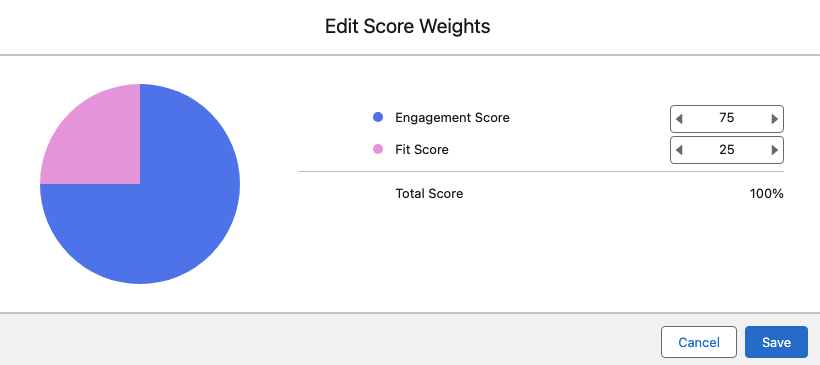
In Account Engagement, Prospects do not have a metric that reflects a combination of the Score and Grade. Score and Grade are kept as completely separate metrics, but can be used together to establish a qualification threshold. In Agentforce Marketing, individuals do have a combined rating called Overall Score. The Overall Score will always be between 0 and 100. The Overall Score is initially 50% Engagement and 50% Fit, but this can be customized as needed as well.
The image below shows how Agentforce Marketing’s score weights can be customized.
In Account Engagement, a prospect’s mailability or mailable status refers to whether or not they can receive marketing emails. If an Account Engagement Prospect has a hard bounce, five soft bounces, has unsubscribed themselves, or has been manually opted out, they are considered unmailable.
Agentforce Marketing uses Consent for a more comprehensive approach to mailability. Within Agentforce Marketing, individuals set their subscription preferences to indicate the channel they want to receive communication within (Email, SMS, WhatsApp) and the subscription (newsletter, events, product updates etc.). For example, an individual may subscribe to receive event updates via SMS and receive your newsletter via email. Agentforce Marketing will create a consent record within Data 360 for each choice.
In Account Engagement, A/B Testing allows you to optimize your email content by sending two versions of an email to a small subset of your recipient list. The engagement data of these two email variations is used to determine a winning version that is then sent to the remaining subset of your recipient list. Agentforce Marketing’s equivalent is Path Experiment, however Path Experiment allows you to do much more than send just two variations of a single email.
Path Experiment, which is available for the Advanced Edition of Agentforce Marketing, allows you to experiment with up to 10 different versions of a customer journey to determine the most effective path. This means you can test content variations (i.e. which subject line gets more opens?), channel variations (i.e. do you get more opens with email or sms?), and even cadence variations (do we get better results sending more or less emails?). Similar to A/B Testing, Path Experiment allows you to test with a subset of your audience before sending your remaining audience members down the winning path.
In Account Engagement, Sender Domains define where you can send emails from. For example, if my Sender is [email protected] then Salesforce.com is my Sender Domain. The Agentforce Marketing equivalent is Authenticated Domains. For both sender and authenticated domains you will need to work with your IT team to create DNS records. These records help improve the deliverability of your emails by defining you as a legitimate sender.
In Account Engagement, Dynamic Content enables you to create field-based variations of content. If the Prospect’s field matches the designated field value, then they will see that content variation on your website or within your marketing assets. Agentforce Marketing also has Dynamic Content, but it has more advanced functionality.
Agentforce Marketing’s Dynamic Content functionality allows you to personalize your email based on fields or any data source connected to your individual. For example, you can build the variations based off of Account data or data from an event the recipient recently attended. You can also personalize multiple sections of your marketing assets, or personalization points, within one Dynamic Content variation. This allows you to dynamically update nearly every aspect of an email more efficiently.
Agentforce Marketing Dynamic Content relies on:
Personalization Point: An element of content that’s eligible for a personalization decision. For example, an email’s subject line and preheader or an image component within the email are “points” that you can personalize.
Personalization Decision: Criteria that determines who’s eligible to receive a personalization response.
Targeting Rule: Conditions for showing a specific variation.
In Account Engagement, Page Actions trigger additional actions after a Prospect views a specific page of your website. In Agentforce Marketing, you can accomplish the same goal using website tracking and the Website Engagement Data Model Object (DMO).
The Website Engagement DMO records website page views and clicks, and engagement signals can be created to zero in on specific page view activities. For example, you can create an Engagement Signal that records when a visitor lands on your Pricing page, a good indicator that they may be interested in making a purchase. These Engagement Signals can then be used to trigger Automation Event-Triggered Flows so you can further automate next steps.
Account Engagement uses both Salesforce and Account Engagement Campaigns. Account Engagement Campaigns are considered thematic touchpoints (similar to a source in other systems), while Salesforce campaigns are a Salesforce CRM object used to plan, manage, and track marketing initiatives. Salesforce and Account Engagement Campaigns are united with the Connected Campaigns feature.
Agentforce Marketing utilizes the Salesforce CRM Campaigns object for both purposes. Campaigns are not only a record that helps organize the audience, assets, and metrics for a specific marketing effort, but they also indicate a touchpoint for your individual.
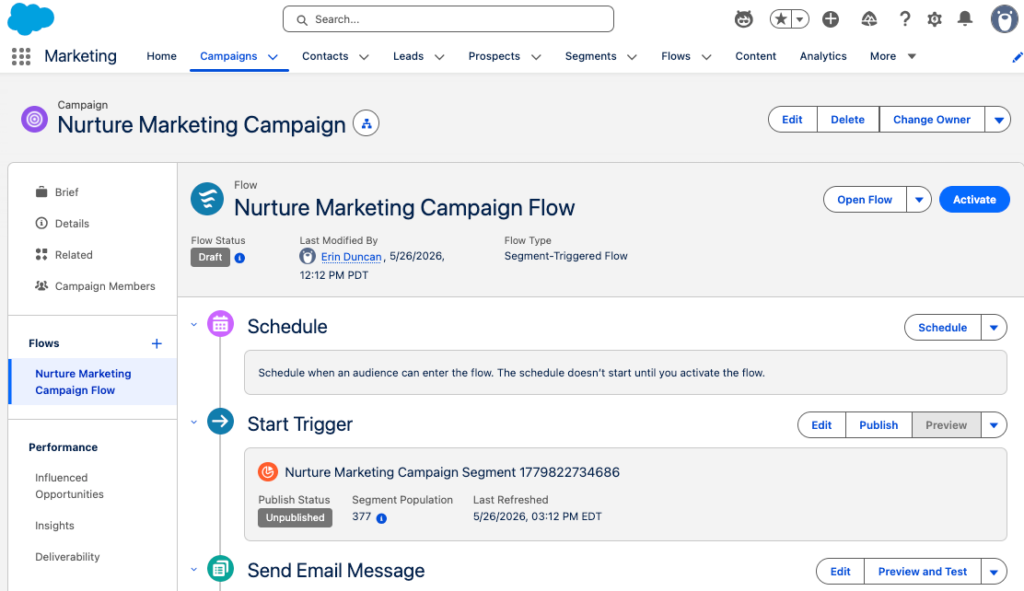
Campaigns serve as a centralized hub for a marketing initiative within Agentforce Marketing. Within a Campaign you will find all the relevant information for your Campaign including your Campaign Brief, Campaign Members, associated flows, and reports.
The user interface shown above is unique to viewing Campaigns within the Marketing app. Don’t let the user interface confuse you though, this is the default Salesforce Campaign object that is used by other processes and applications within Salesforce.
Campaign Influence
In Account Engagement, Campaign Influence helps you tie marketing efforts to your opportunities to see which campaigns are the most influential and successful. Account Engagement Campaign Influence can be a little hands-on, requiring you to add all Leads/Contacts that engage with your Campaign as Campaign Members. Agentforce Marketing uses Opportunity Influence to automate and streamline influence. Opportunity Influence uses engagement data to automatically tie Opportunity revenue back to a specific Campaign without the need for Campaign Membership.
In Account Engagement, AI Assistant is generative AI that assists in drafting forms and landing pages as well as creating email subject lines, headers, and body copy. Agentforce Marketing uses Agentforce and Generative AI to assist with generating copy and so much more. Agentforce Marketing not only helps you generate forms, landing pages, and email content, but can also streamline the entire campaign creation process with the Campaign Creation and Content Builder agents.
Learn more about Agentforce Marketing’s AI features in the AI in Marketing Cloud Next Trailhead Module.The above gives you an overview of how terminology and features translate between Account Engagement and Agentforce Marketing. If you are ready to take the next step in your Agentforce Marketing journey, check out our A Strategic Path to Navigating Marketing Cloud Convergence blog post or contact us!
Agentforce Marketing (aka: Marketing Cloud Next) introduced marketing teams to Salesforce Flow for the first time. While flows provide increased capabilities over tools like Engagement Studio in Account Engagement and Journey Builder in Marketing Cloud Engagement, building them can be time-consuming and even intimidating to new users.
In this post, we’ll explore how to create and use templates to increase efficiency while taking full advantage of the power of Flow.
Non-Admin Flow Types
“Non-admin” flows power Agentforce Marketing and allow marketers to automate key processes without needing administrator-level permissions. Common use cases include sending emails, delivering SMS messages, and creating Salesforce records.
There are two primary Flow types within Agentforce Marketing:
Form-Triggered: These have a 1-to-1 relationship with a marketing form. They are used to create or update Salesforce records, manage consent, and handle immediate post-submission tasks.
Segment-Triggered: These are primarily used to send individual or a series of emails and SMS messages. They also power Path Experiment (available in the Advanced Edition) and provide access to additional flow elements allowing marketers to build customized journeys.
Flow is extremely powerful, but getting started can be tough. The Flow canvas is a “blank slate” that requires thought and configuration.
Let’s take a look at how marketers can simplify and scale their efforts using flow templates with a real-world scenario.
Example Scenario
The marketing team has a high volume of assets that they would like to gate on the website using Agentforce Marketing forms. They need to ensure that existing contacts or leads are updated when a form is submitted before creating any new lead records. Additionally, they must generate consent records whenever a user opts in to marketing communications and add them to the correct Salesforce campaign for tracking purposes.
User Setup and Permissions
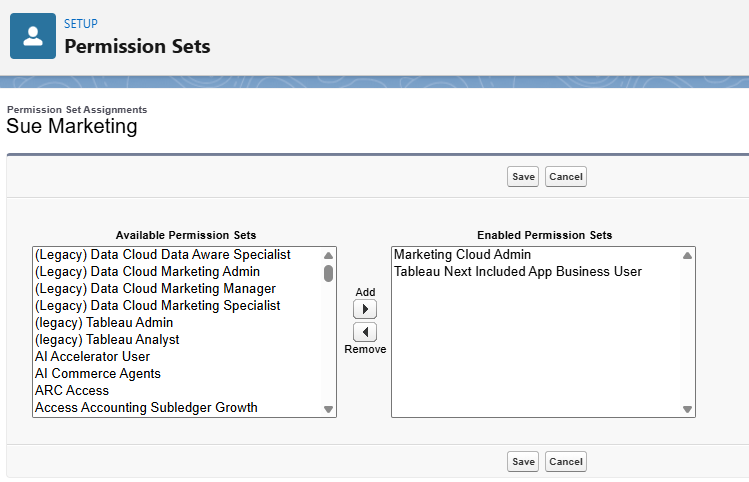
To replicate the experience of a marketing user, all flows and images in this post were created with a Salesforce user with the following profile and permissions. These are reflective of a standard marketing user.
Profile
Standard User
Permission Sets
Marketing Cloud Admin
Tableau Next Included App Business User (This provides access to the Marketing Performance Dashboards)
CMS Contributor Role
Content Manager
Form and Flow Templates
The first step is determining the fields that need to be included on the form. The best approach is to take a minimalistic approach and only ask for information that will be used or is needed for lead routing.
Hidden fields on forms are very useful for capturing form-specific data for use in your flow. For example, you can use them to automatically pass the Campaign ID and Campaign Member Status.
Creating the Form Template
Select the “Marketing” app from the App Launcher.
Click the “Content” tab to enter the Salesforce CMS.
Click on the “Content Workspace for Marketing Cloud” workspace.
Click the “Add” button and select “Content”.
Choose the “Form” CMS content type.
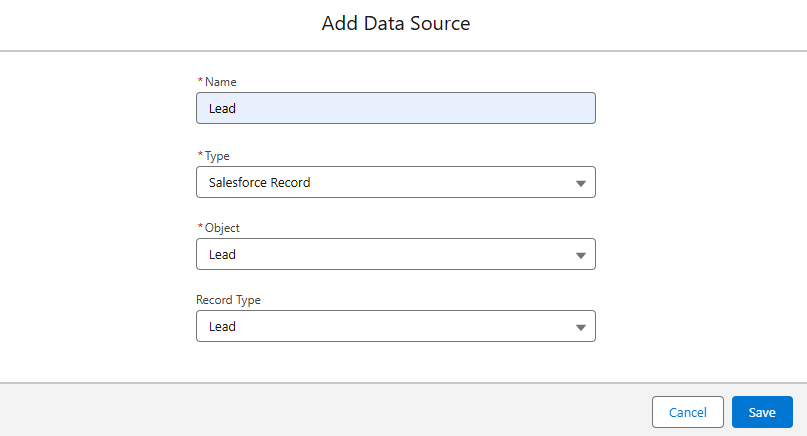
Add Data Source as “Lead”.
Drag the input fields into the form, and configure the labels, unique names, and determine if the field should be required or hidden.
Set the desired action at form submission (show thank you message or redirect).
Add a title, API Name, and description and then save.
Here’s an example of my form. Note that all fields have been set to required (with the exception of the opt-in checkbox). It’s important to know that Flow will overwrite data in Salesforce if a submission is received with blank data. If optional fields are needed, formulas can be created in the flow to protect data.
Creating A Flow
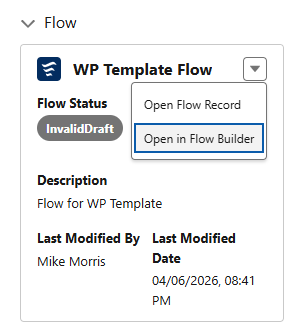
From the form you just created, click “New Flow” in the flow section.
Select “Open Flow in Flow Builder”.
Customize the flow as needed and save.
Customizing the Flow
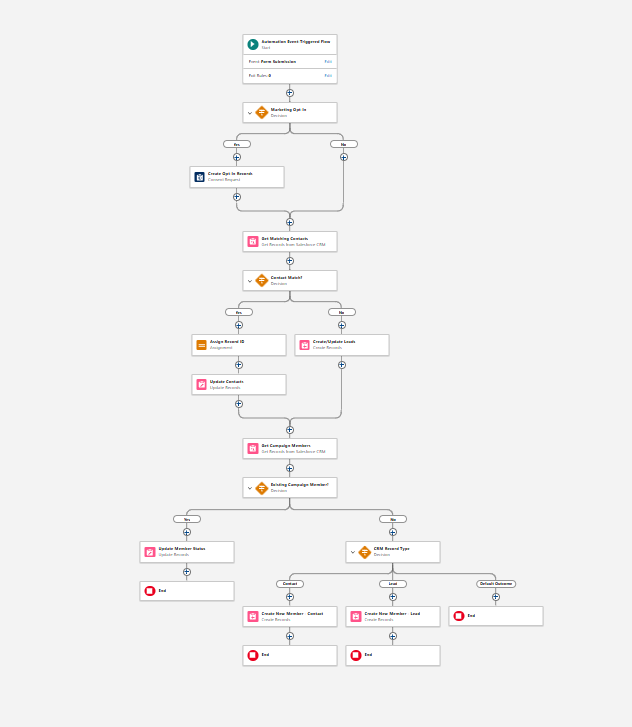
The flow needed to meet our requirements is a little complicated, but that’s the whole point of this post. We don’t want the marketing team building this logic repeatedly.
This flow was built by a user with the “Marketing Cloud Admin” permission set. The “Marketing Cloud Manager” role lacks access to certain required elements. If you’d prefer, your Salesforce Administrator can also set up this template for you.
Flow Summary
Here’s a summary of the actions being performed in the flow.
Creates an opt-in consent record if the consent box on the form is checked.
Finds existing Salesforce contacts based on the email address and last name in the form submission.
Updates existing contact records, if found.
Finds existing Salesforce leads based on the email address and last name in the form submission.
Updates existing lead records, if found.
Created new leads, if matching records are not found.
Retrieves campaign members based on the CRM ID of the person who submitted the form and the campaign ID included in the hidden field on the form.
Updates the campaign member status of existing members to the value included in the Campaign Member Status hidden field from the form.
Created new campaign members using the hidden fields from the form.
Saving the Flow as a Template
We can now complete the creation of the flow template.
Save As Template
From the Flow tab, open the latest version of the flow.
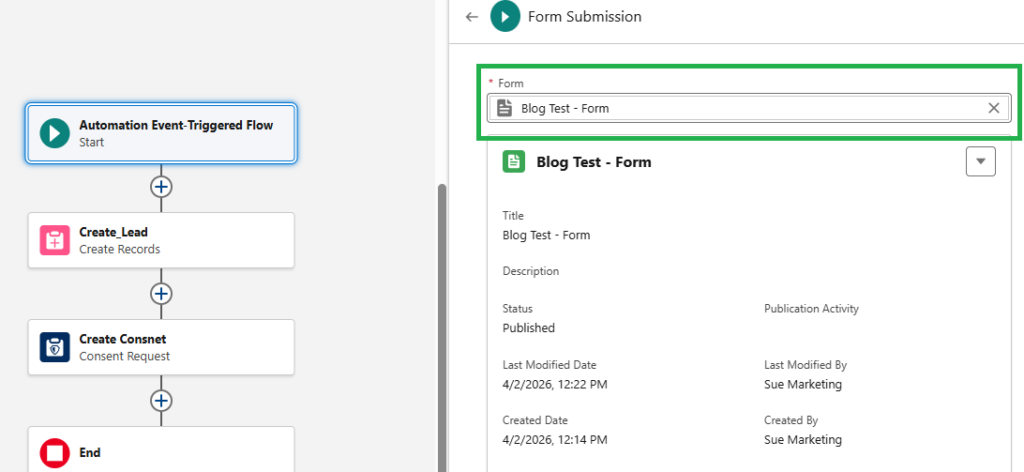
Delete the associated form from the “Start” element.
Click “Edit” next to “Event: Form Submission”.
Click the “X” to delete the form.
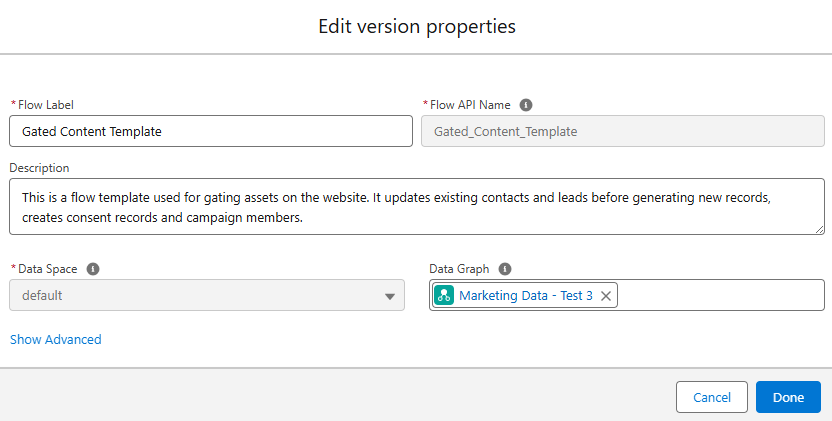
Click “Save As New Flow”.
Add the flow label and a detailed description of what the flow does and when it should be used. The API Name will automatically populate based on the flow label.
Note: You may run into an issue saving due to the presence of the Consent Request element. If this happens, delete the field reference in the Contact Point value and save.
Click “Save As New Version”.
It’s important to create a new version of the flow before saving as a template. The initial version of the flow will be v0.
Saving a new version will increment the version number and ensure your updates are available in the flow template.
Click the dropdown to the right of the “Save As New Version” button and select “Save as Template”.
Confirm that the template has been created by completing the following steps:
Click the Flows tab.
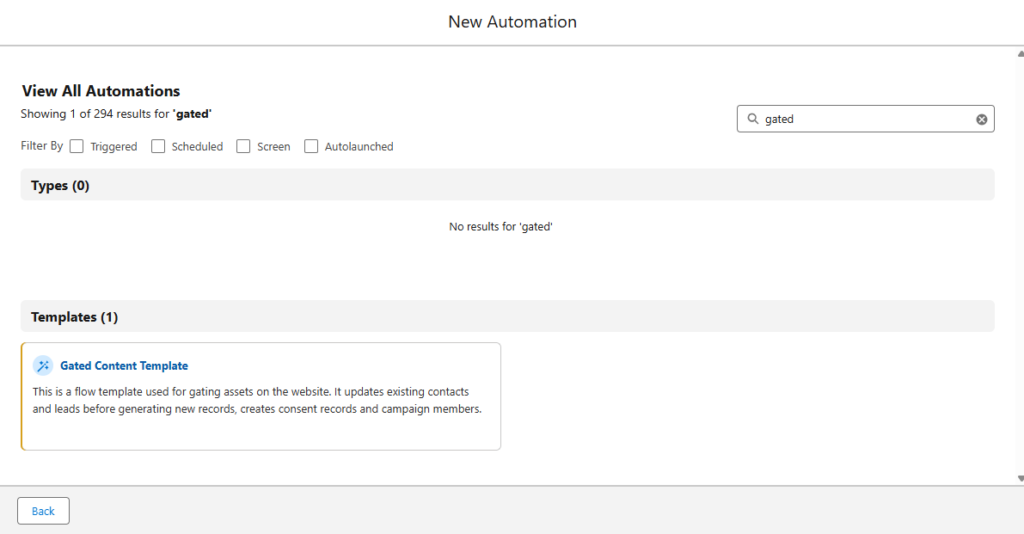
Click the “New” button.
Enter the template name in the search box..
Using Your Templates
Now that all the heavy lifting is done, you or your team can use your form and flow templates to quickly support additional assets. Here’s how.
Repeat the following steps for all new assets
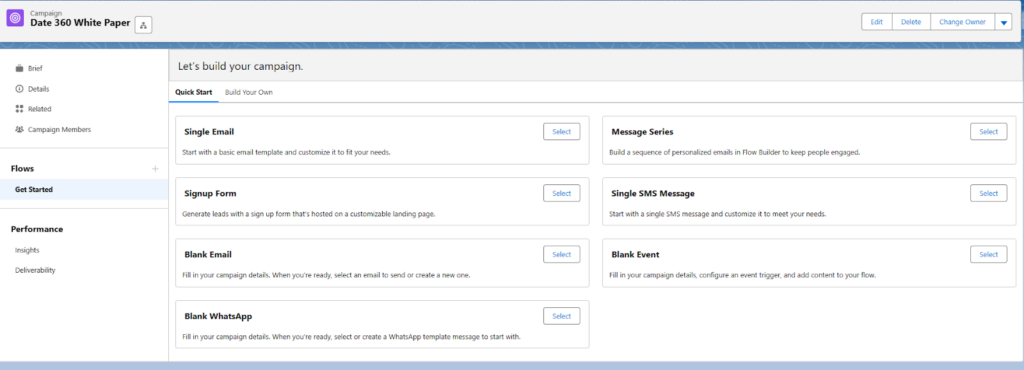
Create the Salesforce campaign that will be used for the form and the campaign members.
When creating the campaign from the Marketing App, do not select a campaign template.
Selecting a template will result in an additional flow being created.
Do not select a template at the following screen.
Navigate to the form template in the CMS.
Select the “Clone” from the dropdown menu to the right of the form name.
Name the new form based on the asset name.
Update the Campaign ID and Campaign Member Status (hidden field values) and Form Submission action.
From the Flow tab, click the “New” button.
Search for and select the gated content template.
Click “Edit” next to “Event: Form Submission” and select the cloned form.
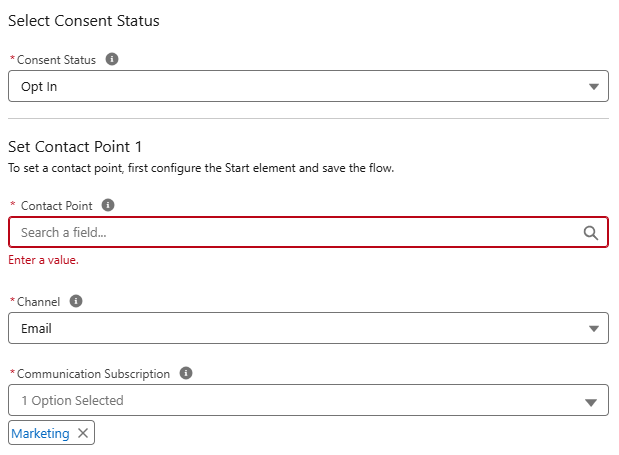
Update the Contact Point value in the Consent Request element to reference the email address from the associated form.
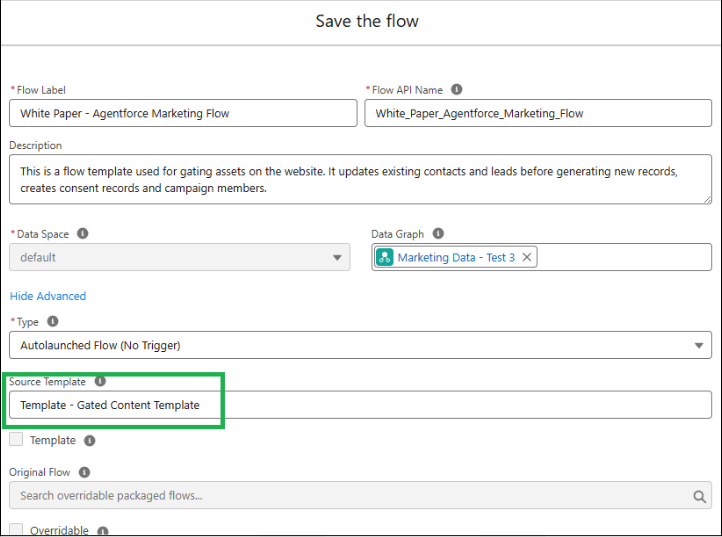
Click “Save” and name the new flow.
Click “Show Advanced” and delete the value in the “Source Template” field.
Non-admin users will not be able to activate the flow if this step is omitted.
The Consent Request element can be a bit finicky. If you see an error after updating the Contact Point, just delete the element and add it back.
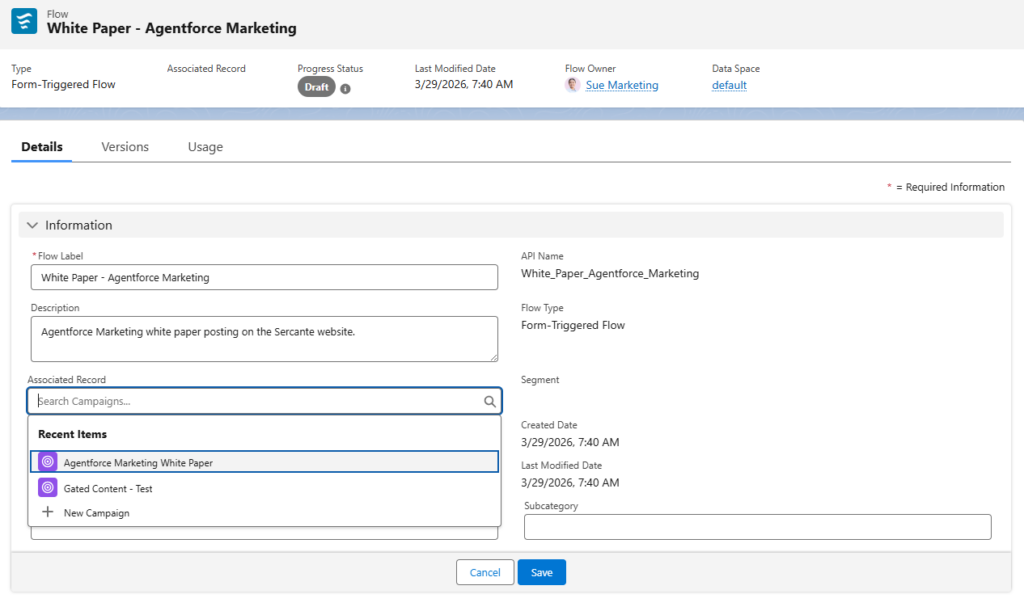
Exit the flow details page and associate the flow to the correct campaign using the “Associated Record” lookup.
Return to the CMS and publish the form (this will also activate the flow).
Add the embed code to the web page promoting the asset.
Save Time and Increase Efficiency with Templates
Building the initial form and flow template featured in this post took approximately one hour. Because the logic is quite involved, I spent a portion of that time testing to ensure everything functioned exactly as intended.
Once the templates were ready, I put them to the test with a stopwatch. While the steps in the “Using Your Template” section might look detailed, I was able to create a brand-new form and flow in just 4 minutes and 1 second. That is a massive 93% time savings!
Beyond just saving time, templates ensure accuracy and process consistency. Asking multiple people to manually replicate the complex requirements stated in this post would almost certainly result in errors.
If you frequently build forms and flows with similar structures, do yourself a favor and templatize. Your future self (and coworkers) will thank you.
Sercante is recognized as a Marketing Cloud Growth and Advanced Implementation Expert and has the expertise to support your Agentforce Marketing needs. If you’re interested in support with Agentforce Marketing, reach out to us and let us know how we can help.
Student retention is one of the most pressing challenges in higher education—and it’s not just about keeping enrollment numbers up. It’s about making sure students feel supported, connected, and confident in their ability to succeed, and engaging them before it’s too late.
Almost a quarter, 22.3%, of first-time, full-time undergraduate freshmen drop out within the first 12 months, while 39% don’t complete their degree within eight years (Education Data Initiative).
Which is why it is imperative for institutions to be taking action to improve student retention. One of the ways they can is by maximizing the technology they have and tapping into the latest solutions available to gain a better view of their students’ journeys and take action to engage when it matters most.
In Sercante’s latest demo, we explored how Salesforce’s connected tech stack—featuring Data Cloud, Marketing Cloud Advanced, and Agentforce can empower institutions to identify and support at-risk students before they fall through the cracks.
In the demo, we followed the journey of Jason Smith, a sophomore whose profile revealed a 77% attrition risk. What followed is a case study in how smarter tech, working harder behind the scenes, can drive real results for both teams and students.
Unifying Student Data for Smarter Insights
Everything begins with data. Using Salesforce Data Cloud, we created a Unified Student Profile by integrating key data sources across systems: academic performance, course engagement, attendance patterns, and more.
This holistic view powered a propensity model that flagged Jason’s risk level at 77%. Instead of relying on gut instinct or outdated reports, the team now had real-time, actionable insight—and a clear signal that it was time to act.
From Insight to Action with Marketing Cloud Advanced
That’s where Marketing Cloud Advanced comes in. Once a student is identified as at-risk, every minute matters. This tool enabled us to build automated, personalized communication journeys, so students like Jason could receive the right message at the right time.
Jason’s message came from Sercante University: a friendly, timely nudge to connect with an advisor. And because it was based on real-time data from his unified profile, it felt relevant, not random.
A Seamless Path to Support with Agentforce
The magic moment? When Jason clicked the link and landed on a scheduling page powered by Agentforce.
Here’s where tech meets empathy. Agentforce’s AI assistant recognized Jason’s concerns about unavailable classes and provided instant, personalized guidance—helping him book an appointment with an advisor in just three clicks or less.
No back-and-forth emails. No waiting. No frustration. Just a frictionless experience that made Jason feel seen, supported, and empowered to move forward.
A Multi-Cloud Solution that Improves Student Retention
What made this work wasn’t just the data or automation—it was how these tools worked together to create a better experience for both students and staff.
For teams: The heavy lifting was handled behind the scenes. With Data Cloud pulling real-time insights, MC Advanced automating outreach, and Agentforce handling the scheduling, advisors could spend less time triaging and more time supporting.
For students: It felt easy, human, and personalized. Jason didn’t need to fight for support—it found him, right when he needed it. He got help fast, with minimal effort and instant gratification.
This Agentforce, Data Cloud, and Marketing Cloud Advanced, multi-cloud solution, is an example of when teams use the power of data and AI to engage their students when it matters most, before it’s too late. Intercepting more students like Jason can help institutions improve student retention while creating real connections that last to drive growth for the institution and in Jason’s educational journey.
Final Takeaway
When schools bring together data, automation, and AI, they unlock a more connected, proactive, and student-centered approach to retention.
Students feel seen, supported, and confident in what to do next
Teams get relief from manual processes and can focus on what matters most
Institutions see better outcomes—without burning out their staff
It’s not just about reducing attrition—it’s about building trust, creating moments that matter, and delivering an experience that helps every student thrive.