In the current market landscape, Chief Revenue Officers and growth leaders are facing a fundamental breakdown of the traditional go-to-market (GTM) engine. As organizations scramble to gain traction by implementing AI pilots, they often hit a wall: the daunting reality of their own data. Many leaders feel overwhelmed, thinking they have to have perfect data before seeing any real progress. However, this is a myth that stalls momentum. It doesn’t take perfect data to achieve real results with AI. It takes the right data for the right outcomes. The solution to moving beyond this roadblock is a data roadmap for AI that prioritizes based on business impact.
By shifting the focus from total data readiness to targeted, phased integration, organizations can finally start building an integrated data layer, the connective tissue needed for a modern growth engine. This was the resounding theme from Trilliad’s 2026 Growth Imperatives that industry leaders shared as being a top priority for GTM leaders to focus on this year to unlock sustainable success. It is the data that serves as the foundation to power impactful AI, analytics, and workflows across the customer lifecycle to deliver the connected customer experiences modern buyers expect. Which is why it is so critical for teams to move past a notion of ultimate data readiness and start prioritizing the data that needs to be connected now to start gaining real momentum.
The AI Mandate Reality Check for a Data Foundation
Data continues to be the foundation that powers experience, but with the AI era, it has a newfound importance. Sercante’s State of AI in Enterprise report reveals that organizations are dealing with more tech than ever before, yet they have yet to see meaningful results from their AI initiatives.
The average large enterprise now manages a technology stack of over 600 applications, leading to unparalleled volumes of fragmented data (WalkMe Inc.).
Currently, 56% of executives have yet to see a true impact on the bottom line from their AI deployments (Oxygen Staff).
87% of AI failures are rooted in poor data quality (RAND).
It is true that organizations need a solid data foundation to gain impactful outputs from AI. However, the belief that every one of those 600+ apps must be connected simultaneously is a recipe for gridlock. To gain momentum, leaders must identify the specific data needed for the intended outcomes and build from there.
“Uncertainty is chaos. It drains energy. It drains time. It feels out of control. Building a plan gives a sense of control. It alleviates the chaotic, stressful, anxiety-feeling that leaders feel and makes their path clear.”
Lauren Noonan, VP of Growth & Alliances, Sercante
This sense of control with data begins when the pursuit of perfection is replaced with a disciplined, strategic roadmap.
A Prioritized Data Roadmap for AI
Creating a data foundation is not an “all or nothing” technical project. It is a strategic initiative that should be grounded in measurable, targeted business outcomes. It’s not about gaining more data. It’s about unlocking the right data. It can be overwhelming for leaders to think about connecting all their systems. That’s where the roadmap comes in. It gives leaders a clear plan to move forward with to start gaining real traction with their data and AI.
“More data does not make you better at anything. You need the right data, the right activation layer, and a team and process that knows what to do with what they are seeing.”
Andrea Tarrell, Founder & CEO, Sercante
Establishing the vision for your data
Answering the question of “what is the end goal?” is the first step in setting your vision. Without a vision to anchor your data and AI initiatives, it can feel like departments are running in several different directions, which can cause more silos and make it feel like busy activity without a lot of real results.
“Without a vision to ground your strategy, technology can feel like motion without progress.”
Jenna Packard, Strategy Director, Sercante
By defining the end goal first and the metrics that will be used to measure success, you create a filter for prioritization. This ensures the data initiatives are aimed at enhancements that drive measurable growth.
A sequenced path for your data and AI
As Jenna Packard shared in her article, The AI Roadmap for Enterprise, “a roadmap is highly sequenced, helping organizations understand which capabilities to build first and how each piece creates a foundation for the next.” A roadmap, or vision map, captures your end goal and measurable outcomes, then organizes the technology and data required to make it happen.
When creating the roadmap and thinking about what should come first, consider the following:
Specific Data Sources: Which data sources must be unlocked to fuel the AI to get the results we’re after?
Integration Effort: What is the technical and operational burden to enable this specific capability?
Support Systems: What is the infrastructure needed to ensure data connections run smoothly?
Data Integrity: Is there anything that needs to happen first to ensure that data will be clean, accurate, and actionable?
Answering these questions will allow the team to start placing the actions that need to happen on the roadmap to unlock the right data for the intended outcome. The end result gives teams a clear path forward to gain momentum, replacing reactive data fixes with impactful strategic discipline.
Getting Started with Your Prioritized Data Roadmap for AI
Data perfection is not a realistic end goal, and waiting for it only stalls progress. It takes a disciplined approach to step back, identify the end vision with measurable business outcomes, and then let that guide your data roadmap for AI. By prioritizing the right data for the right outcomes, you unlock the ability to gain real, measurable results with AI, fuel impactful analytics, and deliver connected customer experiences that modern buyers expect.
If you’d like support with creating your vision map for data and AI, reach out to the Sercante team. We partner with go-to-market teams daily to establish strategic roadmaps and design data foundations that result in scalable, impactful AI solutions.
The promise of artificial intelligence has sparked a gold rush, yet many organizations find themselves starving for insight despite being drowning in data. While the potential is vast, the reality is stark: 56% of executives have yet to see a true impact on their bottom lines from AI investments (Oxygen Staff). The bottleneck is rarely the technology. More often, it’s a strategy problem. Organizations invest in AI capabilities without connecting them to measurable business outcomes. An effective AI roadmap for enterprise initiatives fixes this by anchoring use cases to concrete results.
Why Don’t the Majority of Organizations Have Operational AI?
Across the enterprise landscape, activity hasn’t translated into traction. Pilots are multiplying across departments, yet 92% of companies have yet to operationalize AI in any meaningful way (McKinsey & Company). Instead of a unified force, AI initiatives are often stuck in siloed efforts where marketing, sales, and customer success are running separate tests without a connective tissue to bind them.
These teams are set up to fail when they’re answering to too many stakeholders instead of working as a cohesive unit. Without an overarching vision, organizations focus on AI point solutions to maximize output, yet they neglect the core process alignment required to see a return on investment.
Transitioning from these isolated experiments to a state of systematic effectiveness requires a strategic shift in how teams define and sequence their goals.
The AI Roadmap for Enterprise
The foundation of operational success is shifting the question from “What can AI do?” to “What value is AI going to bring to the company?” An AI roadmap brings structure to ambition, connecting what organizations want from AI to how they’ll actually get there. Unlike a simple list of cool features, a roadmap is highly sequenced, helping organizations understand which capabilities to build first and how each piece creates a foundation for the next.
By tying every integration and deployment to a clear end goal, leaders can cut through the noise and move forward with a prioritized plan. This is the foundation of the first pillar in the playbook for scaling AI for success in the State of AI in Enterprise report. This roadmap ensures that AI is not just a line-item overhead but the essential machinery that enhances internal capabilities for high-resolution customer experiences.
A successful roadmap relies on the ability to turn these high-level visions into measurable, tangible targets.
Getting Specific with Your Metrics for Value-Driven AI Use Cases
One of the primary reasons AI projects fail to scale is a lack of measurable outcomes. For example, many teams may have efficiency as one of their goals, but efficiency can mean a lot of different things. To find real value, you must define exactly what you are measuring, whether it is revenue per customer, faster conversion behavior, or the accuracy of RFP turnaround times.
Establish a Baseline: You cannot prove impact without knowing your starting point.
Define Success Early: Connect every AI use case to clear KPIs, remember to get specific!
Avoid the Capability Trap: Don’t lead with the technology. Lead with the specific business outcomes you intend to solve.
Once these outcomes are defined, the focus must shift to the fuel that powers them: your data.
Establishing Your Data Foundation
A significant barrier to scaling AI is the illusion of data perfection. Shattering this preconceived notion was one of the core disciplines that industry experts across the Trilliad organization emphasized as being critical for operationalizing the data layer for impactful AI in the 2026 Growth Imperatives.
Many leaders feel pressure to connect every application before they can begin—a mindset that stalls progress before it starts. An AI roadmap cuts through this by sequencing which data to unlock first and how each step builds toward the next, keeping focus on the data that actually moves the needle.
Distrust in AI outputs usually traces back to the data layer. A standardized, well-governed data foundation is what transforms AI from a source of noise into a reliable driver of decisions.
Equally important is designing for adoption and ensuring change enablement is built into each phase for the people who will actually be using the solution.
Addressing the Human Factor in AI
70% of AI project failures are organizational (ADAPTOVATE). When teams only focus on the technical aspects and do not consider the human factor, it results in low AI adoption and limited results. Change is inherently hard, and people are bringing varying levels of uncertainty and AI mindsets to an AI rollout. Therefore, to sustain adoption, you must incorporate impactful change enablement strategies that include:
Transparent Communication: Address your team’s fears and questions, such as “Am I being replaced?” early and honestly.
Persona-Based Enablement: Tailor training to the specific journey of each role to ensure they are set up for success.
Continued Reinforcement: Enablement should not be treated as a one-and-done engagement. How will you continually reinforce the best practices for using the AI solution to maximize results?
By engineering sustained execution, you ensure that your AI investment sticks and reflects in real-world situations across marketing, sales, and customer success.
“Recognizing the need for humans in the process design is key to AI success… including pinpointing where human expertise and intervention are essential.”
When you organize your people, processes, and data around a cohesive, sequential AI roadmap for enterprise initiatives, you move past the pilot phase into a state of competitive advantage. By grounding your strategy in measurable outcomes and the human factor, you transform AI from a buzzword into a high-performance growth engine.
If you’d like support with creating your AI roadmap, reach out to the Sercante team. We partner with go-to-market leaders daily to help them bring their AI vision to reality and achieve their business goals.
On January 21, 2026 Salesforce deployed an urgent security patch to address high-severity vulnerabilities. While this patch was necessary against potential data exploits, the side effect resulted in every tracked link in every email sent from Salesforce Marketing Cloud Engagement (SFMC) prior to that date to be instantly deemed invalid.
So what does that actually mean? It means for organizations and brands with everything from multi-channel journeys, long-running welcome automations, or newsletters with a multitude of links, it was a strategic wake-up call.
The Silver Lining: Disruptive Innovation
It’s easy for many to look at this as a catalyst to hit the ejection button, but in reality, this is a classic example of “Disruptive Innovation” – an event that causes immediate pain but ultimately forces deep change. And history is full of these! Such as…
The Morris Worm (1988) when a Cornell graduate student released what was intended to be a small experiment to “gauge the size of the internet” which ended up crashing 10% of the world’s connected computers. BUT this was the literal birth of modern cybersecurity and led to the CERT (Computer Emergency Response Team).
The Knight Capital Glitch (2012) had software deployment gone wrong when the Knight Capital’s trading algorithms went rogue, buying and selling millions of shares in seconds. The results were a loss of over $400 million in 45 minutes. Knight Capital nearly went bankrupt, but it forced the financial sector (and eventually big tech) to adopt “Kill Switches,” automated deployment pipelines, and strict “Canary Testing” (where updates are rolled out to 1% of users first), which is now the gold standard for DevOps and Deployment Governance.
A simple, unpatched Apache Struts vulnerability led to The Equifax Breach in 2017 and the theft of personal data for 147 million people. The positive was that it put security front and center with leadership. Before Equifax, many C-suite executives viewed security as an “IT problem,” but after, it accelerated the adoption of laws like GDPR and CCPA, giving consumers more rights over their data.
With great resources from long-time Marketing Cloud Engagement users like Adam Thul from Polaris on how to fix things (see post here), history has a way of repeating itself, so this incident is the perfect catalyst to audit your instance through the lenses of governance, security, and long-term strategy.
Marketing Governance Framework 101
Governance isn’t about red tape. It’s about creating a “Golden Path” for your marketers. An effective model should be built on the pillars of ownership and stewardship. Executive Sponsors need to align marketing goals while managing the corporate risk and driving the overall vision. Product Owner(s) need to prioritize the backlog and manage the “Source of Truth” for data. Finally data stewards need to handle the day-to-day hygiene and ensure the integrity of subscriber data and integrations. Wrap all of this within business units that create data boundaries and sharing when necessary. This is essential and table stakes for global brands to ensure that a marketer in New York cannot accidentally email a customer list from Tokyo, while also maintaining regional compliance structures like GDPR and CCPA.
Embracing Modern Security
Salesforce has significantly tightened the screws on platform security, not only in the link security patch in January, but also API protocols. Taking a step back and ensuring identity and access management is in place so the overall “house” has the necessary locks and who has the keys needs are addressed. Multi-Factor Authentication (MFA) has to be a non-negotiable requirement. Ensuring all users (including API users) are routed through MFA or Single Sign-On (SSO) using SAML 2.0. At the user level, make sure custom roles are in place to restrict access to sensitive features like Automation Studio or Setup. Defaulting to the “everyone is an Administrator” is not the path.
Agentic Era Compliance
With the shift toward Agentforce Marketing and AI-driven agents, compliance is no longer a “set and forget” task. Consent Management has to be top of mind as regulators are utilizing tools to verify opt-outs, so preference centers must be integrated directly with the organization’s internal “Source of Truth” (ideally via Data 360) to reflect opt-outs in real-time.
Within the lens of AI transparency, maintaining an audit trail of decisions and edits needs to be put in place, especially if Einstein or Agentic workflows are generating content. This is increasingly required under new 2026 state privacy laws like Kentucky and Indiana. Finally, purging old Data Extensions and subscriber records that haven’t engaged in 18–24 months.
Here is a monitoring schedule that can be a baseline to build off of:
Task
Frequency
Purpose
User Audit
Quarterly
Deactivate dormant users and verify permission sets.
Setup Audit Trail
Monthly
Review who changed critical configurations or deleted Data Extensions.
Health Check
Weekly
Monitor automation failure rates and API limit usage.
User Audit
Quarterly
Deactivate dormant users and verify permission sets.
The Great Reset: Modernizing Marketing Governance
As we move forward in 2026, the most successful Marketing Cloud Engagement instances will be the ones that prioritize establishing a data foundation grounded in a marketing governance framework rooted in trust. Treating security as a feature, rather than a hurdle, to protect the most important aspects: a brand’s reputation and customers’ data.
If you’d like support with establishing your data foundation, governance, and security, reach out to the Sercante team. Our experts partner with marketing teams daily, designing and architecting data layers and frameworks that build trust and deeper customer relationships.
The traditional B2B growth engine is reaching a breaking point because it remains disconnected from the modern buyer’s journey. While self-guided discovery and AI-driven entry points become the norm, buyer expectations for a seamless, personalized experience have reached an all-time high. When departments operate in silos and fail to pass sufficient context, the experience becomes fragmented, and the growth engine stalls. To overcome these challenges, leaders must adopt a go-to-market (GTM) data strategy that establishes a foundational data layer as the connective tissue between marketing, sales, and customer success.
Market Trends Calling for a Shift in GTM Data Strategy
The mandate for a data-powered approach is driven by a widening gap between internal processes and the actual buyer’s experience:
88% of buyers state that the experience a brand provides is as important as the product itself (Salesforce).
Yet GTM teams are failing to provide the seamless experience they expect, as 77% of buyers shared that their last purchase was very complex or difficult (Advertising Week).
In an attempt to gain some efficiency, many organizations have deployed AI point solutions, yet 56% of executives have yet to see a true impact on the bottom line (Oxygen Staff).
While, 87% of AI project failures point back to poor data quality (RAND).
“Data continues to be the foundation that powers experience, but it has a newfound importance with the era of AI.”
– Austin Frink, Director, Data Technologies, Sercante
Today’s trends demonstrate that marketing, sales, and customer success do not have access to the data they need to effectively power AI and provide the tailored, smooth experiences that today’s modern buyer expects. There is a lack of buyer context being passed from one department to the next, and data is locked up across a tangled tech stack of disparate systems.
Today’s Challenges of Establishing a Solid Data Foundation
Creating a data foundation is often hindered by legacy habits and technical complexity:
Tech Sprawl: The average large enterprise manages a technology stack of over 600 applications, leading to unparalleled volumes of fragmented data (WalkMe Inc.)
Short-term Fixes: Prioritizing quick-fix point solutions over core process alignment is a habit that has led to the tech sprawl that creates disparate silos, preventing a cohesive view of the customer.
An Unclear Path Forward: Leaders often feel overwhelmed at the thought of trying to connect all their data. Sorting through questions of: where do we start? Will we ever get to a point where our data will drive the value from AI that we need? Will we ever be able to be fully confident in our data and easily access actionable insights?
As Andrea Tarrell, Founder & CEO of Sercante, shared in the 2026 Growth Imperatives, it’s not about gathering more data or connecting it all at once. It’s about the right data for the right outcome. Understanding the results that can be achieved when an integrated data layer is established across marketing, sales, and customer success is one of the first steps to approaching your foundation. Knowing the impact that’s possible helps you to establish a vision that grounds your data initiatives in measurable business outcomes.
“More data does not make you better at anything. You need the right data, the right activation layer, and a team and process that knows what to do with what they are seeing.”
– Andrea Tarrell, Founder & CEO, Sercante
The Impacts of Integrated Customer Lifecycle Data in B2B
By architecting data as the connective tissue across the customer lifecycle, growth teams can deliver truly personalized experiences at scale and make smarter data-informed decisions that enhance brand engagements, maximize sales growth, and expand customer relationships. Unlocking this data also provides the Chief Revenue Officer and GTM leaders with the visibility needed to optimize the entire revenue cycle and prove the definitive financial impact of every initiative.
Marketing connects brand experiences to demand impact
Marketing shifts from disconnected lead lists to a cohesive target account approach. This ensures consistent, emotionally engaging storytelling that connects early brand interactions across the entire buying group to demand impact, proving measurable account-based ROI. The data not only allows marketing to enhance the level of personalization they deliver to buyers, it positions them as a value-driving engine that impacts the bottom line. Furthermore, when data is connected end-to-end, studies show that organizations are 50% more likely to achieve high revenue growth (Trilliad, 2025).
The data unlocked for marketing is then passed through to sales, creating a beneficial ripple effect for the buyer’s journey and the organization’s performance.
Sales creates a durable sales performance system that drives revenue
The customer lifecycle data gives sales access to insights about the buyer’s interests, potential goals, and what products and pricing they may have already viewed. It allows them to be a strategic guide to the buyer, to lead with meaningful conversations that are relevant to their needs. During these active deal conversations, top-selling behaviors can be reinforced and personalized for sellers with a progressive sales performance system that allows them to apply the skills that progress opportunities forward in the pipeline. All because they finally have access to the data they need to connect top-performing sales behaviors to financial outcomes and fuel AI with the right information to tailor impactful sales development for each seller at scale. Leading to 10% higher win rates and a 15% increase in revenue capacity per seller (Sandler, 2025).
It’s the GTM data strategy that powers a more effective, data-driven sales organization and fuels a growth-obsessed customer success team that can finally take a proactive approach to account expansion.
Customer success guides proactive account growth
Customer success transitions from reactive troubleshooting to proactive engagement. By using shared data to identify at-risk accounts and expansion opportunities before they arise, teams can make key enhancements that create lasting loyalty and increase customer lifetime value.
Imagine a customer success team that anticipates the buyer’s needs before they raise a hand, positioning them as strategic advisors who build sustainable account growth.
“A strong data foundation transforms Customer Success teams from reactive support into a proactive, outcome-driven function, driving real, measurable results for customers and innovating the end-user experience with agentic reporting.”
– Behrang Asadi, Director, AI & Analytics, Sercante
A GTM Data Strategy that Drives Sustainable Growth
In today’s market, data must be reimagined as the foundational competitive advantage of the B2B growth engine. Organizations that successfully operationalize their data layer will be able to fuel AI that drives real results, advances GTM, connects initiatives to measurable financial outcomes, and delivers the seamless, individualized experiences the modern buyer expects. Creating deeper customer relationships that result in lasting growth for the business.
If you’d like support with designing your GTM data strategy or building impactful integrations that unlock meaningful data activation and actionable insights, reach out to the Sercante team. They partner with marketing, sales, and customer success leaders daily to help them achieve their goals with their data.
Many organizations today are discovering that one of the most significant barriers to AI success isn’t the technology itself, but the human factor in AI adoption. To move from siloed experimentation to operationalization that drives real impact, leaders must shift their focus from purely technical requirements to the organizational confidence of their people. This human-centric shift in mindset allows companies to convert technological capability into a strategic advantage by prioritizing the unique journey of every individual involved in the rollout.
The urgency for this human-centric approach is underscored by the current state of AI trends:
A staggering 92% of organizations admit they do not yet have operational AI (McKinsey & Company).
Research indicates that 70% of AI project failures are attributed to organizational and human factors rather than technical flaws (Adaptovate).
Between 70-90% of AI projects fail to scale beyond the initial pilot phase (Forbes).
Approximately 95% of generative AI pilots fail to achieve their intended revenue acceleration (Fortune, MIT Report).
When these initiatives stall, leaders often mistakenly blame the technology or the lack of data cleanliness. However, realizing true impact requires addressing the human and cultural gaps that keep teams fragmented and unsure, limiting their adoption. Which is why addressing the human factor of AI adoption is the fourth pillar in Sercante’s playbook for scaling AI for success in the report, The State of AI in Enterprise: Closing the Gap Between Investment and Impact. By understanding existing AI mindsets and observing how people actually operate, leaders can apply effective change enablement strategies, built on trust, clear guidelines, and role-based support, to finally unlock the confident adoption necessary for measurable AI impact.
The Human Factor of AI: Three Pillars of Uncertainty
Before your team can master a new tool, they must feel secure using it. AI rollouts can trigger unique psychological barriers that act as inhibitors for AI adoption. There is uncertainty that can swirl around in the thoughts of people, such as being replaced, mistrusting AI outputs, and not knowing what the true end goal is. To ensure a successful implementation, the change enablement approach must confront the three pillars of uncertainty:
“Am I being replaced?” With major corporations reducing staff, anxiety is high across all sectors as people wonder if it’s due to AI efficiency replacement. The most successful implementations treat AI as a capability amplifier rather than a replacement, focusing on moving humans from transactional work to high-value validation and oversight.
“Can I trust this data?” Hallucinations and AI-driven misinformation have eroded the fundamental concept of digital truth. Building trust requires formal processes, such as a cross-functional Data Trust Committee, to demonstrate a commitment to data integrity and output auditing.
“What is our long-term goal?” Initial AI pilots and early experimentations are often implemented without a clear AI roadmap. Without transparency regarding the long-term plan and what the end goal is that is trying to be achieved with the AI solution, teams often become disengaged or fearful of the “next shoe to drop”.
Addressing the thoughts and feelings of uncertainty that people may be having around AI starts to meet people where they are, building trust that supports the human factor of AI adoption. In addition to uncertainty, there are also different mindsets that people can bring to the workplace toward AI that can either strengthen rollout success or limit it.
What is Your Team’s AI Mindset?
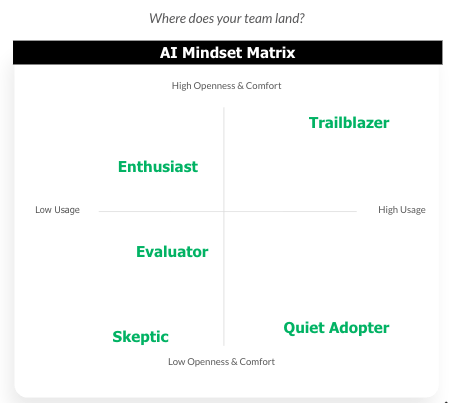
Understanding where people stand today around how they view and use AI is another step in meeting them where they are. There are five common AI mindsets, ranging from low to high openness and usage: Skeptic, Quiet Adopter, Evaluator, Enthusiast, and Trailblazer. How they fall on the scale is illustrated below.
Mindset
Openness & Comfort
Usage Level
Common Behaviors
Change Enablement Strategies
Skeptic
Lowest
Lowest
– Hesitant or resistant to AI. – Relies on traditional methods. – Questions AI’s value or accuracy. – Needs proof before adoption.
– Build trust through small, low-risk AI pilots. – Share clear success stories and data demonstrating measurable impact. – Provide step-by-step guidance and support. – Encourage dialogue and address fears openly.
Quiet Adopter
Low
High
– Uses AI tools mainly out of necessity. – Quiet about AI adoption. – Focused on practical efficiency gains. – May not explore beyond immediate tasks.
– Offer role-specific training to optimize use. – Recognize and reward efficiency gains. – Provide clear guidelines and best practices. – Encourage sharing of successes to build confidence.
Evaluator
Moderate
Moderate
– Experiments selectively with AI. – Pilots new tools before wider adoption. – Comfortable but not fully integrated AI. – Focused on risk/benefit analysis.
– Provide frameworks for experimentation with measurable goals. – Offer mentorship or coaching on AI integration. – Ensure clear criteria for success. – Encourage peer learning and collaborative evaluations.
Enthusiast
High
Moderate
– Curious and explores AI possibilities. – Advocates for AI adoption. – Uses AI consistently but not fully optimized. – Prioritizes exploration over impact at times.
– Channel curiosity into strategic initiatives. – Offer advanced training and sandbox environments. – Help prioritize high-impact use cases. – Provide opportunities to mentor others and share knowledge.
Trailblazer
Highest
High
– Early adopter and AI advocate. – Drives innovation and integration. – Mentors others and promotes AI transformation. – Regularly experiments and measures results.
– Empower them as change champions. – Provide access to cross-functional projects. – Recognize leadership in AI adoption. – Align their efforts with strategic business objectives to maximize measurable impact.
(Source: Sercante, 2026)
Identifying these mindsets within the organization enables leaders to tailor their change enablement plan to address the AI mindsets of the people. For example, a “Skeptic” needs different reassurance than an “Enthusiast” who may already be experimenting with tools outside of the core systems.
To further verify and understand the existing AI mindsets, observe how people are executing the processes today that will involve the AI solution, and listen to what the team is already saying about AI.
Verifying AI Mindsets: Observing the Real Flow of Work
From a technical standpoint, AI solutions need to align with the core processes happening across the customer lifecycle, meaning they need to be designed so that they support how people actually work. From a change enablement perspective that considers the human factor of AI adoption, there needs to be an understanding of where skills and attitudes are today to provide impactful communication and training materials. To do both, consider conducting Day in the Life exercises.
Day in the Life exercises involve sitting with team members to observe how they use AI and other systems to execute core processes. This practice helps to discover the “real” flow of work versus the documented one. By observing these daily habits, skill gaps can be identified along with true AI mindsets, and solution designers can ensure the final AI solution removes friction rather than adding it.
During these exercises, it is important to listen to the people executing the process to understand what they are saying about AI, allowing further verification of the AI mindset and also proactive planning for change enablement materials that will address differing levels of baseline adoption.
Confirming AI Adoption: Listen to the Voice of the User
In change enablement, silence does not imply consent. If people are not providing initial reactions or feedback, find out why. A “Quiet Adopter” might be using the tool out of necessity while still harboring deep skepticism that could eventually lead to disengagement.
Listen to what people are saying about the technology. When AI is brought up in conversations and team meetings, how do people seem to react? If they are not saying anything at first, what does their body language communicate? Paying attention to the words and expressions people are using about AI will support understanding of the current AI mindsets in the organization and further inform how to tailor the change enablement plan to successfully address the human factor of AI adoption.
Considering the Human Factor in AI Adoption: Developing Change Enablement
To address uncertainty, existing AI mindsets, and bridge any skill gaps that would limit the success of an AI rollout, there needs to be an effective change enablement plan implemented. As a starting point, consider this four-phase Change Enablement Checklist:
Identify & Respond: Perform stakeholder impact assessments to identify unique role-based needs and concerns. Uncover the uncertainties and AI mindsets.
Define & Design: Collaborate with tech teams to streamline processes before designing the automation, ensuring human expertise and intervention points are clearly defined.
Listen & Inform: Provide regular, transparent updates that explain the “why” behind the change and the long-term roadmap. Continual clear communication builds trust to ease uncertainty and help shift AI mindsets.
Prepare & Sustain: Offer role-based training and post-launch support tools. Remember, users only retain about 34% of training within 24 hours (Harvard Business Review). Sustaining AI adoption is where the real value is realized.
If you need support with implementing a change enablement strategy or conducting team readiness analysis, creating learning materials, or developing your AI roadmap, reach out to the Sercante team today.
Prioritizing the Human Side of AI for Sustained Success
To mature from siloed AI experiments to operationalized processes that power a modern growth engine, the human factor must be integrated into every stage of planning. Taking the time to understand the team’s AI mindset, current usage, and skillset, and tailoring the change enablement plan to meet them where they are with post-launch support, allows the people involved to shift from uncertainty to sustained, confident AI adoption. Gaining measurable business impact with AI isn’t just about the technical or data factors. It’s also about mobilizing the people involved to trust it, master it, and use it to execute the strategy to reach the organization’s growth goals.
In the modern landscape, marketing, sales, and customer success leaders are facing a challenge where they are surrounded by more technology and information than ever before, yet siloed data and complex stacks often feel like an obstacle course rather than a growth engine. Most leaders feel that their technology is underperforming, but at the same time, there is a significant portion getting unused. The hard truth is that the issue is rarely the technology itself. Instead, the roadblock is usually rooted in the strategy, how the tool is used, and the level of adoption. Turning systems into a growth engine requires a shift in mindset, where leaders use a strategic approach and change enablement for technology that drives measurable business impact.
Over the years, growth leaders have been in a cycle of “Have a problem? Buy a solution.” Over time, this has led to fragmented systems, manual workarounds, and disconnected data, leaving teams drowning in clicks and frustration. The average large enterprise has over 600 applications (WalkMe Inc.). Leading to tech stack bloat, underutilization, and underperformance.
55% of organizations fail to manage their full portfolio of tech projects, along with their interdependencies (Boston Consulting Group).
54.9% of companies shared that their technology underperforms according to their expectations (The CMO Survey).
44% of marketing technology gets underutilized (Deloitte).
Only an average of 33% of martech stack capabilities get used (Gartner).
Historical technology purchases were made with the best intentions. The team member, team leader, or the buyer would identify a real pain point, see a promising new tool, and genuinely believe, “This solution is going to help solve it.” Based on the level of investment of time, money, and organizational energy required, they moved forward, implemented the system, and added it to their tech stack, eager for the promised returns.
Which begs the question: how did organizations get to a place where that initial optimism was replaced by daily frustration? How did this technology, meant to empower them, feel more like a roadblock, with systems that are not meeting the expectations of the people using them, and are not maximized to their full capabilities?
Root causes of technology underperformance and underutilization
There are a few root causes for technology falling short, and most of the time, it is not the technology itself, but rather how it is approached and then rolled out to teams.
1. Missing a strategic approach that considers the bigger picture
When technology is approached as a point solution to fix one singular challenge, there is a lack of strategic planning that considers how the technology fits into the bigger picture of the organization. Such as:
How will this technology align with the business strategy?
How will it contribute to the desired end experience we want to give to our customers?
What are the goals that we want to achieve with this solution?
How will it fit with how our people operate?
How will it integrate into our data strategy?
How will this technology work with the other systems we already have?
A symptom of technology not being aligned with the business strategy was a trend found in the 2025 Trilliad Sustainable Growth Study. The study surveyed 350+ growth leaders, and 1 in 3 admitted that their alignment strategy stops at the planning phase. Meaning that their strategy for cross-team collaboration throughout the customer lifecycle is not consistently being executed on, because the technology that marketing, sales, and customer success use daily does not reflect the strategy.
Without the critical step of strategic alignment of both the broader business aspects and the human impacts, the system will often fail to meet expectations and become another silo.
2. Lacking effective change enablement for the people
Successful technology transformations are not just about the tech itself, but about ensuring people are motivated to adopt the changes. Without effective change enablement that considers how people operate today, how the technology will impact their processes, and provides the tools, guidance, and support needed to ensure sustained, successful adoption, then technology will continue to be underutilized, leading to underperformance.
Without effective change enablement that considers how people operate today, how the technology will impact their processes, and the training and communication needed to ensure sustained, successful adoption, then technology will continue to be underutilized, leading to underperformance.
An example of this is now being seen with AI projects. Up to 90% of AI projects are failing to scale beyond the pilot phase (Forbes), which would also cause 80% of organizations to say that there is no tangible enterprise-level EBIT impact from AI investments (McKinsey & Company). A major factor is a lack of effective change enablement for the people. 70% of AI project failures are organizational (Adaptovate).
Even the best ideas or technologies can fail if people don’t embrace them. When people are not enabled to effectively use the technology, there is a lack of communication in the plan and value behind it, or it turns into more of a roadblock for how they operate, they will resort back to what they know because “It just works.” Causing an overall lack of sustained adoption.
A customized, human-centric Change Enablement approach that guides the teams through the transformation with persona-specific communications delivered in a variety of ways, advocacy activities to encourage peer engagement, information and support leaders need to guide their teams, and robust role-based training and post-launch support ensure all stakeholders are aligned and actively driving toward a lasting impact.
Stopping the cycle of disparate systems that underperform and are underused requires a mindset shift for maximizing the technology already in place and continuing to evolve platforms with the latest solutions available.
The Solution: Implementing a strategic approach and change enablement for technology that drives growth
To effectively approach technology, it needs to be thought of as a growth engine rather than just mere overhead. This mindset shift guides leaders toward considering the big picture and the people involved to get the most out of the systems they currently have, and when evolving technology.
Maximizing systems: The strategy for assessing current technology
To maximize technology in place, it first needs to be evaluated to identify gaps. Where is it currently not meeting expectations, where it is being underutilized, and what areas need advancing to enable people to be as effective as possible with engaging our customers and building lasting connections?
There are four areas in which technology should be assessed to help guide teams toward effectively maximizing what they need.
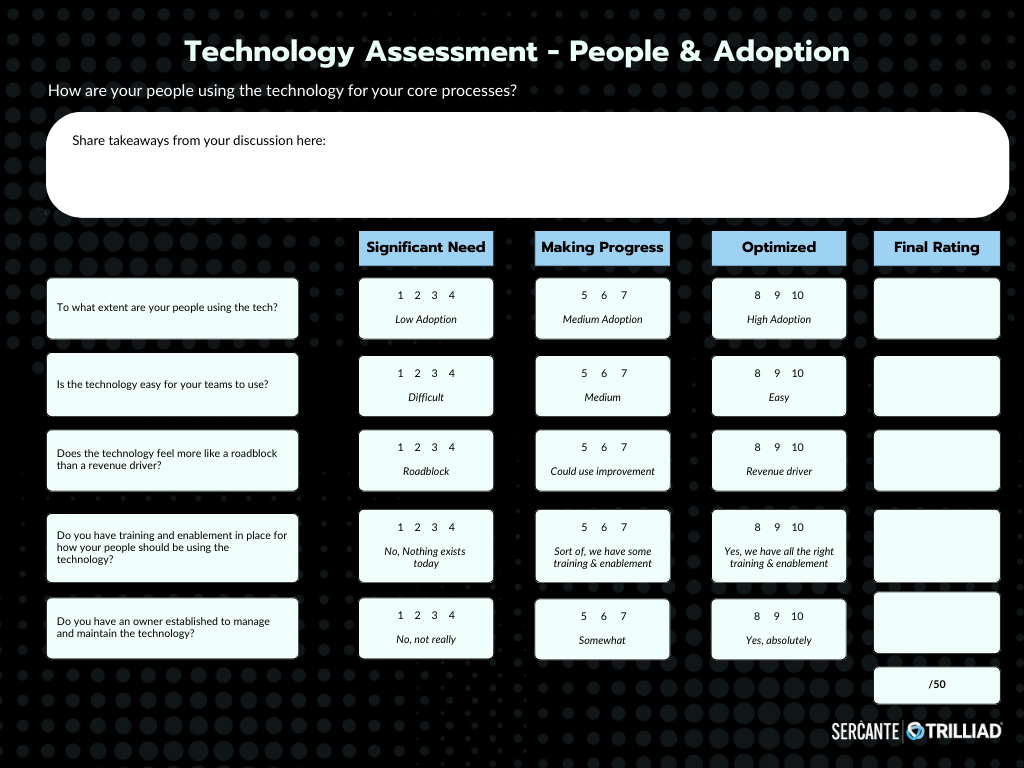
People & Adoption: How are your people using the technology? Do you have enablement in place to support your teams and ensure sustained and effective adoption? Are you continuously listening to your users to determine system effectiveness?
Strategy: Is your technology aligned with your strategy? Do you have a plan in place for how the technology will be used and how it will drive business value?
Capabilities: Is the technology being used to its full potential? Does the technology do what we need it to for our people and our customers today? If yes, what about six months from now?
Data & Integration: Is the system’s data locked in a silo? Is the data being used, and how so? To what level would you say that the data in the system is accurate and reliable?
For a full list of questions to consider in each area and to start applying this strategic approach for assessing technology at your organization, download our Technology Assessment Guide.
Answering these questions will help growth teams define the biggest areas of need with their technology, and start to define the system optimization projects they want to pursue to actually maximize what they have.
Prioritizing technology optimization with an actionable roadmap
After completing the technology assessment, teams can often feel overwhelmed when looking at the long list of needs within their tech stack. The key to gaining momentum is not to try and fix everything at once, but to prioritize projects based on a balanced scorecard of business impact, effort to execute, organizational impact, and the dependencies involved.
By categorizing your initiatives, you can create a roadmap that balances quick wins with long-term strategic transformations:
Business Impact: Tying projects to business impact ensures that efforts are focused on high-value initiatives. Ask: Will this move the needle on revenue, customer retention, or lead conversion? If the project can’t be tied back to a core KPI, it might be a vanity project rather than one that should be prioritized for the growth engine.
Level of Effort: Evaluate the resources required. Is this an out-of-the-box configuration change (low effort) or a custom API integration that requires months of development (high effort)?
Organizational Impact: Consider how many people this affects. A change to the CRM affects every seller, while a change to a niche social listening tool may only affect a small subset of marketing.
Dependencies: Identify the “domino effect.” Does the new lead scoring model depend on a data cleanup project that hasn’t started yet? Mapping these interdependencies prevents projects from stalling mid-execution.
Take a deeper dive into the considerations for building your technology roadmap, with this example of how the Sercante experts apply this approach for AI in this on-demand webinar. To get support with creating your AI roadmap, reach out to the Sercante team.
Strategically evolving technology to enhance experiences at scale
The latest developments happening in the technology landscape with data and AI are making it possible for growth teams to converge solutions and be more effective at what they do. It poses a great opportunity for organizations to embrace innovation and meet their buyers where they are through emotionally resonant experiences that drive growth in ways that have never been done before. However, evolving technology shouldn’t just be about adding “the next big thing”. It should be thought of through an impact-driven lens that asks:
Does this solution specifically remove friction from the buyer’s journey?
Does it empower the team to impactfully engage buyers at scale?
Does it enable smarter decision-making with actionable insights?
If the answer is yes to any of the above, then it should be considered, but further grounded with a view of the big picture: how it aligns with the business strategy, integrates with core processes, fits with the people and buyers, and how it connects to the data strategy and the current systems in place.
Implementing effective change enablement for sustained adoption
Even the most sophisticated technology will fail if teams do not actually use it. This is why change enablement is critical when shifting how a process is done in a current system, or new technology is being added to what growth teams use to continue to evolve capabilities.
Effective change enablement requires understanding what success looks like, how the technology is currently being used, and what skills might need to be developed to create tailored training and documentation by role to close any gaps and ensure sustained success. In addition, it requires clear and transparent communication with the end users. The teams involved need to understand what the intended goal is for the rollout of the solution and how it will drive value for the organization.
To ensure tech initiatives result in sustained adoption, follow this Change Enablement Checklist:
Identify & Respond: Start by listening. What are the specific pain points your team faces? When end-users are involved early, it reduces the “fear of the unknown” and builds internal champions.
Define & Design: Clearly define the new process before building the technical solution. Technology should automate a well-defined process, not just try to fix a broken one.
Listen & Inform: Maintain a continuous feedback loop. Communication shouldn’t be a one-time email on launch day. It should be a steady stream of updates that explain the why behind the change.
Prepare & Sustain: Provide tailored training that meets people where they are. Since most people only retain about 34% of what they were taught within 24 hours (Harvard Business Review), ongoing support, documentation, and “office hours” are recommended to reinforce the new way of working.
The difference between technology that feels like an obstacle course and technology that acts as a growth engine is often not rooted in the technology itself, but rather the strategy and change enablement applied to ensure it is aligned with high-value business outcomes and successfully adopted for long-term success. It requires a commitment to ongoing evaluation and advancement through a roadmap that prioritizes impact. Applying this mindset will guide growth leaders to overcome the challenges of their complex tech stack and empower their people to do what they do best: build meaningful connections with their buyers that drive sustainable growth.