
Category

Community

We all feel it. As humans engage with technology, innovation is moving at a breakneck pace. But as I’ve spent time researching the current landscape of the state of AI in enterprise, “breakneck” doesn’t even do it justice.

To put the acceleration in perspective: it took the telephone 75 years to reach 50 million people, and the internet seven years to reach that same milestone. Generative AI? It reached 100 million people in just two months (Forbes, UBS/World of Statistics).

This isn’t just a tech stat. It has a profound human impact. As innovation accelerates, so does the World Uncertainty Index. We are working with human beings who are feeling this exponential increase in uncertainty—the IMF reported that this index essentially doubled in 2025 alone. As growth services providers, we have a strategic opportunity to help them navigate this chaos.
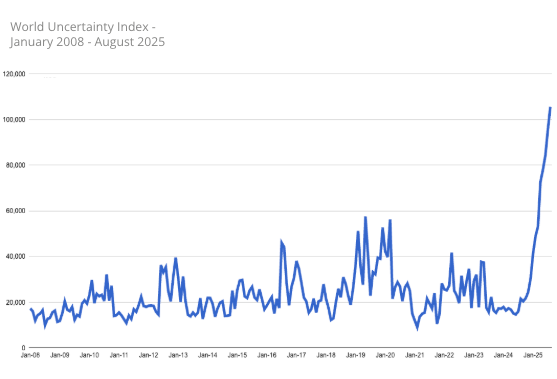
World Uncertainty Index - January 2008 - August 2025

(Source: World Uncertainty Index)

To get the highlights on how we approach creating a clear path for AI success amidst the chaos, continue reading below. To get the full playbook, download the report, The State of AI in Enterprise: Closing the Gap Between Investment and Impact.

The State of AI in Enterprise
Closing the Gap Between Investment and Impact
Why 95% of AI pilots fail to deliver results
The 4-pillar playbook to fix it
Download Report

The State of AI in Enterprise: A $30 Billion Problem

In 2025, aka the “year of the AI pilot”, companies spent over $30 billion on enterprise AI initiatives. Yet, 95% of those pilots failed to deliver measurable returns (Forbes, MIT’s Media Lab).

Why? Because the “silver bullet” mentality is still alive and well. Too many organizations are fluttering from one shiny object to the next without a focus on optimized workflows or incremental lift. As we move through 2026, our goal is to help go-to-market (GTM) teams stop the “SaaS sprawl” and get real value out of what they already have, while continuing to evolve with the latest data and AI capabilities.

Our Four Pillars for Success

1. Anchor on the Vision (Stop Building Stairways to Nowhere)

You wouldn’t build a spiral staircase in a luxury mansion without knowing where it’s supposed to connect. If you just start building, you risk creating a “beautiful stairway to nowhere.”

We avoid this by starting with a Vision Map. This isn’t just another document that collects digital dust, it’s a collaborative body of work that forces every stakeholder to define exactly how technology supports their specific success metrics. By “backcasting” from the end goal, we create a sequential roadmap that prioritizes business impact over guesswork.

Discover what's possible with a vision map for AI Learn More

2. Optimize the Existing Tech Stack (The Stable Foundation)

The average enterprise is sitting on over 600 platforms (Zylo, 2026 SaaS Management Index), and frankly, about 30% of that budget is being lit on fire due to redundant tools and “sloppy” automation (Gartner).

Before we layer AI on top, we have to fix the foundation. We use Maturity Mapping and Friction Analysis to find exactly where your tech is making work harder for your team instead of easier. AI needs clean data and efficient processes to thrive. If your data architecture is a mess, a bot isn’t going to save you.

3. Own the Success Story (Defending Your Budget)

In an era of high tech spend, leadership is going to ask the “million-dollar question”: Did this actually improve our business? If you can’t answer that with data, winning budget for the next cycle is a losing battle.

We ensure our clients are “data-ready” from day one. This means establishing hard baselines and benchmarks before a pilot even starts. We build the dashboards and reports that allow you to walk into the boardroom and prove the ROI of your efforts, moving technology and AI initiatives from a cost center to a revenue driver.

4. Don’t Forget the People (The Heart and Soul)

Technology doesn’t fail; people do. If your users find a tool frustrating or it feels like “noise,” they won’t adopt it.

Our Change Enablement methodology acknowledges the very real “change fatigue” your employees are feeling, addressing the human factor in AI adoption. We don’t do “one-size-fits-all” training. We identify your internal influencers and detractors and create curated, role-based communications. We provide the user guides and “real-world” scenario training that ensures the technology actually sticks, even as your team evolves.

Looking Ahead

The future of navigating tech and AI in enterprise to deliver real value isn’t about chasing the next buzzword. It’s about rolling up our sleeves and doing the hard work of strategy and execution. Let’s stop looking for the “one weird trick” and start building a foundation where AI and your people can actually move the needle.

If you’d like support with gaining real momentum with your AI and technology that delivers measurable results, reach out to the Sercante team. We partner with GTM teams daily to ground their initiatives in business outcomes and design and architect scalable AI and data solutions that achieve their goals.

In today’s modern era, where customer expectations are rising, new technology is coming out every day, and data is living among disparate systems, the key to achieving sustainable growth is proving to be about how your teams, data, and technology are connected and coordinated across the customer lifecycle. 

Why? Internal misalignment among people, processes, and technology creates leaky funnels, slows down pipeline, erodes customer trust, leads to churn, and decreases customer lifetime value. And when 80% of customers say that their experience is as important as the product itself (cropink.com, 2025), it’s clear that a negative customer journey will stunt your growth.

However, the challenge isn’t merely a “culture fix”. It takes strategic planning and coordinated execution to align your marketing, sales, and customer success teams across their processes, data, technology, and analytics through a customer-first lens.

To capture the state of this challenge, the 2025 Trilliad Sustainable Growth Study surveyed 350+ senior growth professionals and provides a playbook for how top performers structure teams, connect workflows, and measure what matters. Below are the 12 most critical statistics that should inform how you consider shaping your strategy for sustainable growth in today’s market.

The 2025 Trilliad Sustainable Growth Study

Growth is challenging, but it’s easier for integrated teams

Let’s level set, growth isn’t easy. When asked to assess the current sentiment around growth, go-to-market (GTM) leaders expressed that it’s becoming more challenging, but the ones who did find it to be easier were the ones who had integrated or joint leadership among their GTM teams.

  • 62% of leaders say growth is getting harder.
    • This feeling is widespread, but the study shows the problem isn’t just external. The single greatest internal roadblock is the lack of coordination between Marketing, Sales, and Customer Success, cited by 44% of respondents. Confirming that alignment is a key determining factor of your growth.
  • Organizations with “Integrated Leadership” are 3x more likely to find growth easier.
    • Integrated leadership means your Marketing, Sales, and CS functions are managed jointly around a single set of KPIs. Only 22% of organizations have adopted this high-performing model. If your leaders are held accountable to siloed metrics, rather than a shared goal, your teams will be driven toward optimizing in service of their own function, rather than in service of their customer, or to each other.

This is a mindset shift that needs to happen internally. Aligning around a shared vision of what the ideal customer experience should look like, around your revenue goals, and around the key metrics to be tracking to get there, becomes the north star that all three teams are marching toward to drive growth easier.

Each department may have its own alignment blind spots

Having cross-team alignment is critical to your growth, but a part of what might be standing in the way of getting aligned in the first place is that some teams may be feeling the disconnects more than others and therefore may not be seeing it as a priority.

  • 54% of Sales teams reported that they feel coordination pain, while only 33% of Customer Success (CS) teams feel the same.
    • This “pain gap” points directly to a process problem. The broken customer handoff occurs within your systems, and Sales, as the team closest to customer revenue expansion, is on the front line of that failure.
  • CS teams rate their organizational coordination significantly higher than other functions (8.33 vs. 7.36 for Sales).
    • This finding suggests a potential cross-team collaboration blind spot. CS teams may be achieving high internal cohesion, but this often happens in isolation from broader GTM processes. 

Marketing, sales, and customer success may all have their own internal thoughts on how well aligned they are cross-functionally, but this can lead to pain for the other departments, and worse, for your customer. Therefore, it’s critical when approaching alignment conversations to get all three teams in a room to think holistically about the customer experience and the shared metrics to track performance.

The customer isn’t thinking to themselves: Am I in a marketing experience, a sales, or a customer success experience? They just know that they’re having an experience with the brand as a whole. Therefore, if customers aren’t thinking about your organization in terms of siloed departments throughout their journey, you shouldn’t be either.

The alignment differentiator: going beyond planning

When it comes to aligning marketing, sales, and customer success, these teams may be strategically aligned, but the question is, are they actually executing it? The data shows that talking about alignment isn’t the same as doing it.

  • Only 27% of organizations say their teams are “fully integrated” across strategy, KPIs, planning, and execution, and 1 in 3 admit that their alignment stops at the planning phase.
    • Meaning the other 70%+ have gaps in how they are making alignment happen in their organization. Getting all your growth teams in a room to talk holistically about the customer journey and align on shared metrics is critical, but then there needs to be the next step of actually acting on the alignment strategy. Bringing this alignment into the technology that your GTM teams use daily is critical to going beyond the planning phase and achieving sustained collaboration.
  • Twice as many high-performing organizations as opposed to struggling ones (48% vs. 23%) are actually acting on their alignment strategy.
    • The key differentiator is action. High-performing organizations prioritize going beyond the planning phase and actively executing it. True integration is a unified process and a single source of truth built into your technology, not a recurring meeting.

Full customer journey data visibility is a must for seamless experiences

One of the ways to gauge your level of alignment is to approach the buying process through the eyes of your customer. If your customer is having to repeat themselves, waiting to be responded to, sharing their frustrations, or not being guided toward the best purchase, or their next best purchase, chances are there’s misalignment in your organization. A big piece of this is your data. Disconnected data prevents seamless experiences.

  • Only 12% of organizations rate their Customer Experience (CX) maturity as “Advanced.”
    • When your data is living in different systems and no one has a complete view of the customer journey, it can seem impossible to have an advanced CX—and with customers now rating the experience to be just as important as the product itself, teams can’t afford anything less than an advanced experience.
  • High-growth organizations are 50% more likely to use data across the “full customer journey.”
    • While 40% only use data for acquisition. The best teams are building their strategy around retention and expansion, not just new logos. To do this, marketing, sales, and customer success need visibility into the critical touchpoints happening throughout the entire customer journey.
      • How else is marketing supposed to know when to tee up a cross-sell campaign that triggers the customer to raise their hand and expand their relationship?
      • How else is sales and customer success supposed to know when an account is at risk and act proactively to ensure retention and reduce churn?

Sustainable growth requires moving past a “first-half” strategy to a truly “full journey” approach and this includes with your data how your technology is integrated to support this.

The path forward: aligning for sustainable growth

The data from the 2025 Trilliad Sustainable Growth Study confirms that alignment across marketing, sales, and customer success is critical to driving sustainable growth. However, this cannot stop at the planning phase, but needs to be executed in your technology and data strategy throughout the whole customer journey, not just at the acquisition stage. 

Prioritizing aligning your people, processes, and technology will deliver a smoother customer experience, leading to stronger brand loyalty, increased retention, and ultimately growth for your business.

If you’d like support with aligning your marketing, sales, and customer success teams across your customer lifecycle, reach out to the Sercante team. Our experts will listen to understand your goals, discover your friction points, and help develop a strategy as well as set up scalable processes for successful execution inside your data, technology, and analytics.

Several data breaches affecting a wide range of companies that use Salesforce have been reported in recent weeks. These incidents have impacted organizations across various sectors, including technology, retail, and insurance. The exposed data has varied by victim but has commonly included customer contact information, internal business records, and even sensitive data like API tokens and credentials.

Sercante clients can be assured that our systems have not been impacted by these recent attacks, however we want to make sure that Salesforce customers are aware of these incidents and are equipped to safeguard their instances.

How the Breaches Occurred

The recent breaches are not due to a vulnerability within the Salesforce Core platform itself. Instead, threat actors have used sophisticated social engineering and supply chain attacks to gain unauthorized access. 

One common method has been targeted voice phishing (vishing) campaigns. In these attacks, bad actors impersonated legitimate employees or IT support staff to trick victims into downloading a malicious replica of Data Loader and granting access to their Salesforce environments.

In a recent and widespread campaign, attackers leveraged compromised OAuth tokens for a third-party application, Salesloft Drift. By exploiting the integration between the app and Salesforce, the threat actors were able to export large volumes of data and credentials from numerous corporate Salesforce instances in what is called a “supply-chain attack”. . The attackers were able to steal “digital keys,” or authentication tokens, from the Drift app. They then used these stolen keys to access and steal data and credentials like passwords, API keys, and access tokens for other services that could be used to compromise other systems integrated with Salesforce.  

This highlights a critical risk: while the core platform may be secure, its connections to third-party apps can introduce vulnerabilities.

Risk to Salesforce Customers

The primary risk to Salesforce customers lies in the potential for stolen data to be used for further attacks. Customer contact information and other details can be weaponized in targeted and highly convincing phishing and social engineering campaigns to gain access to other corporate systems. The exposure of sensitive information like API tokens and credentials poses a significant threat, as it can be used to compromise connected systems, such as other cloud platforms or internal networks.

UPDATE: If you are a Drift customer – Salesloft has announced plans to shut down its Drift chatbot following their recent security breaches. This no doubt presents a challenge to your website engagement strategy.  The Sercante team is well-versed in the various conversational platforms that integrate seamlessly with Salesforce and can help you navigate this transition.

Recommended Actions for Protection

While Salesforce has taken steps to restrict the use of “uninstalled connected apps”, customers should take steps to protect themselves from similar threats:

  • Reauthenticate Drift Connections: Salesloft Drift customers will need to reauthenticate their Salesforce integration with Drift. It’s also advised that any and all authentication tokens stored in or connected to the Drift platform should be considered potentially compromised and update them immediately. 
  • Rotate all credentials and keys: Immediately change any passwords, API keys, and other access tokens that were stored in your Salesforce instance
  • Investigate your Salesforce account: Look for any unusual activity in your Salesforce login history, audit trails, and API access logs from early to mid-August 2025. Look for suspicious logins or data access patterns, particularly from the user account associated with the Drift integration.
  • Audit Third-Party Apps: Audit your connected apps to make sure they are secure, and make sure that all third-party apps connected to your Salesforce account have only the minimum permissions they need to do their job and revoke access for any app that is no longer in use.
  • Secure APIs and Integrations: When configuring new integrations, restrict API access by defining trusted IP ranges and ensuring that connected apps have the most restrictive scope possible.
  • Apply the Principle of Least Privilege: Limit user permissions to only what is necessary for their job role. Restrict administrative access and minimize the use of permissions like “Modify All Data.”
  • Be on high alert for phishing: Warn your employees to be extra cautious about any unexpected or unusual emails, phone calls, or messages. The attackers may use the stolen contact information to try and trick people into giving up more sensitive data.
  • Rinse & Repeat: Security isn’t a set it and forget it function. It takes constant and consistent vigilance to protect your systems and data. 

While the core Salesforce platform is secure, recent data breaches are a reminder that a company’s security is only as strong as its weakest link, which is often a third-party app or a human being. To stay safe, you have to be proactive. By using strong security practices, enforcing strict access rules, and training your team, you can drastically improve your defenses. Ultimately, keeping your data safe is a team effort—you, Salesforce, and all of your employees have a role to play.

If you’d like a guide to help you navigate how to optimize data protection in your organization with Salesforce, reach out to the Sercante team. Our experts can be your guide for impactful next steps.

Since hosting MarDreamin’ in person this year, we’ve gotten a lot of questions about if the virtual experience is still happening. The answer: Yes, but not like you remember. We’re bringing you a fresh take on the virtual conference, designed for how modern marketers on Salesforce learn and connect today. 

Instead of long days staring at the screen, this year’s experience is built around flexible content drops, live moments you don’t want to miss, and deeper conversations with your peers that continue long after the mic cuts out. You’ll be able to learn on your own time, engage when it makes sense for you, and walk away with ideas you can start putting into action right away with MarDreamin’: On Tap.

Introducing: MarDreamin’: On Tap

Throughout the month of November, we’ll be dropping fresh content and kicking off community conversations in Slack. No more “I’ll just catch the recording” or a stream of sessions that are just “on in the background”, this will be binge-worthy content released in bite-sized chunks that you can dive into when it’s convenient for you, kicked off with live moments you’ll want to show up for and meaningful conversations where you’ll exchange experiences, ideas, and get actionable takeaways that drive growth.

Let’s back up: What is MarDreamin’?

MarDreamin’ began during the pandemic as a virtual event—when Sercante partnered with industry leaders to bring the marketing community together at a time when in-person meetups weren’t possible. Since then, it’s grown into a thriving, global community of thousands.

As the founding team at Sercante believes in a tech-driven future where real connections thrive, marketing and technology evolve, but the human element and relationships remain the key to driving real growth—and MarDreamin’ is where the community can continue to build those deeper connections so we can all continue to grow together.

How is MarDreamin’ Virtual different this year?

We’re scrapping the three-day marathon “typical virtual conference” feel and evolving the experience to more closely align with how modern marketing pros on Salesforce interact with content and their peers in their daily lives, think: Netflix meets learning—with an afterparty in Slack.

The shift that brings the best parts of in-person events online

Three-day marathons that end in screen fatigue and attendance that means half-listening in another tab and then never making it to the replay isn’t how people truly learn or connect today. Therefore, we wanted to design an experience made up of content and community that fits your workflow and brings the best parts from in-person events online.

  • The unfiltered conversations in between sessions
  • The spontaneous moments
  • The people you connect with
  • The off-script, honest chats with peers who get it
  • Plus the sessions where you scribble notes so fast, you couldn’t read them later

It’ll be all the insights, game-changing strategies, and solutions you love from industry experts, Salesforce pros, and thought leaders in a way that meets you where you are today and for the future.

MarDreamin’ On Tap: The Drop + The Thread

MarDreamin’: On Tap will be content drops + community threads, spread across the month of November. 

The Drop – A bundle of binge-worthy sessions kicked off by a live moment you’ll want to show up for—AMAs, debates, and unfiltered confessions from marketers in the trenches.

The Thread – Slack threads that get unlocked when the live moment kicks off for insightful conversations that keep going long after the mic cuts out.

Why is MarDreamin’: On Tap a must-attend experience?

MarDreamin’: On Tap is your chance to see what the brightest minds in the industry have to say about all of the latest trends, and how they’re approaching solutions at their organization. It’s an opportunity to tap into their expertise, practical how-tos, and lessons learned from all the ways they have been pushing the boundaries with new ways to engage their customers, maximize AI, and innovate on the Salesforce platform.

  • Learn in a way that’s convenient for you—and retain the information. With impactful live sessions, and snackable content drops, it allows you to actually be present when it’s convenient for you and walk away with bite-sized actionable insights you can easily remember and bring back to your team.
  • Be inspired by peer-led content and build deeper connections. Hear from your peers who have been in the trenches and engage in community-led conversations in Slack to learn from each other in a way that fuels creativity and sparks your best ideas.
  • Maximize impact with real-world value. Every live moment, snackable session, and Slack thread, will be dedicated toward empowering attendees with practical strategies and solutions that they can apply to their customer experiences, role, and careers with the resources and technology they have available today.

Join the waitlist

Join the waitlist for first access to call for speakers, agenda updates, and when registration goes live. 

Then get ready to learn from and engage with marketers on Salesforce from across the globe in a way that fits your workflow for real connections and lasting insights that drive meaningful growth.

About MarDreamin’: On Tap

MarDreamin’: On Tap is a fresh take on the virtual conference—a series of live content drops and meaningful Slack threads made for how modern B2B marketers on Salesforce actually learn and connect today. Each drop delivers snackable insights from the pros in the trenches, plus unfiltered conversations that keep going long after the mic cuts off. It’s the best parts of an event—the bold ideas, the smart sidebars, the off-script hallway convos—delivered virtually in a way that fits your workflow, and sparks real growth.

It’s not a secret, so many growth teams, marketing, sales, and customer success, want to be using AI to streamline processes and elevate customer experiences, but when it comes to adoption, they’re a little stuck on how to get started with AI. 

After hearing a few of the experts at Sercante share their insights and having conversations with marketing leaders who have taken the plunge on applying AI to their initiatives, plus some first-hand experience with our own marketing, I was able to create this collection of tips for how to get started with AI. 

For those thinking, TLDR, let’s cut to the chase, I recommend downloading Sercante’s AI Starter Kit.

Tip 1: Pinpoint the pain

After attending a Connections 2025 Recap Webinar, Sercante’s Salesforce Product Director, Heather Rinke, advised the audience to get started with AI by writing down the biggest pain points they have today.

What is a manual, repetitive, and mundane task, sucking up your bandwidth?

Then consider, of those pain points, which is the lowest barrier to entry? What might have dependencies that might need a little more technology configuration, data setup, or the involvement of multiple departments?

Focus on the low lift, but quick-win initiatives first. Often, this would be an internal process that you could see how it performs, measure impact, and then scale from there.

[Watch On-Demand 2025 Connections Recap]

Tip 2: Do your research

As Laura Curtis, Senior CRM & Marketing Automation Strategist at Sercante said on the Connections Recap, “You don’t know what you don’t know.” 

In fact, 71.7% of non-adopters say “lack of understanding” is their biggest barrier to AI adoption (Influencer Marketing Hub AI in Marketing Benchmark Report). So if you’re feeling overwhelmed, you’re not alone. But it’s also fixable.

One way to start doing your research: Download the Sercante AI Starter Kit. It’s full of:

  • Real use case examples
  • Tips you can steal
  • Customer stories
  • Common pitfalls to avoid

Also, check out Rinke’s article, Five Tips for Getting Started with Agentforce.

Tip 3: Try out-of-the-box tools first

Don’t build the Death Star on day one.

There’s zero need to spin up a complex custom solution to get started. Many platforms—especially Salesforce Agentforce—already have out-of-the-box agents and AI functionality you can activate right now.

Use them.

Start small. Test how it works. See how it helps. Then decide if you want to scale or customize.

Tip 4: Get your data house in order (but don’t wait for perfect)

As Sercante VP of Growth & Alliances, Lauren Noonan,  shared on the Connections Recap, “Very few people buy a home and it’s perfect.”

You can start with AI even if your data isn’t a 10/10. But the better your data hygiene, the better your AI output.

Start by asking:

  • What data is critical for our first use case?
  • Where does it live?
  • What’s messy that could block us?

Then clean it as you go. Consider what other data optimizations you can make along the way to support the future AI initiatives on your roadmap. Like updating the kitchen before you renovate the whole house, and then mapping out what renovations make sense to do next.

Tip 5: Measure what matters

But what metrics are worth tracking to measure the impact of AI?

It depends on your use case, but as an example, Noonan shared the idea of using AI to generate a campaign brief instead doing it manually.

How long does it take you to do it manually versus using AI? 

Before getting started with using AI internally, get benchmarks for how long it typically takes your team do the processes you’ll be using AI for and then measure how long it takes after.

Now, the bigger question that Noonan posed is “What are you going to do with the time you get back and how will it impact the organization?”

If you’re trying to champion AI in your organization and get your leaders on board to support the initiative, answering questions like these can be a huge part of the business case—other than the increased efficiency, maximized output, and better customer experiences that’ll lead to growth.

Tip 6: Taking a crawl, walk, run approach to AI

As the CMO of Mogli, Christina Scarmeas, shared on my recent conversation with her on the Innovator Series about her team’s approach to using AI and Agentforce: 

“One of the biggest things we learned was, it’s okay to slow down and take a crawl, walk, run, approach to AI. Take a step back, look at the infrastructure that we need to deploy, and what we’re trying to do with these agents. Be okay with having a phased approach with expectations of how it’s going to be implemented, and if you put that infrastructure together and have a team that is dedicated to the strategy behind it, the results come fast.”

[Watch the Innovator Series]

This aligns with Rinke’s advice of starting with an initiative that is low-barrier-to-entry, perhaps something internal where you can point to productivity gains. 

A customer in the healthcare industry’s story of getting started with AI

For example, one of Sercante’s customers in the healthcare industry serving multiple practices implemented Service Agents with Salesforce Agentforce.

The Service Agents were set up to help the human agents query knowledge faster to support them in their calls to better serve patients and providers.

The solution has been rolled out to one practice area first, so the team can continue to learn and adapt the solution as needed before scaling to their other practice areas.

This is a great instance of a team starting small, with rolling out an AI-powered solution in one area of their business to then evaluate and see how it can be applied to the other areas of their business..

Tip 7: Build your AI roadmap

Once you’ve dipped your toe in, it’s time to zoom out.

As the Director of Marketing at Mogli, Evan Thomas shared on the Innovator Series:

“AI is the next evolution of technology and like all the tools that came before it, you have to have a plan. Just getting AI into your org isn’t going to fix it. You have to have a plan for that AI. What is it going to do for you? What is the process it is going to supplement or help your team focus on? What is the reason you’re doing it?”

Creating your AI Roadmap for quick wins and long-term success

Therefore, the next step is creating your plan or your AI roadmap. Identifying your pain points and use cases is the first step of this. The other piece of this is evaluating the customer lifecycle through the lens of the customer and identifying points of friction that could benefit from a solution to help your team scale and make the engagement seamless. However, as this can be overwhelming for teams to do, experts have started collaborating to put together resources for this.

Sercante’s session, AI Roadmap: The Strategy for Driving Growth with AI, is a great resource that includes insights from experts on how to approach creating a plan that:

  • identifies high-impact use cases
  • considers dependencies and how to address roadblocks
  • outlines key metrics to track for measuring success
  • clearly defines your path for quick wins and long-term success

Take advantage of training opportunities for creating your AI plan

Another option for getting started with creating your AI Roadmap is to get training. According to SurveyMonkey, 70% of employers don’t provide training on AI, even though 70% of marketers say it’s essential. Therefore, any time you can get training and advance your skills on how to approach AI or how to use it, take advantage!

One training offered is Sercante’s AI Workshop: Building your roadmap for real impact. This is the deep dive where the experts will guide you through creating your 30-60-90 day plan to help your organization get started with AI and scale for the future.

One last thing: Pick yourself in this era

CEO of Sercante, Andrea Tarrell, shared this sentiment during her opening keynote at MarDreamin’ Summit, encouraging the community to take action asking, “If not you, then who?”

This technology is at our fingertips, and it’s up to us to decide how we’re going to use it to streamline processes, meet customers where they are at scale, and create a truly seamless experience.

It’s time to get started with AI.

On June 30, 2025, Salesforce announced the class of 2025 Salesforce MVPs while also celebrating the 15th anniversary of the MVP program. Among the class was Sercante’s Account Engagement Product Director, Erin Duncan. In the Salesforce ecosystem, Erin Duncan is known as an inspiring leader, Marketing Champion, Speaker, Writer, and Trailblazer Community Group Leader. Her path to Salesforce MVP really starts back in 2018 with a 30 To Watch list and an exhilarating experience at Dreamforce.

Salesforce MVP Class of 2025 with Erin Duncan

Meet Erin Duncan

Erin has been in the Salesforce ecosystem for over a decade, and her passion for diving into new technology and helping fellow trailblazers succeed on the Salesforce platform has fueled her actions to obtain 11 Salesforce certifications, lead the Atlanta Marketers User Group, the Pardashians Slack group, and share her expertise and lessons learned through blog articles and speaking engagements.

How Erin’s story really began

When we spoke with Erin she said, “2018 was really the year that I caught the Salesforce Community bug. This was the year that Salesforce did a magazine with 30 Marketers to watch that I was in, and this was also the first year I spoke at Dreamforce. This really made me want to continue teaching others how to be successful in the community.” 2018 was also the year that Erin became a Salesforce Consultant, so that she could continue to lean into partnering alongside teams using the technology and help them to reach their goals on the platform.

After catching the Salesforce Community bug, Erin soon joined Sercante as a CRM and Marketing Automation Strategist, started writing blogs for The Spot (see all of her posts here), where she soon became a top contributor, and was recognized as a Salesforce Marketing Champion.

A strategic guide for growth

In 2021, Erin became Sercante’s Account Engagement Product Director, where she leads educating and enabling teams on all things Marketing Cloud (Account Engagement, Growth & Advanced Edition) to empower them to maximize the full capabilities of the technology to drive growth. 

As soon as a new feature or announcement is made for the product, Erin is rolling up her sleeves, diving in, and then presenting her recommendations and best practices to help customers navigate the ever-evolving technology.

A collage of photos featuring Erin Duncan speaking at Connections, MarDreamin', and engaging with the community at Dreamforce and Southeast Dreamin'.

Leading enablement for Marketing Cloud Growth and Advanced

Fast forwarding to today, Erin’s latest efforts have been leading the charge to enable the community on Salesforce’s latest marketing automation technology, Marketing Cloud Growth & Advanced Edition. 

After being a part of the Marketing Cloud Growth pilot team with Salesforce, Erin dove into the platform to test use cases, explore its full functionality, and compile her recommendations for how to get the most out of the tech to create personalized multichannel journeys that meet customers where they are.

Since then, Erin has written and collaborated on 30 blog articles (find them on The Spot here), led multiple speaking sessions, demos, and workshops, including presentations at Connections, Dreamforce, MarDreamin’, and Southeast Dreamin’. She also participated in leading three sessions for the Trailblazer Community’s Marketing Cloud Learning Bootcamp: Introducing the Marketing Cloud Growth, Data Mastery for Marketers: Leveraging Data Cloud, and Mastering MC’s Flow, Builders, Personalization, and Reporting.

Erin’s latest contributions

Erin’s latest resources she has put together for this initiative include an on-demand webinar, Elevating Your Campaigns with Next Gen Marketing Cloud, a recorded demo walking through the AI features that can be applied when creating a campaign with the platform, Agentforce for Marketing, and compiling the course materials for Sercante’s training course, Marketing Cloud Growth and Advanced Bootcamp.

The community’s testimonials of Erin’s impact

When nominating Erin for the Salesforce MVP program, community members shared the following:

“Beyond her impressive credentials, Erin is an inspiring leader and an influential figure within the Salesforce B2B community. She speaks at Salesforce and community events, manages the Pardashian Slack channel with over 10K customers and contributes by writing how-to content.”

“Erin has done all the things talking about MC Growth Edition – blog posts, supporting people in the Pardashian slack workspace, talks at community events (midwest, southeast, in addition to MarDreamin), community group meetings.“

 “Truly amazing! She continues to go above and beyond for the community.”

Follow Erin Duncan for her latest insights

We’re always looking forward to seeing what Erin will do next and continue to be wowed by her relentless zeal and passion for continuing to empower the community for success on the Salesforce platform.

To get in touch with and follow Erin for her latest insights, recommendations, and best practices, follow her on LinkedIn, join the Pardashians Slack community, and subscribe to The Spot.

What is the Salesforce MVP program?

The community nominates Salesforce MVPs, and they are selected for their expertise, leadership, and generosity. MVPs are re-evaluated each year for their contributions to the community and those who maintain this status after five years join the Salesforce MVP Hall of Fame.

No more posts to show