Category

Strategy

The marketing landscape has reached a tipping point. As buyer expectations continue to rise and budgets tighten, the need to be more effective with the resources available increases. Marketers are navigating technology that is evolving faster than ever. With data spread across disparate systems, the current trajectory of working to meaningfully engage buyers at scale while churning out campaign after campaign is not sustainable. AI offers the opportunity for a shift, but many organizations have deployed point solutions in an effort to gain efficiency without the feeling of actually getting anywhere. It begs the question: how can marketers maximize what they have while tapping into the latest solutions available, and free up their team’s capacity, so they can be more effective at engaging customers at scale? The solution: a strategic path towards convergence on Marketing Cloud.

A Modern Marketer’s Challenges

Most marketing teams are currently operating in survival mode. Launching campaigns at lightning speed, yet lacking the capacity to actually innovate or slow down to be more strategic and visualize the impact on the bigger picture. Three primary challenges keep marketers trapped in this cycle.

Legacy Systems

For years, the marketing mantra has been: “Have a problem? Buy a technology solution.” This “buy-as-you-go” era has left marketers with a complex, fragmented reality where systems simply don’t talk to each other. Today, the average large enterprise is juggling over 600 applications (WalkMe Inc.), and even mid-sized firms find themselves buried in hundreds of single-purpose tools.

Siloed Data

With critical engagement data and customer information scattered across disparate systems, it makes it challenging for marketers to see which campaigns are truly moving the needle, tailor messaging and strategy to key audience segments, and collaborate with sales and customer success on initiatives that progress deals and expand customer relationships.

Capacity Constraints

Marketers are working to maximize output with tighter resource constraints and have less capacity to be innovative, while mundane tasks such as manually importing and exporting segmentation data or reports are sapping the creative brain power needed to create unique brand experiences that emotionally resonate and set them apart in the market.

To break the cycle, marketers can overcome these challenges with the right strategic approach that leans into the resources they have, while seizing the opportunity that the latest technology presents.

Marketing’s Opportunity to Shift with AI

AI is changing the way buyers engage with brands and how marketers operate. Buyers are turning to AI answer engines for initial discovery and research, engaging in more self-guided behavior before brands ever see a click or a form submission. 50% of searches only use AI summaries. (McKinsey) Meanwhile, marketers can generate whole content assets with a well-crafted prompt in seconds and use agentic capabilities to streamline processes and create interactive buyer experiences. Presenting a great opportunity for marketers to more effectively engage buyers through personalized, two-way conversations at scale. However, the technology is evolving at a speed faster than organizations can operationalize. 92% of organizations do not have operational AI (McKinsey).
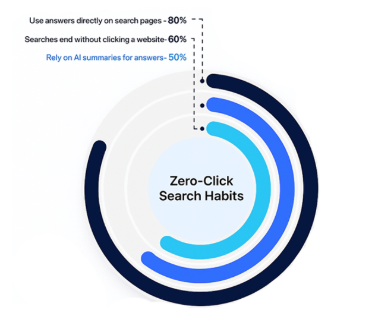
Zero-click search habits. 80% use answers directly on search pages. 60% of searches end without clicking a website. 50% of searches rely on AI summaries for answers.

(Image Source: McKinsey, 2025)

AI Efficiency vs. Operationalization

In an effort for marketers to start gaining traction with AI, many have implemented pilots and attempted experimentation in an effort to gain some efficiency. However, these point solutions have been set up outside their flow of work, causing more manual workarounds and presenting further silos that hinder meaningful results.

For AI to be truly operationalized and impact the bottom line, it needs to be embedded within marketing’s core business processes, powered by integrated data, and aligned with how they operate and how customers engage the brand. Empowering marketers to be more effective with AI and take advantage of the capabilities it has to offer, for example:

  • Agentic Marketing: Agents embedded within the marketing technology that drive productivity and orchestrate campaign execution with functions such as, generating actionable insights from campaign results and recommending next steps, instantly populating audience segments, and generating personalized messaging.
  • Agentic Customer Experiences: Agents that make it easier for your customer to engage with your brand and accelerate the path to purchase with experiences that could entail engagements like instant answers to their service questions or digital interactions where they can see what the product would look like based on their preferred customizations in seconds.

The possibilities with AI pose the opportunity for marketers to shift, operate, and engage their customers in ways they haven’t before at scale, to break the survival mode cycle, reach new levels of growth, and gain a competitive advantage. Therefore, having the right data, technology, and strategic foundation to support this is critical.

See how fellow marketers at Denver Public Schools are already using Agentforce Marketing features to streamline campaign workflows, deliver multi-channel campaigns, and track attribution. Register Here

Marketing Cloud Next: Agentic + Real-Time Data Capabilities

Marketing Cloud Next (Marketing Cloud Growth and Advanced Editions) gives marketers the ability to tap into real-time, connected data and AI functionality that integrates into their core processes, allowing them to streamline campaign launch, seamlessly segment audiences, easily tailor messaging, and then measure performance to make data-driven decisions.

Marketing innovators who want to start tapping into Marketing Cloud Next capabilities can do so while using the technology alongside their current marketing automation platform. Senior Engagement Manager at Sercante, Cara Weese, shares a few ideas for how Account Engagement customers can get started in her article, Smarter, Stronger Marketing with Account Engagement and Marketing Cloud. However, the journey of how to get there can seem unclear. 

Questions marketers may be asking are:

Where do I begin?

What incremental value can I get out of Marketing Cloud Next?

Can I improve the insights I’m able to deliver to my organization?

When does it make sense for my organization to converge onto one system?

Can I even get to one system?

To avoid the repeating cycle of having a problem, buy a solution, strategists are taking a step back to ask, what is the most effective way for us to use this technology while maximizing what we have?

The Solution: A Strategic Convergence Path

The answer: a strategic path to navigating Marketing Cloud Convergence, designed to take the guesswork out of this transition.

Rather than a lift and shift of legacy problems, there is a parallel path that allows organizations to move at their own pace and align with their vision, so they can be confident about heading in the right direction with Marketing Cloud Next.

A clear Marketing Cloud Convergence path includes:

  • An Actionable Roadmap: A tailored vision map that prioritizes use cases based on the organization’s unique mix of people, processes, and data.
  • High-Impact Use Cases: Use cases aligned with business goals to deliver value fast, for long-term scalability.
  • Agentic Value: A defined plan with AI capability embedded to drive productivity gains, connected to core processes.
  • Change Enablement: Customized training materials and enablement to ensure sustained and successful adoption across the marketing organization.

Navigating a Unique Marketing Cloud Convergence Path

Each organization has its own mix of people, processes, data, and technology. Therefore, each organization’s path to Convergence will be different from the rest. 

An approach that scales to the team’s organizational readiness is recommended. Some teams are ready to move faster than others, and some teams need to go slow at first to then go fast. A strategic path to Convergence should adapt to fit the organization’s needs with an individualized roadmap that guides everyone to success.

The Impact of Marketing Cloud Convergence

Choosing the path of Convergence is a strategic decision to integrate data and the latest technology directly into core marketing processes, while maximizing existing resources. By aligning these tools with overarching business goals, marketers reclaim the cognitive bandwidth and operational capacity necessary for the team to do what they do best. This approach empowers marketers to engage buyers through personalized, seamless experiences at scale, ultimately driving higher conversion rates and fostering lasting customer relationships.

How to Get Started

Depending on where marketers are in their journey, determine the next steps for starting their Marketing Cloud Convergence path. For example, teams in an earlier stage may just want to start learning about the Marketing Cloud Next functionality, while other organizations that are further along could start exploring and deploying.

  • Learn & Plan: Understand what Marketing Cloud Next capabilities can do for the organization and start creating a customized roadmap.
  • Explore & Deploy: Pick 1–2 low-effort, high-impact use cases to run in parallel with existing marketing systems and take a deeper dive into Marketing Cloud Next.
  • Evolve: Continue expanding Marketing Cloud Next usage in alignment with the business goals to progress along the Convergence path.

To get expert guidance on your Marketing Cloud Convergence path journey and where to start, reach out to the Sercante team. They have been a part of the Marketing Cloud Next product development since day one as a part of the pilot team, and partner alongside organizations to provide a clear path for Convergence success. 

Leaning Into Innovation to Drive Sustainable Growth

The path to Marketing Cloud Convergence is not a singular event, but a strategic evolution. By choosing to lean into innovation and take the first steps toward Convergence, marketers transition from the reactive survival mode of managing disparate tools and toward a proactive model where data and AI work to drive meaningful impact. Whether the team is just beginning to explore new capabilities or ready to implement agentic workflows, the key is to move at a pace that considers the team’s unique organizational readiness while keeping the long-term vision in sight. With a clear roadmap and a focus on incremental value, marketers can transform their operations from a fragmented collection of tasks into a streamlined engine that engages buyers at scale for real connections that drive sustainable growth.


As a buyer, we’ve all been there. You fill out a form, wait to hear from sales, and then maybe you receive a piece of content that isn’t relevant to you, or you find yourself repeating what you shared in the form later on a call. And what happens? You find yourself starting to feel less and less confident about the brand because your experience hasn’t been seamless. What we don’t think about as buyers is what the seller is probably experiencing in the CRM and how the data, or the lack thereof, is impacting their interactions with you. 

When the CRM is a roadblock rather than a revenue driver for sellers, it negatively impacts the buying experience in addition to sales performance. In today’s modern era, where buyer expectations are rising and marketing, sales, and customer success teams are under more pressure to drive growth with tighter budgets, it is critical that they prioritize optimizing core functions to deliver the best experience possible for buyers. An essential piece: optimizing the CRM seller experience.

To get the highlights on how to approach this, continue reading below. To get the full deep dive, watch Part III: A Better CRM for Sellers = A Better Experience for Buyers, of the Built to Buy series.

Built to Buy Part III
A Better CRM for Sellers Equals a Better Experience for Buyers
Speakers: Siso Ntuli, Senior Engagement, and Taylor Bacchus, Account Director
Watch Now

Why the Seller Experience Must Be a Growth Priority

For marketing, sales ops, and revenue teams, optimizing the seller experience isn’t just a nice-to-have operational fix. It is a critical growth lever.

  • Impact on Sales Performance: Unfortunately, the majority of a seller’s day is not spent selling. Only about 28% of their time actually is. (Salesforce) The rest of their day is consumed by manual data entry, hunting for siloed information, and navigating non-optimized processes. When the CRM experience is clunky, difficult for sellers to find what they need, not aligned to their sales process, or not reinforcing their training best practices, it slows them down, continuing to hinder the time they do have to sell, acting as a roadblock to their performance.
  • Impact on the Buying Experience: Buyers are not thinking: Am I in a marketing, sales, or customer success experience? They see one singular brand experience. When a CRM is friction-heavy, sellers can show up to calls sounding unprepared, while buyers find themselves forced to repeat information they already gave to marketing, making the brand seem not in tune with their specific needs. According to Gartner, 77% of B2B buyers reporting that their last purchase was very complex or difficult, it shows that these experiences are happening more often than growth teams probably realize. Any internal friction added erodes their trust.

To empower sellers to achieve higher performance and deliver the best buying experience possible for customers, optimizing the seller experience in the CRM is a must.

Through the Seller’s Eyes: How Marketing Can Help

The buyer’s experience is everyone’s responsibility, and marketers can play a pivotal role in helping to improve the seller experience. For marketers, when the CRM is aligned to core sales processes and optimized to how sellers actually work, it makes it easier to collaborate, streamlines the marketing to sales handoff, and ensures fewer leads fall through the cracks and more of the right leads form meaningful connections with your brand.

To fully understand what a seller’s experience is in the CRM, the strategy needs to be approached from the seller’s perspective and knowing what matters to them.

To a seller, more data does not always mean more value. When a lead hits their queue, they are looking for clarity on two simple questions: Who are you, and what should we be talking about?

Marketing can significantly improve the seller experience by shifting focus from data quantity to context quality. Instead of throwing more data over the wall, marketing should provide the connective tissue that tells the buyer’s story. This includes:

  • Prioritization: Is this a “hot” hand-raiser or someone in an explorative phase?
  • Relevant context: What specific content did they consume? Knowing if a prospect looked at a pricing sheet versus a top-of-funnel blog post changes the entire sales approach.
  • Laser-focused data: Provide only the key data points needed to frame a strategic conversation rather than overwhelming the seller with noise.

Having a conversation with sales to understand what questions they are asking themselves when a lead comes through, how they prioritize follow-up, and how they are gathering resources and data to create a strategy that will guide future sales conversations can help the marketing team focus on the right data when passing over leads and collaborating with sales to improve the seller experience.

A Strategic Approach to a Better CRM Experience

Aside from the initiatives that marketing can take, optimizing the seller experience in the CRM requires a mindset shift around how the technology is approached. Is it only seen as a database for sellers to enter information about their deals for reporting and forecasting, or is it seen as a powerful productivity engine that can support sellers in their sales process: arming them with insights for impactful conversations, streamlining and automating mundane admin tasks, and reinforcing sales training best practices?  

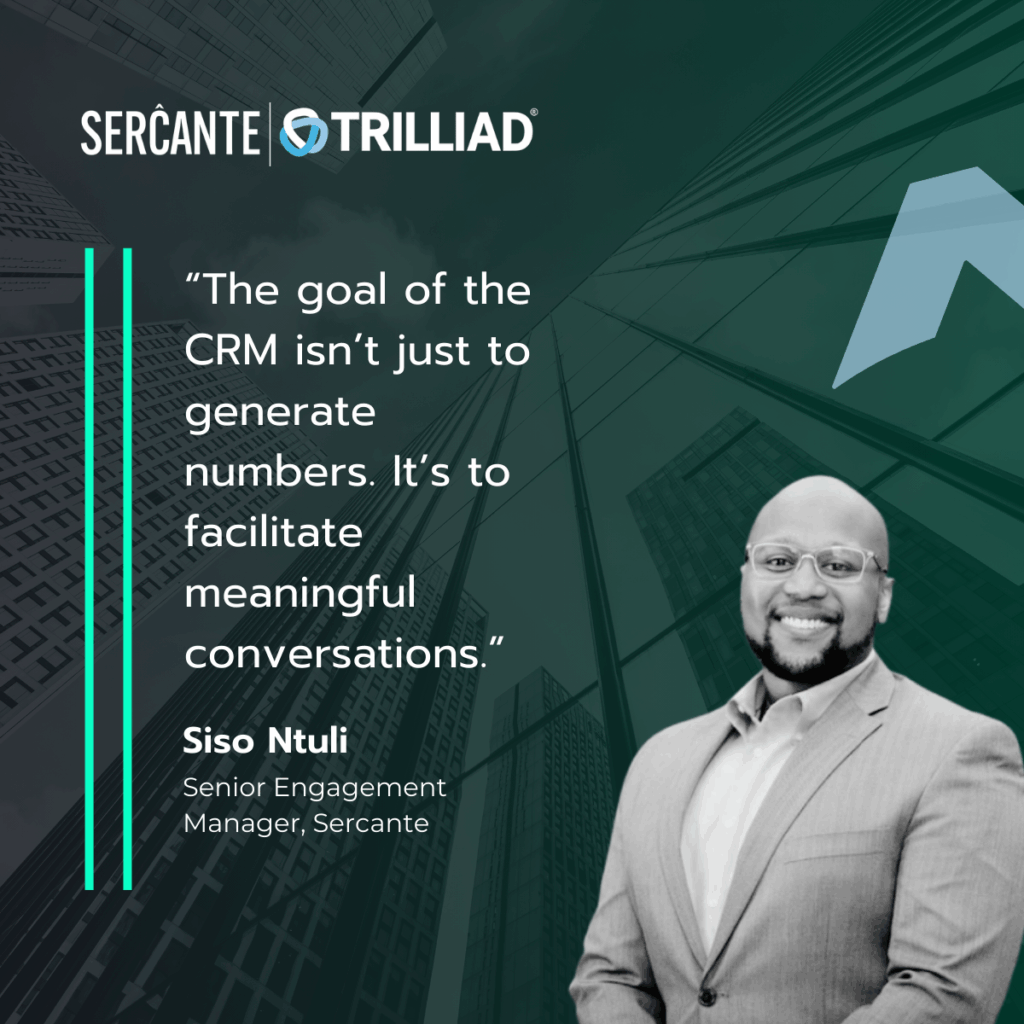
As Siso Ntuli, Senior Engagement Manager at Sercante, puts it: “The goal isn’t just to generate numbers. It’s to facilitate meaningful conversations”.

A quote from Siso Ntuli, Senior Engagement Manager at Sercante: The goal of the CRM isn't just to generate numbers. It's to facilitate meaningful conversations.

To turn your CRM into a growth accelerator, teams should take the following strategic steps:

  1. Map the processes: Outline every step of the sales process alongside the buying process to see how it currently aligns with your CRM setup to see where there is misalignment.
  2. Spot the silos: Identify swivel-chair work: tasks that force sellers out of the CRM and into spreadsheets or disparate systems.
  3. Identify opportunities for AI & automation: When thinking through the steps in the sales process, highlight the repetitive and mundane tasks that could be streamlined with AI and automation. This can free up time and brainpower for sellers, so they can focus more on the customer.
  4. Approach with a customer-centric mindset: As the team considers what improvements could be made to the CRM for the seller’s experience, ask: What will the end experience feel like to the buyer? Keeping this in mind will guide CRM optimization initiatives to be designed not just for internal processes, but for the experience the buyer expects.  

Shifting the mindset to approach the CRM as a system that can be a revenue driver rather than a roadblock for sellers, and keeping the buyer’s experience at the forefront, is the beginning of optimizing the CRM. The next step is understanding the current state of the CRM seller experience.

The CRM Seller Experience Scorecard

Getting a baseline from your sales team on what their experience and sentiment are with the CRM allows teams to identify in which areas they may want to improve first. 

Ntuli introduced the CRM Seller Experience Scorecard to evaluate the CRM across five key criteria:

  • Level of Adoption: Is the system easy to use, or do sellers dread logging in?
  • Level of Data Visibility: Is the must-have data readily available at their fingertips?
  • Level of Automation Use: Is automation being used to eliminate manual tasks?
  • Amount of Manual Data Entry: How much manual data entry is being done?
  • Data Reliability: Do sellers trust the data in the CRM?

Each area is rated on a scale of 1 – 10. Anything from 1 – 4 is the sign of a roadblock. Anything from 8 – 10 is considered optimized.

The CRM Seller Experience Scorecard

Download the CRM Seller Experience Scorecard to do this exercise with your team.

Any area that is identified as a roadblock shows teams where they might want to focus first. To ensure CRM optimizations are effective, Sercante’s Strategy Director, Jenna Packard, and Change Enablement Director, Debra Engels, recommend using a phased roadmap that considers the level of impact on the business, the level of effort to implement, and the effect it would have on the people involved. Tune into Part VI: Tech That Grows With You (Not Against You), of the Built to Buy series to hear their approach.

Built to Buy Part VI
Tech That Grows With You (Not Against You)
Speakers: Jenna Packard, Strategy Director, and Debra Engels, Change Enablement Director
Watch Now

A CRM Seller Experience That Drives Growth

A CRM that works against your sellers is a CRM that causes friction for your buyers. When sales can easily get what they need in the CRM, spend less time and brainpower on mundane tasks, be supported with reinforced training, and access key insights to have meaningful conversations, they have a seller experience in the CRM that supports meaningful conversations, building real connections that drive lasting growth. Giving today’s buyers the experience they expect.

Clunky handoffs between marketing, sales, and customer success are one of the most common ways teams lose momentum, drop leads, and tank trust—costing you customers. Whether it’s a hot prospect that never makes it into a rep’s queue or a new customer who has to re-explain everything they shared in discovery, these gaps compound. Which is why aligning sales, marketing, and customer success for seamless handoffs is so critical to delivering the smooth journeys today’s buyers expect.

The Sercante team shared their insights about how to approach aligning across teams for efficient transitions in Part II, Stop Dropping the Baton: Fix Your Handoffs, of our series, Built to Buy Designing the B2B Journeys Your Buyers Actually Want. The highlights from the conversation are below. Watch the full episode to get all the details.

Part II Stop Dropping the Baton: Fix Your Handoffs
Watch Now
Speakers: Angelica Cabral Demand Gen Marketing Manager and Sara Hernandez Senior Director of Delivery

Clunky handoffs are stunting your growth

When a buyer is easily transitioned from one department to the next, it breaks down their trust in your business. This loss of trust ultimately hurts the longevity of their potential relationship with you, impacting customer lifetime value before it has a chance to grow.

Other statistics show the impact on revenue when the teams don’t have strong cross-team collaboration for smooth handoffs.

  • 10%+ of annual revenue is lost due to poor cross-team alignment (Demandbase)
  • 70%+ of leads are wasted because of delayed response times (Credofy)
  • It’s 5x cheaper to retain a customer than to acquire a new one (Forbes)—yet many teams fumble the transition from sales to customer success, weakening loyalty and shrinking lifetime value.

You have probably seen the above statistics before, so why does this matter now? In today’s modern era, buyer expectations are higher than ever. People don’t have the patience anymore to wait around to be followed up with, repeat themselves over and over, and if they feel like a company isn’t in sync with them, they’ll move on to the next option. 80% of buyers say that the customer experience is as important as the product itself (cropink.com, 2025), while 77% of buyers said that their last purchase was very complex or difficult (Gartner). 

Therefore, creating stronger alignment and fixing your handoffs isn’t something that can be ignored.

Approaching alignment with a customer-first mindset

Approach these conversations through a customer-first lens. Think about it, if you were your buyer, what does the journey feel like today? What could be done to make it better? Answering these questions will help to focus your marketing, sales, and customer success teams around the same outcome: a seamless buying process. As you identify your areas of opportunity, write them down, and then soon you’ll be able to start digging into the customer lifecycle and the processes happening internally.

In Part I, Walk Your Funnel Like a Customer, of the series, the Sercante team shared their expertise on how to approach this exercise and then map your customer lifecycle to think about how you can define your stages, establish who owns what, improve data visibility, and create feedback loops.

Part I: Walk Your Funnel Like a Customer
Watch Now

Walk your funnel like a customer.
Take one of your latest customers and look at every touchpoint they had with you. How long did it take before they were followed up with? Were they waiting at all? At any point was the handoff clunky? Write it down and you’ll most likely find a few areas for improvement.

Map your stages and define ownership of each stage
Internally, what are all the stages of the customer lifecycle? Who’s responsible for what? What’s the entry and exit criteria for each stage? What happens during the transition? Make it clear.

Get the right data in front of the right people.
Visibility is everything. If customer success can’t see sales notes, or sales can’t see marketing engagement, your buyer is repeating themselves.

Build feedback loops into your process.
Alignment isn’t one and done. Create recurring meetings and shared reporting to stay in sync and fix issues before they grow.

Establishing this customer-first lens and starting to map your customer lifecycle helps to set your team up for success for the deep-dive alignment conversations throughout the different areas of the funnel.

From marketing to sales: clarify expectations with an SLA

There are several aspects that go into having strong cross-team collaboration across marketing and sales: accountability, trust, shared definitions, metrics, and reports. It can be overwhelming when looking at it as a whole. Therefore, one of the best ways to get started, as Angelica Cabral said, “Put it on paper.”

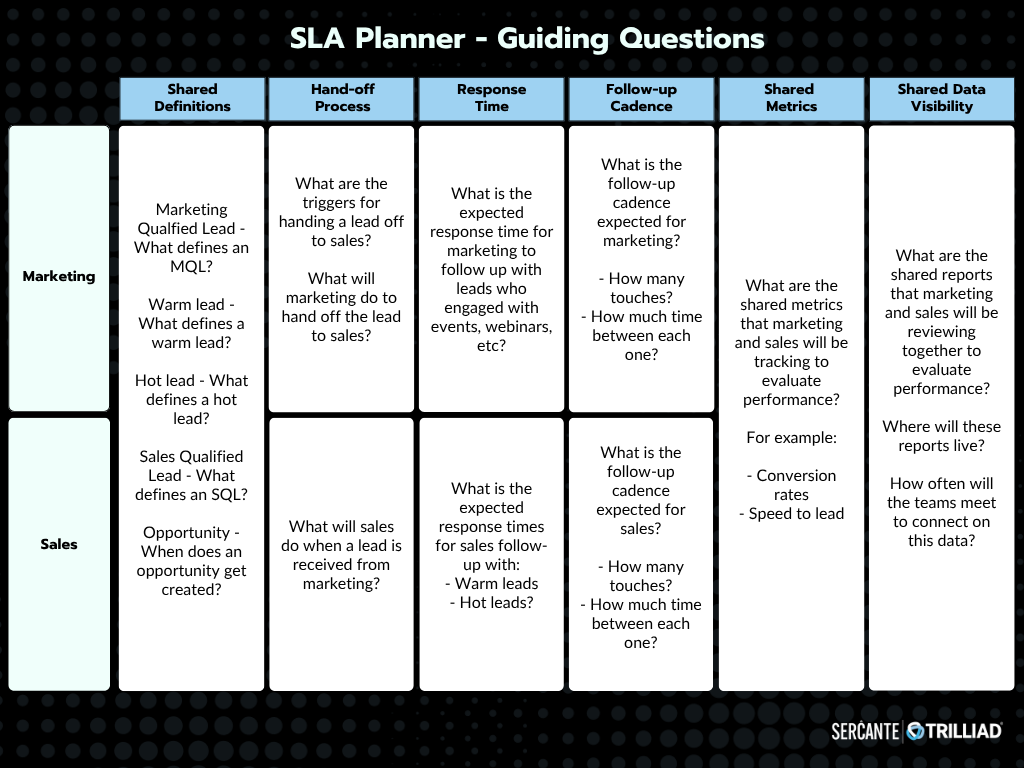
That’s where a Service Level Agreement (SLA) comes in. This doc helps teams define shared definitions, response expectations, and metrics for success. It doesn’t have to be fancy. But it does have to be clear.

Here are a few guiding questions to get started:

  • How do we define a Marketing Qualified Lead (MQL)? A Sales Qualified Lead (SQL)?
  • What triggers the lead handoff from marketing to sales?
  • What will marketing and sales do during the handoff?
  • What’s the expected response time from sales once a lead is handed off?
  • How many touches should sales make?
  • What metrics are both teams tracking (e.g., conversion rates, speed to lead)?
  • Where will shared reports live? How often will we review them?

You can use Sercante’s SLA planner to help organize all your thoughts and use that as a base for starting to build your roadmap.

Sercante's SLA Planner Guiding Questions

From sales to customer success: it’s a hand-hold

The customer lifespan doesn’t end at conversion. As a result, the collaboration between sales and customer success should act more “like a hand-hold” as Sara Hernandez put it, rather than a hand-off, to continue to grow the customer relationship.

To keep the experience connected, similar to the SLA exercise, the Sercante team shared the Post-Conversion Customer Alignment Guide that your teams can use to help approach the critical alignment conversations of how you’ll continue to coordinate in sync as the buyer converts.

Here are some guiding questions to get started:

  • What information needs to be shared from sales to customer success and vice versa?
  • What is the ideal timeframe to bring customer success into the loop?
  • Where should the deal context live (and how do we keep it updated)?
  • What KPIs are we tracking across sales and customer success (e.g., retention, upsell, NPS)?
  • How often are we meeting to review customer progress?

Having these conversations gives your team a starting point to understand where your gaps are, where you may already be aligned, and how you can start making improvements to deliver a better buyer experience.

Don’t stop at the planning phase

A word of caution to keep in mind is: after your teams have these alignment conversations and document everything, your alignment strategy then needs to be executed. According to the 2025 Trilliad Sustainable Growth Study, where 350+ senior B2B go-to-market leaders were interviewed, 1 in 3 admit that their alignment stops at the planning phase.

The 2025 Trilliad Sustainable Growth Study
The Integration Advantage: Sustainable B2B Growth Through Cross-Functional Alignment

Without actually executing your alignment strategy, change won’t happen, and your buyer will continue to feel clunky handoffs in the buying process.

Therefore, after you have your alignment strategy all set, take the next step and bring it into your technology, the systems that your go-to-market teams use every day, such as your CRM and marketing automation systems, to ensure that your SLA and Post-Conversion Alignment plans actually get put into practice for sustained alignment.

Seamless handoffs lead to scalable growth

At the end of the day, this isn’t just about process hygiene. It’s about the full experience your customer has with your brand and whether they choose to keep investing in that relationship.

By improving your internal handoffs, you can:

  • Deliver the buyer experience, your buyers actually want
  • Increase retention, loyalty, and customer lifetime value
  • Reduce lead leakage and missed opportunities
  • Strengthen cross-functional trust and accountability
  • And make it a whole lot easier to hit those revenue targets

Because when your teams are aligned, your buyer feels it. The experience is smoother. The trust is stronger. And the results? They start compounding. 

To bring in an expert resource and a strategic partner to help put your alignment goals in motion and build scalable processes that deliver seamless customer experiences, reach out to the Sercante team. We’ve helped thousands of teams succeed and bridge the gap between vision and reality for buyer experiences that build real connections and drive lasting growth.

In today’s modern era, where customer expectations are rising, new technology is coming out every day, and data is living among disparate systems, the key to achieving sustainable growth is proving to be about how your teams, data, and technology are connected and coordinated across the customer lifecycle. 

Why? Internal misalignment among people, processes, and technology creates leaky funnels, slows down pipeline, erodes customer trust, leads to churn, and decreases customer lifetime value. And when 80% of customers say that their experience is as important as the product itself (cropink.com, 2025), it’s clear that a negative customer journey will stunt your growth.

However, the challenge isn’t merely a “culture fix”. It takes strategic planning and coordinated execution to align your marketing, sales, and customer success teams across their processes, data, technology, and analytics through a customer-first lens.

To capture the state of this challenge, the 2025 Trilliad Sustainable Growth Study surveyed 350+ senior growth professionals and provides a playbook for how top performers structure teams, connect workflows, and measure what matters. Below are the 12 most critical statistics that should inform how you consider shaping your strategy for sustainable growth in today’s market.

The 2025 Trilliad Sustainable Growth Study

Growth is challenging, but it’s easier for integrated teams

Let’s level set, growth isn’t easy. When asked to assess the current sentiment around growth, go-to-market (GTM) leaders expressed that it’s becoming more challenging, but the ones who did find it to be easier were the ones who had integrated or joint leadership among their GTM teams.

  • 62% of leaders say growth is getting harder.
    • This feeling is widespread, but the study shows the problem isn’t just external. The single greatest internal roadblock is the lack of coordination between Marketing, Sales, and Customer Success, cited by 44% of respondents. Confirming that alignment is a key determining factor of your growth.
  • Organizations with “Integrated Leadership” are 3x more likely to find growth easier.
    • Integrated leadership means your Marketing, Sales, and CS functions are managed jointly around a single set of KPIs. Only 22% of organizations have adopted this high-performing model. If your leaders are held accountable to siloed metrics, rather than a shared goal, your teams will be driven toward optimizing in service of their own function, rather than in service of their customer, or to each other.

This is a mindset shift that needs to happen internally. Aligning around a shared vision of what the ideal customer experience should look like, around your revenue goals, and around the key metrics to be tracking to get there, becomes the north star that all three teams are marching toward to drive growth easier.

Each department may have its own alignment blind spots

Having cross-team alignment is critical to your growth, but a part of what might be standing in the way of getting aligned in the first place is that some teams may be feeling the disconnects more than others and therefore may not be seeing it as a priority.

  • 54% of Sales teams reported that they feel coordination pain, while only 33% of Customer Success (CS) teams feel the same.
    • This “pain gap” points directly to a process problem. The broken customer handoff occurs within your systems, and Sales, as the team closest to customer revenue expansion, is on the front line of that failure.
  • CS teams rate their organizational coordination significantly higher than other functions (8.33 vs. 7.36 for Sales).
    • This finding suggests a potential cross-team collaboration blind spot. CS teams may be achieving high internal cohesion, but this often happens in isolation from broader GTM processes. 

Marketing, sales, and customer success may all have their own internal thoughts on how well aligned they are cross-functionally, but this can lead to pain for the other departments, and worse, for your customer. Therefore, it’s critical when approaching alignment conversations to get all three teams in a room to think holistically about the customer experience and the shared metrics to track performance.

The customer isn’t thinking to themselves: Am I in a marketing experience, a sales, or a customer success experience? They just know that they’re having an experience with the brand as a whole. Therefore, if customers aren’t thinking about your organization in terms of siloed departments throughout their journey, you shouldn’t be either.

The alignment differentiator: going beyond planning

When it comes to aligning marketing, sales, and customer success, these teams may be strategically aligned, but the question is, are they actually executing it? The data shows that talking about alignment isn’t the same as doing it.

  • Only 27% of organizations say their teams are “fully integrated” across strategy, KPIs, planning, and execution, and 1 in 3 admit that their alignment stops at the planning phase.
    • Meaning the other 70%+ have gaps in how they are making alignment happen in their organization. Getting all your growth teams in a room to talk holistically about the customer journey and align on shared metrics is critical, but then there needs to be the next step of actually acting on the alignment strategy. Bringing this alignment into the technology that your GTM teams use daily is critical to going beyond the planning phase and achieving sustained collaboration.
  • Twice as many high-performing organizations as opposed to struggling ones (48% vs. 23%) are actually acting on their alignment strategy.
    • The key differentiator is action. High-performing organizations prioritize going beyond the planning phase and actively executing it. True integration is a unified process and a single source of truth built into your technology, not a recurring meeting.

Full customer journey data visibility is a must for seamless experiences

One of the ways to gauge your level of alignment is to approach the buying process through the eyes of your customer. If your customer is having to repeat themselves, waiting to be responded to, sharing their frustrations, or not being guided toward the best purchase, or their next best purchase, chances are there’s misalignment in your organization. A big piece of this is your data. Disconnected data prevents seamless experiences.

  • Only 12% of organizations rate their Customer Experience (CX) maturity as “Advanced.”
    • When your data is living in different systems and no one has a complete view of the customer journey, it can seem impossible to have an advanced CX—and with customers now rating the experience to be just as important as the product itself, teams can’t afford anything less than an advanced experience.
  • High-growth organizations are 50% more likely to use data across the “full customer journey.”
    • While 40% only use data for acquisition. The best teams are building their strategy around retention and expansion, not just new logos. To do this, marketing, sales, and customer success need visibility into the critical touchpoints happening throughout the entire customer journey.
      • How else is marketing supposed to know when to tee up a cross-sell campaign that triggers the customer to raise their hand and expand their relationship?
      • How else is sales and customer success supposed to know when an account is at risk and act proactively to ensure retention and reduce churn?

Sustainable growth requires moving past a “first-half” strategy to a truly “full journey” approach and this includes with your data how your technology is integrated to support this.

The path forward: aligning for sustainable growth

The data from the 2025 Trilliad Sustainable Growth Study confirms that alignment across marketing, sales, and customer success is critical to driving sustainable growth. However, this cannot stop at the planning phase, but needs to be executed in your technology and data strategy throughout the whole customer journey, not just at the acquisition stage. 

Prioritizing aligning your people, processes, and technology will deliver a smoother customer experience, leading to stronger brand loyalty, increased retention, and ultimately growth for your business.

If you’d like support with aligning your marketing, sales, and customer success teams across your customer lifecycle, reach out to the Sercante team. Our experts will listen to understand your goals, discover your friction points, and help develop a strategy as well as set up scalable processes for successful execution inside your data, technology, and analytics.

If you’re exploring Agentforce or Data Cloud, but feel unsure where to start—or how to ensure real outcomes—you’re not alone. In our recent webinar, “A No-Nonsense Guide to Launching Agentforce & Data Cloud,” we heard from marketing, RevOps pros, admins, and IT professionals across industries who are in the same boat.

The good news? You don’t need to launch a massive initiative to get started. But you do need a strategy. To help guide yours, I’ve shared the key concepts from the webinar where I spoke alongside Sercante’s VP of Growth & Alliances, Lauren Noonan, and Data Cloud Practice Director, Austin Frink, for our proven approach to creating a strategy for Agentforce & Data Cloud that sets you up for success.

A No-Nonsense Guide to Launching Agentforce and Data Cloud
Watch On Demand

Why having a strategy for Agentforce and Data Cloud is imperative

Implementing Agentforce or Data Cloud without a clearly defined strategy is like building a house without blueprints. According to RAND, over 80% of AI initiatives fail—not because the technology doesn’t work, but because teams skip over the foundational work of aligning their tools to real problems, realistic goals, and existing infrastructure.

What we’ve often experienced is that implementing these tools without a clear strategy often exposes existing challenges:

  • Data silos become more obvious.
  • Misaligned processes are harder to ignore.
  • Adoption falters because people don’t see the value.

When we’ve asked organizations about their vision or what they want to accomplish, we’ve heard many who say, “I want an agent” or “I want a unified profile.” While those are great aspirations, they are just starting points. A successful implementation requires more than a desire for automation or consolidated data. It requires a full vision of the why, the what, and the who.

Setting an impactful vision

Instead of focusing on the tool, focus on the challenge, the opportunity, and the people involved.

Ask yourself:

  • Why do we want an agent or a unified profile?
  • What business challenge are we solving?
  • What do we want the agent to actually do? / What will the data be used for?
  • How will the data or AI support better decisions?
  • Who will benefit, and how?

When considering these questions, be specific. If your starting point is, we want to have better segmentation or to deliver more personalized experiences, dig deeper. What would you like to segment by? Are there specific segments you’re focusing on for a business need? What part of the customer experience would you like to personalize more? Uncovering the more specific needs that lie within will help shape a more actionable vision.

Other questions you can consider for getting started to identify your use cases are:

  • Where are the friction points in your customer journey?
  • What repetitive tasks are your teams spending time on?
  • What segmentation or personalization capabilities are limited by your current data?

Use this framework to build your vision statement. Your vision should capture:

  • WHAT: The capabilities you’re adding
  • WHY: The impact those capabilities will have
  • WHO: The people in your organization who will benefit

This vision becomes your team’s north star. As you outline the use cases for Agentforce and Data Cloud, you will also need to define how they will impact the business.

Anchoring your Agentforce & Data Cloud use cases to business value

Lauren Noonan emphasized during the webinar, that this step is often missed, but it’s key to alignment. The use cases that drive meaningful business value are the ones that sustain momentum and stakeholder support.

To help frame your use cases in terms of the level of impact, consider impact levels such as the following:

  • High: Critical to strategic goals or revenue
  • Medium: Important contributor to organizational priorities
  • Low: Helpful improvements, but not game-changing

For example, one Agentforce use case that would be considered higher impact would be streamlining lead qualification and routing.

Use Case: AI-Powered Lead Qualification & Routing Agent
Scenario: Deploy an Agentforce assistant that engages with inbound demo requests, asks qualifying questions (budget, timeline, decision-maker status), and routes hot leads to the correct rep in real-time based on region, product, or account type.
Why It’s High Value:

  • Directly impacts pipeline acceleration and conversion rates
  • Reduces lead response time, which is closely tied to revenue performance
  • Supports strategic goals around improving sales velocity and rep productivity
  • Teams Impacted: Marketing Ops, Sales Development, Revenue Leadership, Prospects, Customers

Notice how the above framing points to impacts such as increased pipeline velocity and speed to lead which leads to higher conversion rates, all tied to revenue.

Medium to low-impact Agentforce use cases might include ones that result in internal efficiency gains, such as streamlining campaign brief creation or surfacing answers to FAQs faster using articles from your knowledge base. However, these lower-impact use cases are often a low-risk and lower level of effort to deploy, so they can be a great starting point as small efficiency gains do add up and free up your team’s time to focus on higher-impact initiatives. Continue to weigh this as you frame your roadmap of priorities.

The other detail to call out from the lead qualification and routing Agentforce example is that it outlined the people who would be impacted. Which is often overlooked, but absolutely necessary when creating your strategy.

Considering the level of impact on your people

Agentforce and Data Cloud aren’t just technical implementations—they’re changes to how people work. According to CIO Dive, 42% of businesses have scrapped most of their AI initiatives in the last year, where studies have shown that the teams that see success are ones that are customizing their use cases and prioritizing them according to their needs and impact. As Lauren shared in her previous article on how to create your AI roadmap, “your unique AI path is the only one that matters.”

You have a unique set of people at your organization with different skill levels, needs, and talents. Not considering a change management plan for how your Agentforce and Data Cloud rollout will be applied will often lead to low adoption rates, causing a low level of success and your initiative to fizzle out.

That’s why it’s so important to assess:

  • How will workflows shift?
  • What training or enablement will be needed?
  • How disruptive will this be to current roles?

Then classify the level of impact on your people:

  • High: Many roles and processes change significantly
  • Medium: Moderate impact with some changes to roles or responsibilities
  • Low: Minimal disruption to current workflows

Evaluating the level of business value alongside the level of impact on your people will help determine which use cases you might want to prioritize first based on the level of effort to deploy.

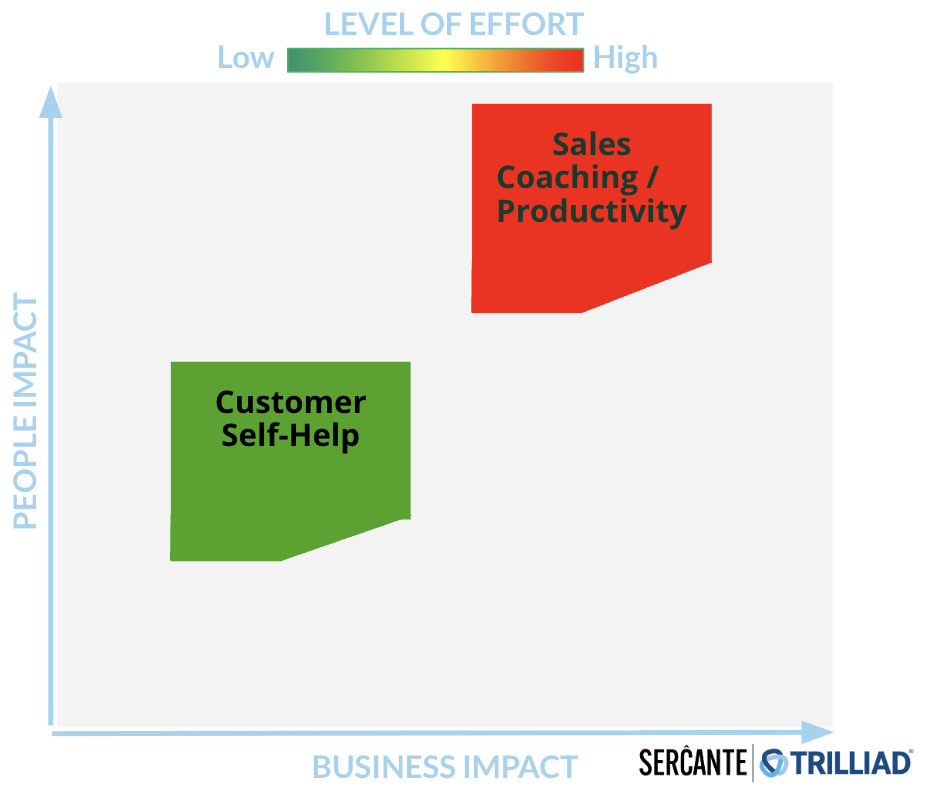
During the webinar, we showed the chart below as a visualization of the ideal intersection point, which is medium-to-high business impact and low-to-medium people impact, with a lower level of effort to deploy.

A chart that shows the business impact on the x-axis and the people impact on the y-axis with the level of of effort ranging from low to high above. On the chart, Customer Self-Help is plotted on the low to medium business impact level and medium people impact with a lower level of effort. Sales coaching/productivity is mapped at higher level of effort, business impact and people impact.

Take your considerations of the people impact a step further with this on-demand MarDreamin’ Session: Empowering Your People: Nailing Change Enablement for AI Rollouts by Director of Change Enablement at Sercante, Debra Engles. 

The other aspect of your strategy that needs to be considered is the dependencies involved with deploying your use case for Agentforce and Data Cloud.

Understanding your dependencies

As Austin Frink and I emphasized in the webinar: implementation depends on more than just ideas. You need to understand the full picture of what it’ll take to make your use case a reality. That full picture includes the infrastructure that you have, including:

  • Technology: What do you already have? Where are the gaps?
  • Data: Do you have the right data sources? Are they integrated? Is the quality strong enough?
  • People & process: Who owns what? Where will the lift be felt most?

Dependencies aren’t necessarily roadblocks, but more factors that will help you to decide where you might want to start when it comes to implementing technology like Agentforce and Data Cloud.

The last piece to consider when defining your strategy is the metrics you’ll use to measure the impact of your Agentforce and Data Cloud initiative.

Defining your metrics for measurement

Your metrics will be used to help prove the business values that you defined earlier. For every use case, identify one or two key success metrics. Before you start your Agentforce and Data Cloud project, measure where you are right now to get a baseline, so that you can benchmark later on and compare your level of improvement.

Some ideas:

  • Customer satisfaction
  • Campaign performance
  • Churn rate

Ideas of metrics that could be associated with our Agentforce use case example of lead qualification and routing, would be speed to lead, conversion rate, and sales cycle time. If your use case will focus more on efficiency gains, consider the amount of time it takes your team to perform the task without the agent implemented, and then measure the hours of time that are saved as a result.

Pro tip: When bringing your strategy to stakeholders, share what your team will accomplish with the time gained back. This goes beyond just thinking through the metrics, and it will be key when articulating the full picture of the impact that implementing Agentforce and Data Cloud can have on your business.

Identifying a success metric is one part of it, you also want to make sure you have defined how that metric will be tracked and validated. For example, will it come from Salesforce, Data Cloud or an external system? Consider, are you capturing the fields that are needed for that metric today?

Also, don’t forget to capture a pre-project snapshot of your metric. Without a clean, documented baseline gathered before any implementation, you lose the ability to accurately show ROI.

Common misconception: you don’t need to start with a massive rollout

One of the most common misconceptions when teams are thinking about implementing Agentforce and Data Cloud is that it requires a massive rollout and overhaul. However, this is not the case.

You don’t have to ingest all your data to use Data Cloud. You don’t need to first implement Agentforce into every aspect of your business.

Start with:

  • 1–2 use cases
  • Lower people impact
  • Medium-to-high business value

Clearly defining your use cases will inform you of the data that you’ll need, which will then point to the data sources required. The use case will then point to the agent that you’ll need and the teams or subsect of a department that will be impacted. 

As the CMO of Mogli, Christina Scarmeas, shared during her conversation with us about how her team approached implementing Agentforce, “It’s okay to take a crawl, walk, run approach.”

Using AI and Agentforce to Make it Easier to Text on Salesforce
Watch On Demand

Which is why Sercante service offerings such as an Agentforce Quickstart or Data Cloud In-A-Box are so helpful for teams. They enable you to start small, accelerate time-to-value, and showcase the impact, to then scale the initiative to other areas of the business.

Let’s get started with your approach to Agentforce and Data Cloud

To recap, a successful approach to Agentforce and Data Cloud includes:

  • A clear, problem-driven vision
  • Use cases tied to real business value
  • Understanding the people impact
  • Mapping your technology and data dependencies
  • Identifying the metrics that will be used to measure impact

Having this all defined will help to serve as your team’s north star to guide a successful approach to Agentforce and Data Cloud.

Now I know how it can be overwhelming to think through all of this, especially with multiple department goals and initiatives, so if you’d like support with creating your Agentforce and Data Cloud strategy, reach out to the Sercante team. We’ll listen to understand your goals, challenges, and help bridge the gap between your vision and reality, for an impactful Agentforce and Data Cloud rollout.

Create Your Roadmap with the Experts
Contact Us

If you’re feeling overwhelmed with AI at your organization, you’re not alone. In fact, during our recent webinar, AI Roadmap: The Strategy to Drive Growth with AI, 85% of attendees said they were either leading or supporting AI initiatives at their organization. And 70% of them admitted they had more questions than answers. Therefore, we’re sharing our proven approach for creating an AI roadmap that results in meaningful impact, to be a guide for growth leaders who are navigating AI for their organizations.

Why an AI roadmap matters

Just like any other solution, implementing AI without a set strategy and a plan for how it will be used, the goal you’re after, the dependencies to consider, and enablement for your team, is only going to hold you back from maximizing its value. If anything, diving in without a strategy will most likely highlight your gaps in processes, data, and alignment.

According to RAND, 80% of AI projects fail due to a misalignment of the problem being solved, not having adequate data, or a lack of infrastructure and readiness. These causes for failure can be avoided if teams take the time up front to think through their strategy. As the CMO of Mogli, Christina Scarmeas, shared from her episode, Using AI & Agentforce to Make it Easier to Text on Salesforce (Watch here), “The biggest thing that we learned was it’s okay to take a crawl, walk, run approach…if you put that infrastructure together and actually have a team that’s dedicated to the strategy behind [AI], the results come fast.”

Therefore, when navigating AI and rolling it out in your organization, don’t skip the important step of defining your strategy and building your roadmap. When considering how to start thinking through your strategy for AI, use the steps below from our proven approach to get started.

The CMO of Mogli, Christina Scarmeas, quote "If you have a team that's dedicated to the strategy of AI, the results come fast."

And if you’re ready to take action to start creating your customized AI roadmap with the guidance from our experts, check out our AI Workshop: Building Your Roadmap for Real Impact.

AI Workshop: Building Your Roadmap for Real Impact Sign Up

The Proven Approach to Create Your AI Roadmap

When thinking through your strategy for how to get started with AI, you want to start with your use cases and the goals you want to accomplish. Then, using your use cases and goals as the foundation allows you to tie to the business value and consider the data needed, the dependencies, and the impact it will have on your people for change management, so your first step is to frame your vision.

Start with the vision

To get the ideas started, think about your team’s daily workflows. Where are the friction points in their day? What repetitive tasks are slowing people down? Where is your time being taken, or where are you missing opportunities? That can start to highlight a few efficiency gains you could get from implementing AI for internal use cases.

Most importantly, you also want to think about your customer journey. Where are the friction points for the customer? What transition points could be made more seamless if AI were used? Taking this customer-centric approach will then highlight use cases where AI could be deployed for externally facing engagements.

As you identify your use cases, start defining the goals you want to accomplish. For example, if you implement AI to assist with lead qualification, what is the desired result you want to come out of that? What is the problem being solved, and what will success look like?

Then combine everything into one vision statement. The vision statement should capture:

  • WHO: The people involved who will benefit from the implementation
  • WHAT: The capabilities that will be added to your organization
  • WHY: The impact that is expected as a result
Director, Marketing Innovation & Technology, Zebra Technologies, Johanna Lehner, quote "The use case is the most important to define. Everything else should follow and be aligned."

This is the most critical step, and leaders who have started down this path of approaching AI for their organization agree. The Director of Marketing Innovation & Technology at Zebra Technologies, Johanna Lehner, shared on her episode, Future-Proofing Technology Through Impact-Driven Use Cases (Watch here), that“The use case is the most important thing you want to define…so that you’re thinking about what that process looks like in order to meet that goal or accomplish that use case in the most efficient and effective way possible. I would say that’s the most important thing, everything else should follow and be aligned with those goals that you’re trying to accomplish with the tool.”

Your vision becomes your north star that guides your team through the rest of the AI roadmap process.

Anchor it to the business value

This is where we shift from “wouldn’t it be cool if…” to “here’s why it matters.” For every use case you consider, think about what value it would add to your organization. Does it drive revenue? Improve customer satisfaction? Shorten the sales cycle? Some use cases will be mission-critical, while others might be helpful but not game-changing. For each use case, frame if it would be a high, medium, or low level of value. 

  • High: Critical to the organization’s strategic goals
  • Medium: Important and contributes to the organization’s goals
  • Low: Has a minimal direct impact on the organization’s strategic goals, financial performance, or overall operations

Framing the level of business value will help guide the team’s decision-making later when choosing which use cases to prioritize first. But, in addition to the level of business value, you also have to consider the level of impact on your people.

Evaluating the impact on your people

Let’s be clear: AI is a people thing. Yes, it’s tech. But adopting it requires real humans to shift how they work. That means you need to map the impact. Will an initiative completely overhaul someone’s role? Or just take a few manual tasks off their plate? The more disruption, the more intentional you need to be about change enablement. Low-impact projects might require just a little training. High-impact ones? Those need a communication plan, champions, and a solid support structure. Therefore, for each use case, you’ll also want to define the level of impact on your people.

  • High: Many roles are impacted, many processes will change, and roles will be redesigned
  • Medium: Some roles are impacted, some processes will change, and roles might change slightly
  • Low: Very few roles are impacted, minimal process changes, and no role restructuring will be needed

As you consider the level of business value and how your people will be affected by the AI solution implemented, this thought process will highlight the level of effort that would be required for rollout. This is where finding the ideal sweet spot comes in for all three when considering which use cases to prioritize first on your roadmap.

Finding your sweet spot

Every use case you explore should be evaluated based on three things: the value it delivers, the impact on your people, and the level of effort it will take to implement. Think of this like a chart where you’re looking for where the ideal points intersect. The sweet spot with medium to high business value, relatively low people disruption, and feasible to get off the ground. We’ve seen many organizations start with internal processes to get some efficiency gains as a starting proof of concept. However, these small efficiency wins are not to be overlooked as they add up to greater impact and make the customer experience feel that much more seamless.  experience feel that much more seamless. 

A chart visualizing the examples of two AI use cases: Sales Coaching/Productivity and Customer Self-Help and where they fall on the chart measuring Business Impact on the x-axis, People Impact on the y-axis, and also the Level of Effort at the top.

For example, Advanta Health partnered with Sercante to implement Agentforce to help scale their member services team and address the needs of their growing customer base. The solution surfaced answers to FAQs faster, using their Knowledge articles, assisting the service team, and cutting down on their handle time, while making responses more consistent across the board. As a result, members reaching out with inquiries experience a more streamlined engagement that gets them the answers to their questions faster.

Advanta Health Scaling Member Services with Agentforce Read Case Study

Therefore, when considering which use cases to start with first on your roadmap, use the “sweet spot” to guide you, and don’t underestimate the impact that can come from small efficiency gains. 

Once you start to get an idea of the use cases you might want to start with, based on where they land among the level of business value, people impact, and effort to deploy, the other important piece you need to consider, which will impact your level of effort, is your dependencies.

Map your dependencies

This is the part of the roadmap where things can get messy if you don’t slow down and look under the hood. Before rolling out anything new, you need to assess what it’s going to take to support it. Do your systems talk to each other? Is your data accessible and clean? Do you have a governance structure in place? Do your people have time and capacity to manage the shift? These aren’t roadblocks—they’re flags that help you build smarter. Ignoring them can cause your AI project to fail.

Here are some starting questions to ask yourself to help identify your dependencies:

Technology

  • What technologies do you already have?
  • Do you have gaps in technology needs based on the use cases?
  • What will it take to close these gaps?

Data

  • What data will AI need access to?
  • Do you have data sources that are not integrated today?
  • Do you have data quality issues?

People

  • What teams/roles are impacted by these AI use cases?
  • What amount of time will AI unlock for these teams?  What can they focus on instead?

As you think through the dependencies for each use case, this can help give you a clearer idea of the level of effort it would take and then better inform which use cases truly fall in the sweet spot.

Then last, but certainly not least, if you didn’t already think through the metrics you’ll use to measure success when defining your goals in the first step, this is where you’ll want to do that.

Define your success metrics

If you want to prove AI is working, you need to measure it. Tie every use case to a clear outcome. That might be lead conversion, campaign ROI, sales cycle length, or something else entirely. Pick metrics that matter to your business and are realistically measurable. And don’t wait until you’ve rolled something out to start tracking. Get benchmarks in place now so you can show progress early and often.

A final word of wisdom

The final and last piece of wisdom when thinking about your approach to AI is your unique AI path is the only one that matters. Now is not the time to be a copycat with AI. The chatter I keep hearing is, “What are other companies doing? What are their use cases?  How quickly can we implement those use cases at our organization?” And frankly, it feels dangerous.

Why? Because the last decade has left every single company with a unique technological fingerprint. We all have our own way of working, our own internal processes, and a pile of tech debt and data quality issues to go along with it.

Thinking you can just copy someone else’s AI strategy is like trying to replicate a recipe with totally different ingredients. The output is destined to be different. The truth is, the successful path isn’t about looking outward. It’s about looking inward.

Therefore, when thinking through your AI strategy, don’t be so concerned about what everyone else is doing, focus on what will drive value for your customers and your business.

Getting started on your AI Roadmap

Creating an AI roadmap is about solving real problems in a way that supports your people, your business goals, and your vision. It is your guide to rolling out a successful AI solution that empowers your people to focus on the most important initiatives and deliver a seamless experience for your customers.
If you’re ready to dive in to start building your AI roadmap and would like an expert guide to take you through step by step, of defining your vision and use cases and creating your prioritized roadmap, reach out to the Sercante team. We’ve helped many organizations get on the right path to maximizing AI for their organization and driving meaningful business impact with our AI Roadmap offering.

Discover what's possible with the AI Roadmap

No more posts to show