Category

Catherine Williams

Accelerating Marketing Automation with Pre-Built Salesforce Flow Templates

Building effective marketing automation takes time, and staring at a blank canvas can often delay your first campaign. With Agentforce Marketing (aka Marketing Cloud Next), you can bypass those early hurdles with six out-of-the-box flow templates designed to accelerate your path from idea to execution.

Instead of building common campaign patterns from scratch, you can now select a proven framework, customize it to your business needs, and launch faster. These templates don’t replace your marketing strategy—they accelerate it, providing the structure and foundational assets you need to focus on what truly differentiates your brand: messaging, personalization, and customer experience.

Why Flow Templates Matter for Marketers

Marketing automation success is not just about sending emails. It’s about creating relevant, timely experiences that guide customers through their relationship with a brand.

These flow templates help marketers:

  • Reduce implementation time: Launch common marketing journeys faster.
  • Create consistency across campaigns: Follow proven automation patterns.
  • Focus on what matters: Spend less time building and more time optimizing.

For organizations adopting Agentforce Marketing, these templates spark a critical shift in focus: What does this experience need to accomplish now?

Register for the Agentforce Marketing Flow Fundamentals Workshop.

Learn how to build your own Flows in Agentforce Marketing with this expert-led workshop.  Register here.

How to Access the New Flow Templates

The new templates are available directly within the campaign creation experience. 

To access them:

  • Open the Marketing app
  • Navigate to Campaigns
  • Select Add New to create a campaign
  • Fill out details on the campaign creation pop-up window
  • Enter your campaign details and check the “Active” box

Once in the campaign workspace, look to the  “Let’s build your campaign” section, scroll down to “Need a faster start? Browse templates.” 

Selecting Browse Templates opens up the available Salesforce-created flow templates. 

From here, marketers can select the template that best matches their campaign goal and use it as the foundation for their automation. 

After selecting the template, you’ll be guided through the configuration process, including automation settings within the flow template itself. 
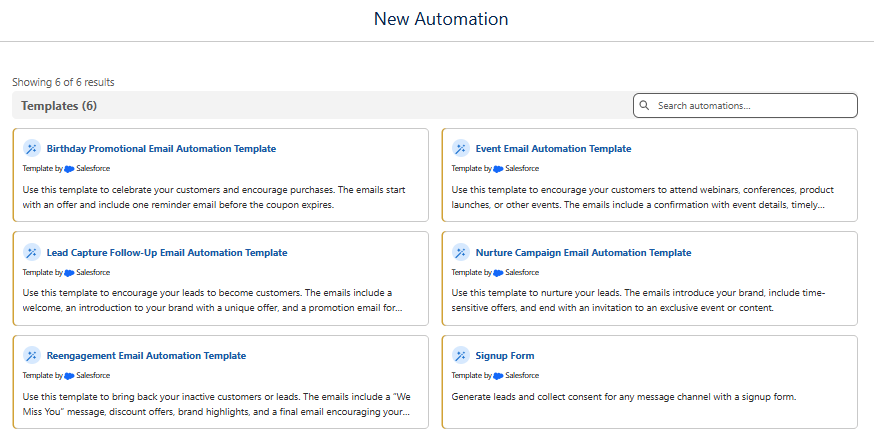
Creating a new automation and choosing which template you want.

Inside the Templates: Six Salesforce-Designed Marketing Journeys

1. Birthday Promotional Email Automation Template

What It Does:

The birthday promotional email automation template helps organizations celebrate customers while encouraging repeat purchases through a personalized promotional experience.

This template for organizations looking to create a simple but effective customer engagement moment to:

  • Recognize a customer’s birthday
  • Provide an offer
  • Encourage action before the promotion expires

Inside the Flow:

This is a segment-triggered flow. The template includes:

  • Birthday offer email
  • Birthday offer reminder email

Why It Matters:

Birthday campaigns are great examples of personalized lifecycle marketing. They create a meaningful customer touchpoint while encouraging engagement. This template removes the need to build the basic journey structure manually, allowing marketers to focus on the offer, branding, and customer experience.

Pro-Tip: Before activating a birthday automation, validate that your customer birthday data is accurate and consistently maintained. Personalization is only effective when the underlying data is reliable.
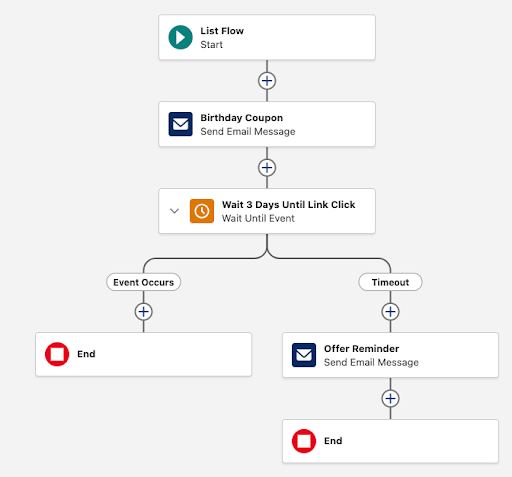
Setting up a birthday automation.

2. Lead Capture Follow-Up Email Automation Template

What It Does:

The lead capture follow-up email automation template helps organizations convert new leads into engaged prospects through an automated welcome and nurture experience. This is one of the templates I expect many B2B organizations will recognize the value of because lead follow-up is one of the most common marketing automation use cases.

Inside the Flow:

This is an event-triggered flow. The template includes:

  • Lead capture welcome email
  • Lead capture product email
  • Lead capture brand value proposition email

Why It Matters:

Many organizations invest heavily in generating leads but struggle with what happens next. This template creates an immediate, consistent follow-up experience by helping organizations welcome new prospects, introduce their brand, highlight products or services, and provide valuable resources.

Pro-Tip: This is one of the templates I would recommend reviewing early during an Agentforce Marketing implementation. It provides a strong foundation for lead nurturing while allowing marketers to focus on content strategy and personalization.
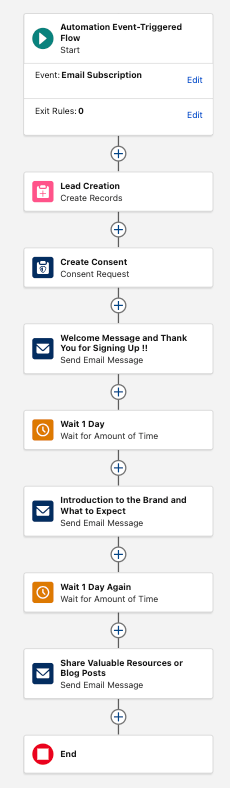
Setting up an automation event-triggered flow.

3. Reengagement Email Automation Template

What It Does:

The reengagement email automation template helps organizations reconnect with inactive customers or leads. Instead of continuing to send the same messaging to disengaged audiences, this template creates an intentional journey designed to win customers back.

Inside the Flow:

This is a segment-triggered flow. The template includes:

  • “We miss you” email
  • Benefits and social proof email
  • Second discount offer/reminder email
  • Final call to action email

Why It Matters:

A mature marketing strategy is not only about acquiring new customers. It’s also about understanding and improving engagement with existing audiences. This template helps marketers reconnect with inactive contacts using incentives strategically, reduce unnecessary communication, and create clear exit paths.

Pro-Tip: Define what “inactive” means before activating the flow. A customer inactive for 30 days may require a different approach than someone who has not been engaged in over a year.
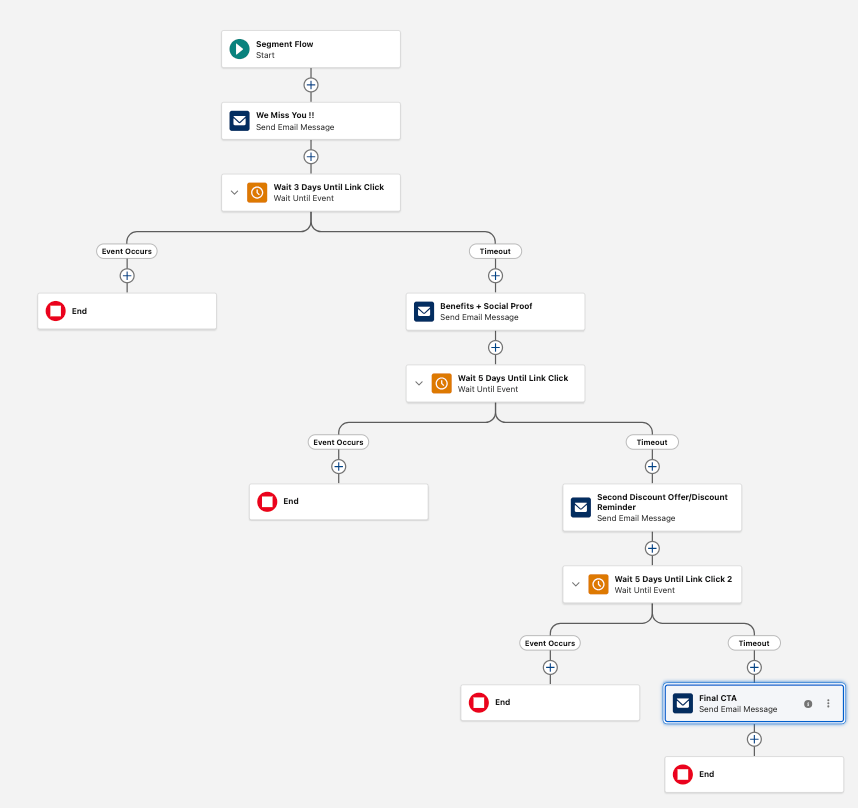
Setting up a template that is meant to reconnect with inactive customers or leads.

4. Event Email Automation Template

What It Does: 

The event email automation template helps marketers manage communications before and after webinars, conferences, product launches, and other events. Successful events require more than registration emails. Customers need reminders, confirmations, and meaningful follow-up.

Inside the Flow: 

This is a segment-triggered flow. The template includes:

  • Event registration confirmation
  • Event one-week reminder
  • Event one-day reminder
  • Event attended follow-up
  • Event did not attend follow-up

Why It Matters: 

This template extends the customer experience beyond attendance. We also recommend using Campaign Member and Campaign Member Status to track attendance, creating strong alignment between marketing engagement and CRM reporting.

Pro-Tip: Many teams focus heavily on driving registrations, but underestimate the value of post-event communication. The follow-up experience is often where the strongest conversion opportunities happen.
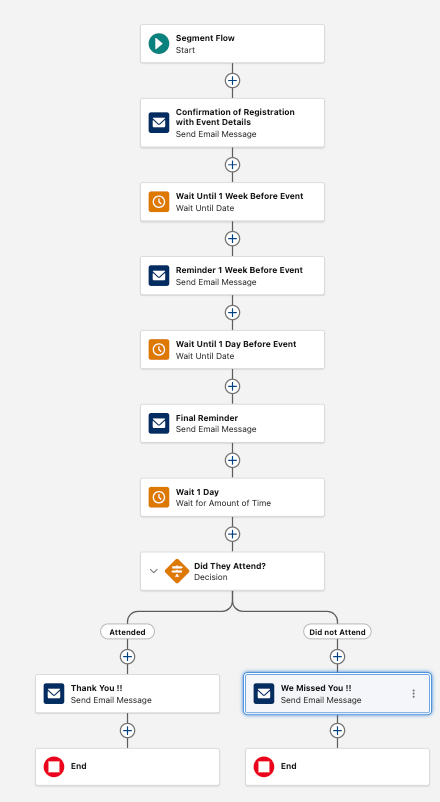
Setting up an event email automation template.

5. Nurture Campaign Email Automation Template

What It Does: 

The nurture campaign email automation template helps organizations build ongoing relationships with leads through a structured engagement journey. This is especially valuable for B2B organizations with longer buying cycles, where prospects need education and trust-building before making a decision.

Inside the Flow: 

This is a segment-triggered flow. The template includes:

  • Welcome to our brand
  • Exclusive event or content invitation
  • Exclusive offer ends soon

Why It Matters: 

Effective nurturing is about responding to customer behavior, not just following a schedule. The built-in decision paths help ensure that engaged prospects do not continue receiving irrelevant communications.

Pro-Tip: Define your entry criteria, engagement signals, and exit strategy before launching a nurture journey. The technology enables automation, but your strategic rules drive its success.
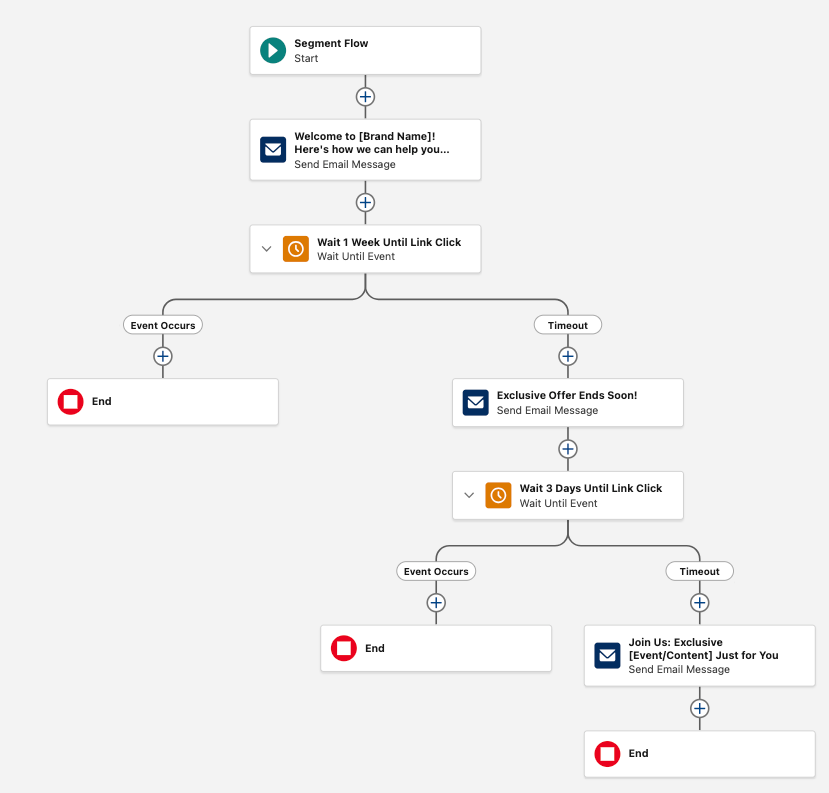
Setting up a nurture campaign email automation template.

6. Signup Form Automation Template

What It Does: The signup form template walks the user through what is needed to build a new form, such as Data Source, Fields, Form Content, and an optional Landing Page. This template also captures consent for communications immediately upon form submission.

Inside the Flow: This is an event-triggered flow. The journey follows this sequence:

  1. Customer submits form
  2. Create record
  3. Create consent request
  4. End flow
Setting up a signup form automation template.

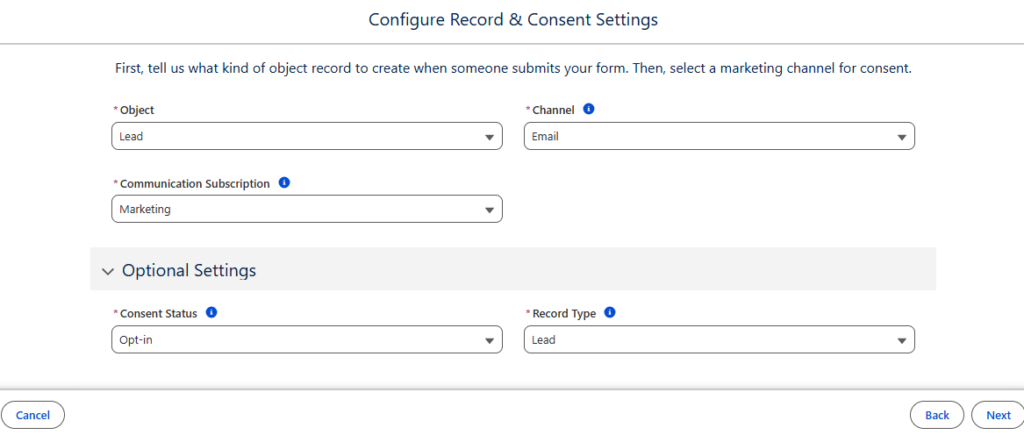
During configuration, marketers define the record type created (options include Lead, Contact, or Account), the marketing channel, the communication channel (Email or SMS), the consent status, and specific record type settings.
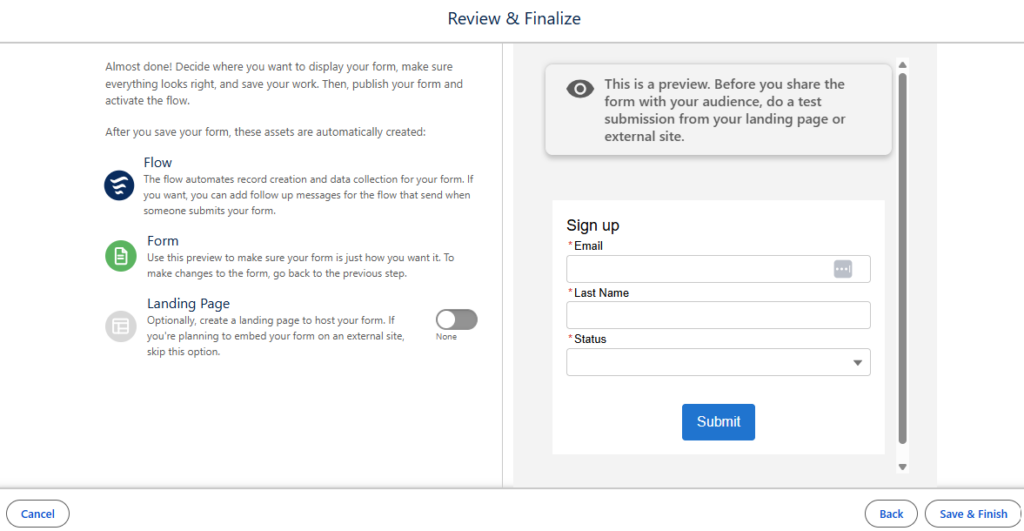
Reviewing and finalizing the form.

Why It Matters: Strong marketing automation starts with strong data practices. This template connects lead generation, data creation, and consent management into one unified, automated process.

Pro-Tip: Before activating this flow, confirm your organization’s data model and consent strategy. Decide what records should be created, what information sales needs, and how communication preferences should be managed.

For more tips on building Agentforce Marketing Forms, check out the Building Better Form Flows with The New Agentforce Marketing Flow Template blog post. 
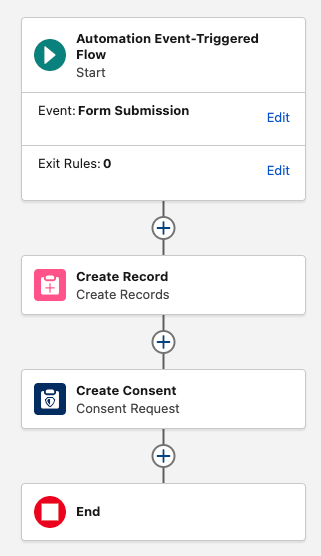
Automation event-triggered flow template.

Summary of Flows 

Flow NameTrigger TypePrimary Benefit
Birthday Promotional Email AutomationSegmentCelebrates customers and encourages repeat purchases with personalized offers.
Lead Capture Follow-Up Email AutomationEventConverts new leads into engaged prospects via automated welcome and nurture journeys.
Reengagement Email AutomationSegmentReconnects with inactive customers or leads through strategic, incentivized re-engagement.
Event Email AutomationSegmentManages end-to-end communications for webinars, conferences, and product launches.
Nurture Campaign Email AutomationSegmentBuilds long-term relationships through structured, behavior-based engagement journeys.
Signup Form AutomationEventCaptures consent and automates record creation immediately upon form submission.

Moving from Building Automation to Optimizing Experience

The six flow templates in Agentforce Marketing represent an important shift in how organizations approach marketing automation. Instead of spending hours recreating common journeys, marketers now have pre-designed frameworks that provide a strong starting point. Whether you are launching a lead nurture program, reconnecting with inactive customers, managing an event experience, or capturing new subscribers, these templates help reduce implementation effort and accelerate time to value.

The future of marketing automation is not about removing the marketer from the process. It’s about removing repetitive work so marketers can spend more time where they provide the most value: understanding customers, creating meaningful experiences, and driving business growth. Open the Agentforce Marketing app today, explore the new templates, and see how much faster you can get your next campaign live.

Need Assistance?

If you need any assistance with your Agentforce Marketing platform, please reach out to the Sercante l Trilliad team! We would be happy to help you navigate your next steps in starting to use the platform alongside your existing technology to drive better results.


Contact the Sercante | Trilliad team for help with your Agentforce Marketing Platform.

Living in a fast-paced world of technology, it’s easy to get caught up in the whirlwind of innovation and lose sight of the human element. We can occasionally prioritize the tools and systems we use over the people who rely on them. 

I had the honor of attending Florida Dreamin’ in October 2023. I was especially inspired by one session in particular.

Here’s a summary of that session.

Insights from Daniel Gorton’s Florida Dreamin’ Presentation

Daniel Gorton, a Salesforce architect with a unique background in social work and psychology, recently delivered a thought-provoking presentation at Florida Dreamin’ that reminded us of the importance of centering people within our technology discussions.

Here are the insights he shared.

Asking The Right Questions

Gorton, who defines himself as an “empathetic and multi-centered Salesforce architect,” captivated the audience with his perspective at the intersection of technology and social work. He posed essential questions that challenge our approach to change and user experiences, asking, “What are some ways we can be inclusive and intentional with change?” and “How do we make sure everyone has their needs met?”

Consider Learning Styles and Needs

One of the key takeaways from his presentation was the emphasis on inclusivity, considering diverse learning styles and needs. Gorton reminded us that individuals have varying comfort and experience levels with technology. This message couldn’t be more relevant as we continue to integrate artificial intelligence into our daily lives. In a separate presentation during Florida Dreamin where the A.I. Lay’s campaign “Messi Messages” came up and an audience member asked, “Just because we can, does it mean we should?” which reflects the unease many feel when confronted with different and evolving types of technology. 

Change management was also a focus of Gorton’s presentation. He stressed the importance of not just looking at systems but also focusing on the people behind it — those who build, test, approve, and use it. Gorton encouraged us to add value and create experiences that anticipate users’ needs, ultimately leading to joy and delight. He reminded us that even small gestures, like adding emojis, can brighten someone’s mood. Additionally, he underlined the fact that users teach us valuable lessons in the process.

Where Empathy and Strategy Meet 

Combining our empathetic sides with strategic approaches, such as focus groups, road mapping, and well-defined processes, can help bridge the gap between technology, those who work in it, and the end users.

Gorton urged the audience to “consider organizational context, system performance, & Salesforce well-architected best practices.” He provided several examples of how Sales Cloud does this today, citing Path as one of the easiest-to-offer UI features. 

Gorton also provided insights into best practices for training, emphasizing the importance of feedback and requests, encouraging feedback loops, and breaking down silos. He encouraged us not to be afraid to iterate and build slowly, ensuring that we can fine-tune our solutions over time.

Finally, Daniel Gorton’s presentation was a reminder that technology should enhance human experiences, not overshadow them. By being more inclusive, empathetic, and thoughtful in our approach, we can create solutions that bring not only use but also delight users. Let’s reflect on Gorton’s insights and let them serve as a valuable guide for how each of us can navigate through the intersection of technology and the people behind those systems. 

Get More Highlights from Florida Dreamin’

Be sure to check out these other posts from my fellow dragons who attended Florida Dreamin’ with me and shared details about their favorite sessions there.

Imagine this — your marketing team is generating more leads than ever before. And at the same time, you’re facing a reduction in sales team staff. 

Sounds impossible to overcome, right? 

With the best tools, like Marketing Cloud Account Engagement (Pardot), and a winning lead prioritization strategy, you can tackle these obstacles head-on and turn them into opportunities for success. 

As a marketing consultant who has worked with numerous sales teams, I understand the challenges that can arise with lead prioritization and management. Let me tell you, there’s nothing more exhilarating than overcoming those challenges! 

Here are five lead prioritization strategies lean sales teams can follow to maximize their impact.

Lead Prioritization Strategy #1. Rank Your Leads with Scoring and Grading

One of the most effective ways to prioritize your leads is through scoring and grading criteria. By setting up a system that assigns points based on the level of engagement demonstrated by each lead, you can quickly identify those with the highest potential for conversion. 

For example, a lead who has visited your website multiple times, downloaded whitepapers, and attended webinars may be given a higher score than one who has only filled out a form. In addition to assigning scores, you can also use grading criteria to evaluate the overall quality of a lead based on factors such as company size, industry, and location.

Lead Prioritization Strategy #2. Fast-Track Urgent Leads with Qualifying Questions

Another strategy to prioritize your leads is by adding a qualifying question to your lead capture forms. This can help fast track leads that are urgent or ready to close, while the remaining leads can be put into a lead nurture campaign that includes emails from your sales staff to keep them engaged and interested. 

For example, a qualifying question could ask whether the lead is actively seeking a solution for their problem or if they are just researching their options. By segmenting your leads based on their level of intent, you can ensure that your sales team is focusing their efforts on those with the greatest potential for conversion.

Lead Prioritization Strategy #3. Automate Lead Follow-Up with Autoresponders

Setting up autoresponders is another strategy to keep your leads engaged and ensure that they don’t fall through the cracks. Autoresponders are automated emails that are triggered by specific actions, such as filling out a form or downloading a whitepaper. 

Layer in a custom redirect behind a CTA button to track which converts the most.  These emails can acknowledge and thank leads for their interest, and provide them with additional information and resources to keep them engaged. 

Lead Prioritization Strategy #4. Qualify and Prioritize Leads with Chatbot Technology

Another tool to consider when managing the influx of leads is through chatbot technology. Chatbots are automated messaging platforms that can be integrated into your website or messaging apps to provide immediate responses to leads and qualify them before transferring them to your sales team.

 By using chatbots, you can provide a personalized experience for your leads, answering their questions and guiding them through the sales process, all while gathering important information about their needs and preferences. 

This can help reduce the workload on your sales team by providing a pre-qualified lead before they even reach out. Furthermore, chatbots can operate 24/7, allowing you to capture leads even when your sales team is not available. With the help of chatbot technology, you can improve your lead generation efforts and ensure that your sales team is focusing on the most promising opportunities.

Lead Prioritization Strategy #5. Maximize Lead Contact with a BDR Agency

If your sales team is still struggling to keep up with the volume of leads, you may want to consider using a Business Development Representative (BDR) agency to handle initial contact with leads and prioritize the most promising ones to send to your sales team. A BDR agency can help ensure that each lead is contacted promptly and that priority ones are directed to your sales team for follow-up.

Use Strategies That Focus on the Hottest Leads

We all know managing the influx of leads can be a challenge, but with the right strategies and tools, you can streamline your team’s efforts and focus on the most promising leads. Marketing Cloud Account Engagement (Pardot) offers several features that can help you score and grade leads, add qualifying questions to form and set up autoresponders. You might even consider outsourcing a BDR agency if necessary. 

By prioritizing and automating effectively, you can maximize your sales team’s productivity, convert more leads, and save money by cutting out ineffective practices. 
Need help building your lead prioritization strategy? Drop us a line to chat about it.

Calling all Marketing Cloud Account Engagement (Pardot) end users, admins and friends, make sure you are signed up for MarDreamin’ 2022. Join fellow Trailblazers as we share best practices, tips and tricks, and stories from the industries most admired thought leaders.  

This virtual event runs from November 2-4, 2022 and is perfect if you are looking to ramp up sales and marketing initiatives for the year ahead. 

Register now for MarDreamin’ 

MarDreamin’ 2022 agenda for Pardot people

Dive deep into the exciting collection of sessions that are lined up to entice, educate, and expand your knowledge and skill set as a marketing and Salesforce professional. Learn about the latest features and explore fascinating use cases. Skill levels from beginner to intermediate and even the most advanced users will gain insight and leverage exciting takeaways. 

Below is an agenda for Pardot, which enthusiasts like you can watch live during MarDreamin’ 2022.

Note: We’ve listed these sessions in chronological order. You can get details about the event and see the full schedule on the MarDreamin’ event website

Day 1 – Wednesday, Nov 2, 2022

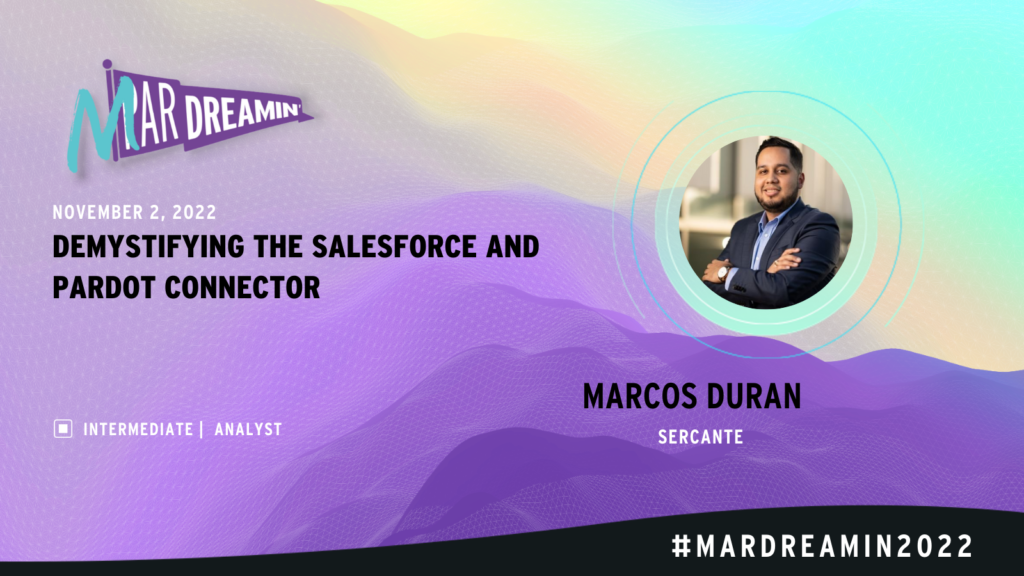
Demystifying the Salesforce and Pardot Connector | 10:35 a.m. – 11:00 a.m. ET

Do you find data flow between Marketing Cloud Account Engagement (Pardot) and Salesforce to be a difficult topic in your organization? Are you plagued by thousands of sync errors? What do all the checkboxes and settings on the connector page do? 

In this session, we will cover the basics of the Salesforce connector in a friendly and easy-to-understand way. 

Topics we will touch include: 

  • Pardot V1/V2 connector
  • Marketing Data Sharing Rules
  • User Sync

The multiple checkboxes found in the settings panel and field management.

Additionally, we will cover some quick-win scenarios for you to run through to get your org running more efficiently. And, time permitting, we will have an open Q&A for the audience to share in on the fun!

This session is perfect for both Pardot veterans and newcomers who want to have a deep understanding of the connector to act as air control for their org.

Presenter: Marcos Duran

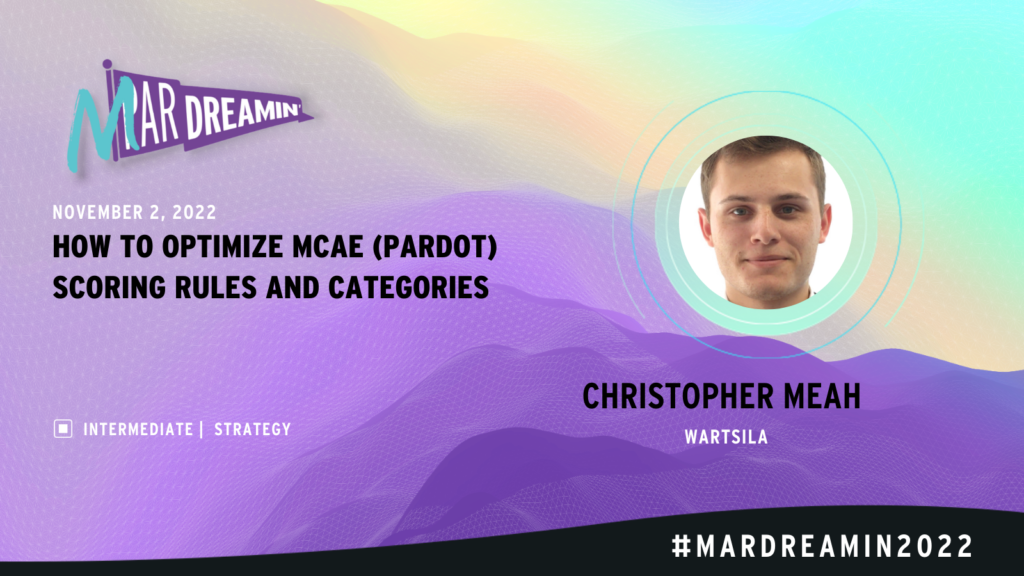
How to Optimize MCAE (Pardot) Scoring Rules and Categories | 10:20 – 10:45 a.m. ET

Join us for a complete overview of Marketing Cloud Account Engagement (Pardot) Scoring Rules and Scoring Categories. 

You’ll learn how to track and aggregate prospect engagement using a lead scoring framework. This will include a thorough introduction to both Pardot Scoring Rules and Scoring Categories with clear definitions as well as technical explanations and use cases. 

Key learnings:

  • Introduction to Pardot Scoring and Scoring Categories
  • Identifying and measuring key touch points across the marketing funnel
  • Developing a customized scorecard for specific business needs
  • Technical setup
  • Naming conventions and best practices

You will come away from the presentation with an attitude change that makes you more critically minded and data driven. The objective is not to simply make you aware of scoring tools available, but to provide you with the knowledge that empowers you to customize these options for your specific business needs and marketing goals. 

Presenter: Christopher Meah

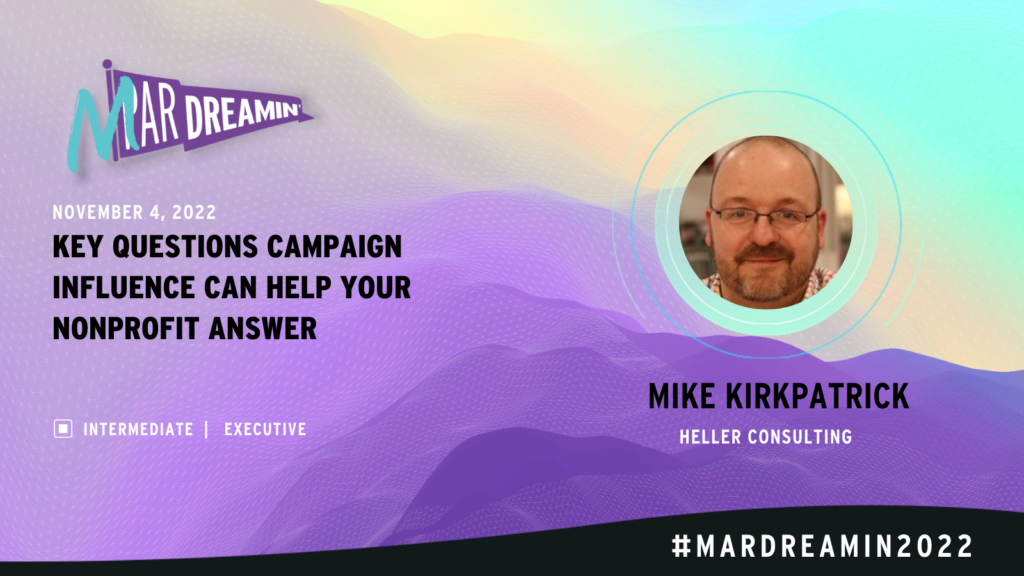
Key Questions Campaign Influence Can Help Your Nonprofit Answer | 11:10am – 11:50 p.m. ET

For years, nonprofit fundraisers and marketers have been chasing down the answers to questions from leaders around impact. How much did a campaign contribute to the fundraising goal? How did this marketing effort generate awareness about our cause? How did a new program impact our community?

With Salesforce and Marketing Cloud Account Engagement (Pardot), your nonprofit staff can start tracking data to find answers. Pulling from the hands-on work he’s done at large national nonprofit organizations, nonprofit consultant Mike Kirkpatrick breaks down Campaign Influence (a.k.a. attribution) and how to effectively fold it into a marketing plan for better reporting. 

Attendees will learn how to use Campaign Influence to track fundraising or marketing efforts. From there, Mike will equip attendees with tips for using analytics to showcase the ROI of specific fundraising or marketing campaigns.

Presenter: Mike Kirkpatrick

Pardot Lightning Email and Landing Page Builders: Lessons Learned | 11:55 – 12:35 p.m. ET

The Marketing Cloud Account Engagement (Pardot) Lightning landing page and email builders brought the sweet relief of drag-and-drop capabilities to the tool. But with great power comes great responsibility. 

While many Pardot users found excellent use cases for the new builders, some quickly found a few gotchas to keep in mind. 

This session is a deep dive into the lessons learned from implementing and using the Lightning email and landing page builders in Pardot. 

Topics include: 

  • Capabilities and limitations of the Lightning builders
  • Tips and tricks for building emails & landing pages
  • Demo of the Lightning builders

Presenter: Hannah Horning

Fun with Pardot Form Handlers | 1:10pm – 1:35 p.m. ET

In this Session, we will uncover the power of using form handler features in Marketing Cloud Account Engagement (Pardot). Using Pardot form handlers is the alternative to creating forms using Pardot iFrames. That’s because the feature allows you to have complete control over the look and feel of your form as well as other customization options you need to reach your goals.

As an outcome of this session, you’ll learn:

  • The value of using form handlers
  • Anatomy and technical components of an endpoint URL
  • Basics of an http POST and query strings
  • Best practices for working with Pardot form handlers

Presenter: Brandon Walton

Here At Last: Pardot Conditional Completion Actions | 2:25 – 2:50 p.m. ET

Conditional Completion Actions was much-awaited for in the Pardot community and was only just released this year. Join us to get tips and tricks to maximize the new Marketing Cloud Account Engagement (Pardot) Conditional Completion Actions feature that’s sure to be a time saver for Pardot admins everywhere.

We’ll cover:

  • Tips and gotchas to watch for
  • Helpful use cases
  • How users can maximize this brand-new feature

Presenter: Karla Vince

Day 2 – Thursday, Nov 3, 2022

Improve Accuracy and Compliance by Automating Campaign Management in Salesforce | 10:20- 10:45am ET

We’ve all been there. The creative use of campaign member status, inconsistent campaign names, campaigns that have been “In Progress” for years, and missing actual costs in campaigns. 

These common issues are not a problem for OwnBackup. Learn how they have automated the campaign management process using several cool tools (free) created by Sercante Labs and Salesforce Flow Builder. 

Presenter: Mike Morris

Double Trouble or Double Awesome? Embedding Dynamic Content within Dynamic Content | 10:50am – 11:15 a.m. ET

Marketers know how to leverage Marketing Cloud Account Engagement (Pardot) dynamic content features to add personalization to campaigns. But have you ever considered advanced use cases for Pardot dynamic content?

As an organization continues to advance, the need or potential need for double-dynamic content becomes a reality. That means, you may find yourself embedding dynamic content blocks within other dynamic content blocks. 

In this session, you’ll learn the pros and cons of using dynamic content within dynamic content. Then, you’ll uncover use cases for double dynamic content so it all makes sense and you can put it into action. 

Presenter: Dani Reeve

Identify Ideal Customers and Tune Pardot to Better Serve Them | 11:20 – 11:45 a.m. ET

All customers are equal, but some are more equal than others. If you agree with this and/or love Orwell quotes, then this session is for you. 

We will show you how you can create an Ideal customer profile to streamline your sales and marketing and target prospects that bring the most value to your business — today and in the future. Moreover, we will demonstrate how you can gear Marketing Cloud Account Engagement to give these customers a smooth experience and fast-track them through the funnel.

Presenter: Jaime López

How to Bring Pardot Capabilities into Salesforce Flow | 12:00 – 12:40 p.m. ET

The Marketing Cloud Account Engagement V5 API allows external systems to work with Pardot data. But, what if that “external system” is actually our Salesforce Sales Cloud instance? 

We have the Salesforce Connector to get things done between Pardot and Sales Cloud. And, thanks to the V5 API, we can extend that functionality by treating Sales Cloud as an external system.

This session will walk you through Flow Actions for Pardot, which is an app you can install in your org to get started with Salesforce flows for Pardot activities. You’ll leave with an understanding of how to install the app and use it to bring a range of Account Engagement (Pardot) capabilities into Salesforce Flow designer.

Presenter: Adam Erstelle, Mike Creuzer, and Jacob Catalano

Using Account Engagement (Pardot) Engagement Studio for Complex Lead Routing | 1:05 – 1:30 p.m. ET

Engagement Studio, which lives within Marketing Cloud Account Engagement (Pardot), is a powerful tool with seemingly endless use cases and customization possibilities. Did you know that you can even use Engagement Studio to create complex lead routing processes? 

We’ll walk you through a real-life example of an automation setup using Engagement Studio that takes the guesswork out of sorting through marketing leads. Learn how you can achieve a similar setup in your own Pardot instance that automatically sorts leads and identifies the hottest ones for sales to contact. 

We’ll show you how to handle complex lead routing in Engagement Studio including assigning ownership based on:

Customer data points

  • Customer engagement activity
  • Business criteria
  • And more

Presenter: Sarah Empson

Pardot External Actions: An Intro and How to Build Them | 1:35 – 2:15 p.m. ET

External Actions is a newer feature for Marketing Cloud Account Engagement (Pardot).

It’s a game-changer because it enables external callouts from within an Engagement Studio Program (ESP). For example, you can now do things from ESPs like sending an SMS text or registering someone for a webinar.

Come and learn more about the power of Pardot External Actions. This session covers:

  • An overview of use cases for the feature
  • How to build Pardot External Actions
  • How to package the actions you build

Presenter: Christopher Cornett

Understand and Protect Your System of Record | 2:20 –  2:45 p.m .ET

Behind every great technology is a system of record. Every. Single. One. 

Marketing Cloud Account Engagement (Pardot), webinar systems, data analytics systems, Sales Cloud. They all have a system of record.

There are lots of functions, and behind every system is a discreet database. This talk will focus on how to:

  • Determine your system of record
  • Communicate it across your stakeholders
  • Protect that database like your digital life depends on it — because it does.  

MH will discuss simple non-tech solutions and best practices gleaned from years on the DevOps side of the world.

Presenter: M.H. Lines

Day 3 – Friday, Nov 4, 2022

7 Tips to Bridge the Gap Between Sales and Marketing | 12:40- 1:05 p.m. ET

It’s time for sales teams and marketers to realize they’re all working toward common goals — to keep customers happy and smash revenue targets. And we all know that sales and marketing teams that work together do more with less and shine brightly in the customer’s eyes.

In this session, get 7 actionable insights to use when building relationships between sales and marketing teams through shared technology tools. You’ll learn how to make the best decisions for your tech stack and how to encourage open communication between the teams.

This presentation is especially valuable for companies currently implementing Marketing Cloud Account Engagement (Pardot), but it is also relevant for teams with existing implementations.

Presenter: Sharon Taylor

Pardot Business Units: Pros, Cons, and Gotchas | 12:45pm – 1:10 p.m. ET

We are all now getting used to working with Marketing Cloud Account Engagement (Pardot) business units, but most of the implementations we’re seeing are still one business unit. However, many companies are now looking at this as a “what if?” They’re asking questions like “shall we?” or “should we be looking at more than one business unit?” 

There are many pros and cons to making this decision, and we will walk through them and discuss. We also have a couple of shiny gotchas to look at and consider before making the leap to multiple Pardot business units.

Presenter: Tracy Keeling

Grab and Hold Those UTMS: Advanced Touchpoint Attribution Techniques | 1:15 – 1:40 p.m. ET

In the past, determining marketing attribution using UTMs with Marketing Cloud Account Engagement was limited to a same-page-same-visit form fill. What if you could hold those UTMs across multiple pages and even across multiple visits, until the visitor completes a form?  

This session lays out a process using a simple low-cost third-party tool that works on ANY website and enables tracking of UTMs across site pages. It even tracks visits between landing pages and your main site. The process works by capturing first- and last-touch UTMs in hidden fields on any Pardot form and on any page.

We will further explore the process of setting first- and last-touch UTM fields that flow through Salesforce from leads to opportunities. Ultimately, you’ll have the power to attribute newly acquired business to specific UTM campaigns.

Presenter: Bill Fetter

Using Einstein AI within Account Engagement | 1:45- 2:10 p.m. ET

It’s time to put Einstein to the test to feel the benefits of using data-driven insights to power your sales and marketing efforts. This session will help you understand how artificial intelligence (AI) tools can show you which prospects are most engaged and the campaigns that were most successful.

You’ll walk away with a better understanding of:

  • How the different Einstein features work within Marketing Cloud Account Engagement (Pardot)
  • The value of using these features
  • Best practices from Salesforce customers

Presenter: Jeffrey Stollenwerk

Houston, We Have A Problem: Avoiding Pardot Personalization SOS Scenarios | 2:50 – 3:30 p.m. ET

Marketing Cloud Account Engagement (Pardot) is full of features that can help you personalize different types of experiences within the tool. From Dynamic Content to Handlebars Merge Language to Snippets — these features lean on the strong connection between Salesforce and Pardot (data) to power these functions. What happens when the data fails you or these features don’t play along with one another?

Join us for this discussion and show and tell about personalization in Pardot. We will focus on key use cases where these features could fail AND how to prevent this from happening in the first case. 

You’ll understand concepts such as:

  • CRM User (Sender)
  • Handlebars Merge Language (HML) 
  • Dynamic Content and Snippet testing best practices 

This session is for any admin who deals with data and/or manages campaigns using Pardot.

Presenter: Marcos Duran

Get Ready for MarDreamin’ 2022

Register now for the leading 3-day virtual conference that’s all about marketing with Salesforce. 

There’s still time to sign up! Be sure to register now and share the registration link with your colleagues so they can watch the sessions too. Secure your favorite board room, grab some popcorn, and make a multi-day event with your entire marketing team. 

To get the most out of the MarDreamin’ and soak in all the knowledge, take a look at the 1 day pre-conference training workshops.

If you are a motivated marketer looking to take your skillset to the next level and get an edge over the competition, your all-access pass to the workshops are a must-have add-on to the main event. New this year — get access to our entire catalog of workshops for the price of one. We look forward to seeing you this year and we’re here to help if you have any questions.

The Great Resignation has impacted businesses throughout the US for the last two years and more specifically, it has created a talent gap for many departments. Marketing teams in particular seem to be taking a big hit, mainly when it comes to specialty roles like digital marketing and marketing operations/technology. 

One theory behind the Great Resignation is that it can be traced to the earlier part of the Covid-19 pandemic; workers reevaluated their current employment and determined if their role at said company was still in alignment with their needs and wants. Whether that was tied to company policies around PTO, working from home or their level of pay, workers started to seek out new opportunities and leave their sometimes long-held positions.

Whatever the impetus behind the Great Resignation, it has caused many business leaders to take pause and evaluate both how they retain and hire top talent. 

Retaining and hiring marketers in the Great Resignation

Retention often means understanding what your current marketers want and need in their job to stay satisfied. It’s time to break down some of the old traditions of once a year, one-sided evaluations as an indicator of worker satisfaction. Do those evaluations fully articulate satisfaction anyway? Probably not. Internal surveys, informal check-ins and reverse evaluations can offer both qualitative and quantitative  insight. 

When hiring is the next feasible option, your company’s reputation, training and benefits are what will be of most import to the job seeker. If resourcing becomes more critical in terms of immediate need, there are additional options to consider and supplement until top talent can be brought in or even in lieu of onboarding new employees. 

Use your company website as a talent pipeline

A company career page isn’t solely a place to post job descriptions, it also provides insight into the culture and values that a particular company holds. This can be articulated through mission statements and core values, but also pictures of team building trips and activities. First impressions hold true in many circumstances, but especially for potential candidates searching your site for a glimpse into your company’s culture and overall vibe. 

Since review sites like Glassdoor.com exist and often display as a top search result, establishing your company’s image first can make a significant difference when it comes to reputation management and drawing in the top candidates you seek. 

On this career page, within job descriptions themselves, you have another opportunity to snag the attention of top marketing candidates. Give the job description a broader appeal and provide a vision of what the position’s “day in the life” can be like. 

Crafting a story within the job description can help job seekers envision themselves in that role with greater ease and get a better understanding of expectations and cross departmental functionalities. Here’s an example from the Sercante website.

Another way to capture the attention of the ideal marketing technology candidate is to include a pay range within the position description. This can make your company stand out and create good faith moving forward, especially for previously underpaid demographics.  Pay transparency is the new unlimited PTO. 

Train marketing talent from within 

Instead of looking outside the company for the ideal marketing ops candidate, empower existing team members to learn something new by offering training opportunities

Many “traditional” marketers can feel pigeonholed and often want to learn a new skill to expand their expertise. For example, a PR professional might be tired of writing press releases and want to delve into the social media world, or content writers might wonder how their email copy is being used within a particular marketing automation platform. 

Giving your internal team members the time to learn on the clock can be a major confidence booster. Assign a task in Asana (or other project management tool) with 3-5 hours per week to team members open to learning new technology. 

Allowing company time for learning and growth opportunities may help build toward a positive impression with your current employees. Salesforce Trailhead is one of the best platforms to turn marketing-minded individuals into marketing technology powerhouses. Likewise, HubSpot offers free marketing certifications. Take it one step further by paying for certification tests and/or tying certification completions to additional bonuses. 

To supplement self-guided training, setting up a company catered Lunch & Learns results in a pro-learning environment and is a beneficial team building tool. When the training models are checked off and certificates produced, the next step is aligning team members on openings and evaluating opportunities for advancement in title and pay. 

Offer solid benefits + competitive pay to stand out 

Competitive pay will often be the number one indicator of a company’s ability to obtain top talent. In addition to pay though, a generous and even unique benefits package can help your company stand out among competitors. 

The standard (or expected) benefits such as a tech stipend, retirement investment account, healthcare and PTO are now considered the bare minimum. Here are additional benefits that businesses have recently started offering:

  • Fitness reimbursement 
  • eBook subscriptions
  • At home office stipend
  • Meditation app subscriptions
  • Nap pods 
  • Food delivery/meal prep service discounts 
  • Unlimited or extra PTO

As family structures change, more forward-thinking companies are aligning to different parental leave benefits or PTO for recent adoptions or foster care placement. Perhaps some of the more sought after benefits aren’t just tangible, they are about breaking down the very structure of how folks are seeking to work such as 100% remote workplaces or even 4-day work weeks. 

Leverage external resource for team expansion 

So you’ve tackled your reputation, finessed the job descriptions and looked internally for resources but have a gap and have an immediate resource need. After all those emails won’t trigger themselves and that landing page won’t magically layout on its own. For some companies, the immediate need for marketing technology individuals can hold up business processes and slow down the marketing to sales pipeline if not fulfilled. 

So who can you turn to when looking to supplement your internal team? This is where hiring managers can tap into freelance marketing professionals or consultant agencies. Agencies, like Sercante can act as an extension of the team, function on a project basis lending expertise or fill in for someone on health leave. Sometimes you can even have a fully trained team but too many projects that are all priorities. This is where the external support can assist with minimal ramp-up time.  

The Sercante motto is we make marketers wildly successful with the Salesforce platform. This means we share our expertise for all things automation and Sales Cloud and training teams to use the tools themselves. 

Looking toward the Great Resignation bright side 

One of the benefits of the Great Resignation is opportunity for realignment both inside companies and for the new job seeker. 

The last two years have shown us that workers want to feel valued and seen for their contributions and companies are starting to see the importance of finding the right talent or resources to assist with marketing technology projects. 

Are you looking to become or obtain top marketing talent within the Salesforce ecosystem? Feel free to check out the Pardot & Marketing Cloud Job Hub.