Category

Community

Product Note: Marketing Cloud Growth and Advanced are editions of Marketing Cloud Next and have also been referred to as Agentforce Marketing.

Marketing Cloud Growth Edition is here and its infrastructure represents a fundamental shift compared to Account Engagement. While Account Engagement is “near core,” Marketing Cloud Growth Edition is built on the Einstein 1 platform and leverages Data Cloud, Flow, and Einstein capabilities. This signals a shift in the skills that marketers will need in the future. But don’t worry, we’ve curated some resources to help you get a head start.   

Is Marketing Cloud Account Engagement being retired? 

Absolutely not. This question has come up in just about every social post that I’ve seen and has been addressed in detail in the blogs below by Andrea Tarrell and Erin Duncan, so we’re not going to dig too deeply into it here. 

The short reason is that Marketing Cloud Growth Edition is a distinct offering geared toward small to medium-sized businesses (SMBs). However, innovations and features from this product will make their way into Marketing Cloud Account Engagement, so there will be a need for marketers to evolve their skills.

What are these new skills that you keep mentioning? 

After playing with Marketing Cloud Growth Edition a bit, three areas really stood out to me.

  • Audiences are created using Data Cloud
  • Assets are built with Experience Cloud
  • Automations (including email series) are powered by Salesforce Flow

While Data Cloud, Experience Cloud, and Flow might sound a little scary, these represent great opportunities for Account Engagement pros to develop new skills. To make things even easier, Salesforce has provided excellent learning resources for all these topics in Trailhead. Let’s get started!

Data Cloud

Data Cloud is a dream come true for marketers. Imagine having all your customer data from different applications centralized in a single location and available when creating your marketing segments. Imagine no more as that’s exactly what Data Cloud delivers.

Marketers need a general understanding of the tool and key terminology. They will also need to be able to utilize Data Cloud to build segments.

Key Data Cloud Terms

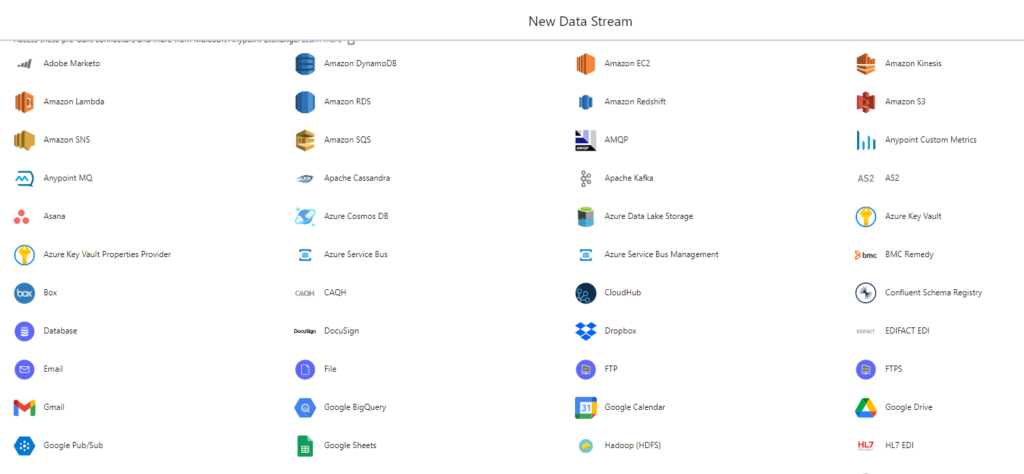
  • Data Stream: A data source ingested into Data Cloud. Examples include Salesforce CRM and Amazon S3 – and many more.
  • Data Lake Object (DLO): A storage container for the data ingested into data streams.
  • Data Model Object (DMO): A Data Cloud object created from data streams, insights, and other sources.
  • Customer 360 Data Model: Data Cloud’s standard canonical data model. Data ingested into Data Cloud is mapped to DMOs found in the Customer 360 Data Model.
  • Starter Data Bundles: A Salesforce-defined data stream that includes mapping to the Data Cloud DMO structure.

Here are some of the sources that can be used as data streams in Data Cloud

Recommended Trailhead Modules

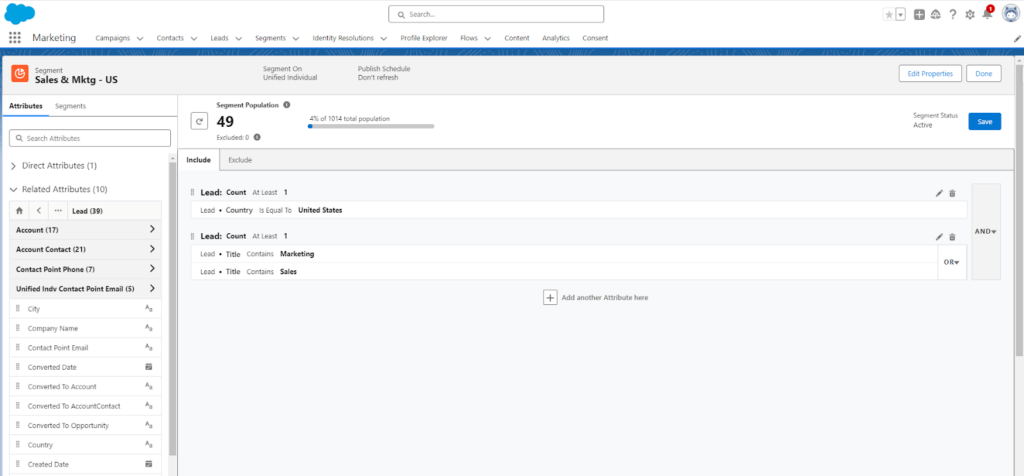
Here’s an example of how a segment focusing on Sales and Marketing titles based in the United States would look in Marketing Cloud Growth Edition.

Experience Cloud

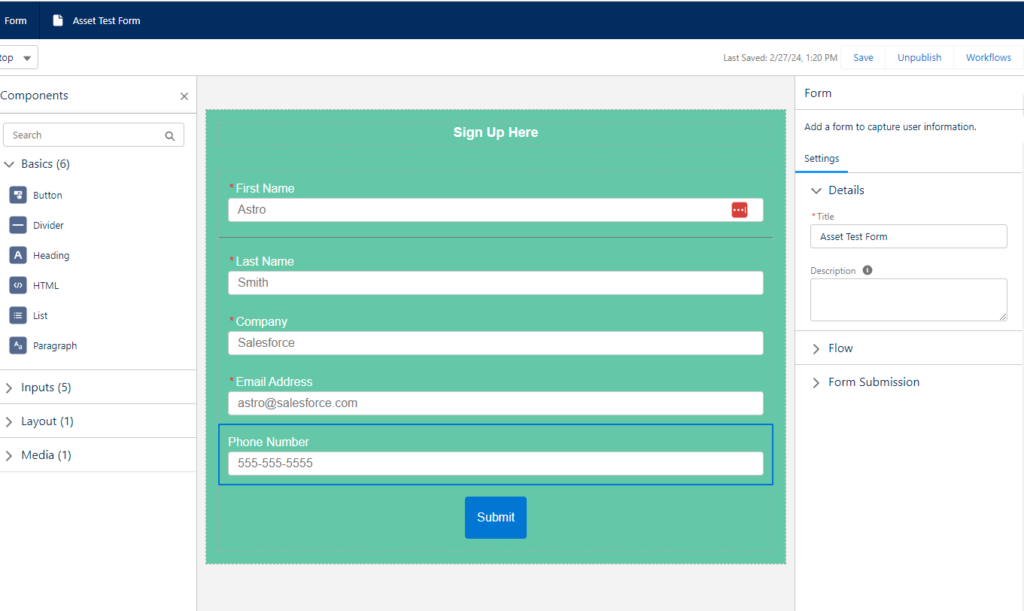
Assets in Marketing Cloud Growth are built using Experience Cloud. The experience feels similar to the Account Engagement Lighting Builders, but the foundation is different and there are some cool upgrades. I’m a big fan of the campaign-based workflow, the ability to publish/unpublish forms, and the ease with which forms can be styled — without the need for CSS.

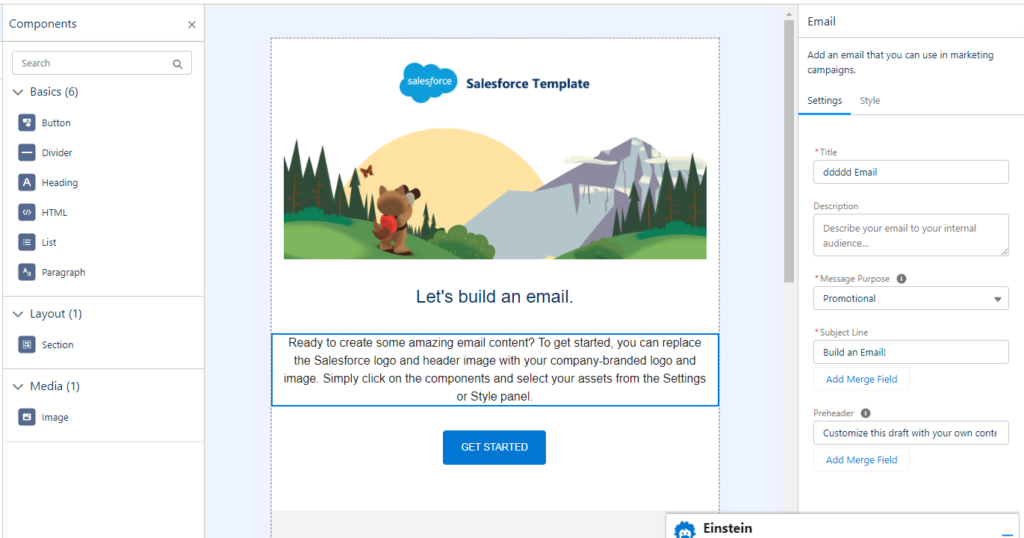
Marketing Cloud Growth Email Builder


Marketing Cloud Growth Form Builder

At this time, the best way to prepare for the asset-building experience in Marketing Cloud Growth is to get hands-on with the lightning builders in Account Engagement. If you have not yet enabled them in your org, take a moment to do so using this blog as a guide. You can still access and use the classic builder after the lighting builder is activated, so you are not locked into a single builder.

Recommended Trailhead Modules

Salesforce Flow

Salesforce Flow is at the heart of Marketing Cloud Growth and represents a great learning opportunity for account engagement pros. Flow has historically been the solution of choice for Salesforce admins when creating declarative automations within Salesforce, but it’s now a marketing tool as well (and you’re going to love it).

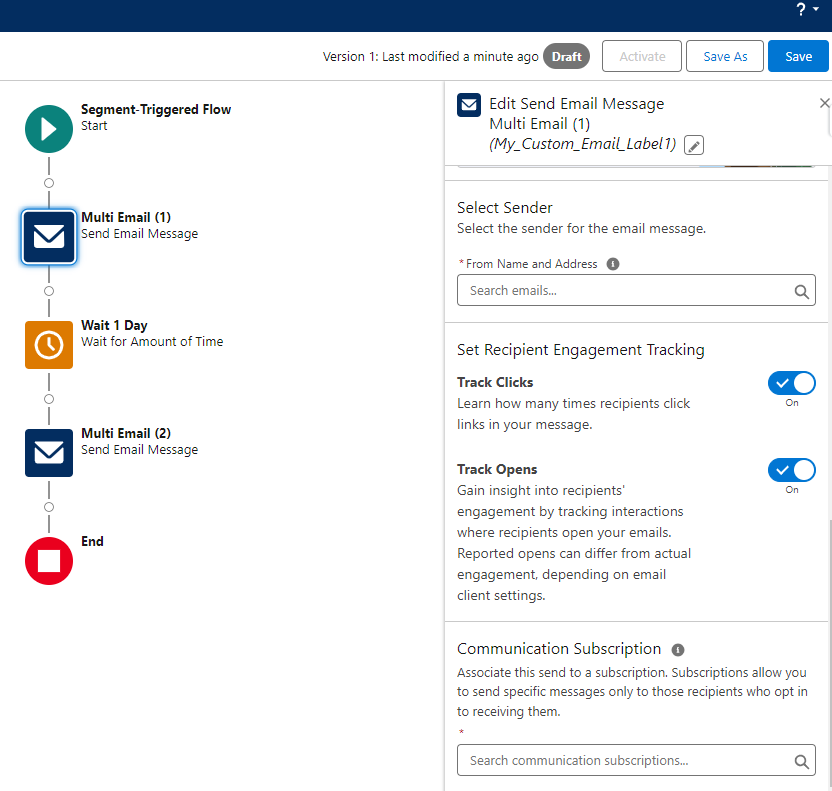
Marketing Cloud Growth generates a pre-built flow when assets are created. These are an excellent starting point and can be customized to specify tracking (for emails), subscriptions, and wait step times (in minutes, hours, days, months, or a specific time of day).  Branch logic can also be added to further customize the recipient journey and more features are on the roadmap for future releases.

Flow is one of the tools that is best learned by doing. Fortunately, there are plenty of great Trailhead modules, projects, and superbadges on this topic. If you learn better with the help of an instructor, our Salesforce Flow Basics For Marketers Workshop is for you!

Recommend Trailhead Modules

There are also a few posts on the Spot that will guide you, step-by-step, through creating flows that address common marketing needs. These are fun little projects that are highly relevant, so be sure to check them out. As always, practice in your sandbox or Trailhead org.

Start building your Marketing Cloud Account Engagement skills for the future 

The current release of Marketing Cloud Growth Edition is not a replacement for Account Engagement, but it does give us a glimpse into the future. Many innovations and features from  Marketing Cloud Growth Edition will make their way into Marketing Cloud Account Engagement, so it’s time to begin evolving your skills in preparation.

Product Note: Marketing Cloud Growth and Advanced are editions of Marketing Cloud Next and have also been referred to as Agentforce Marketing.

The role of marketers is continually evolving. This is especially true for those working within the Salesforce ecosystem. With the advent of advanced technologies, products, and functionalities to support — all while sticking to data-driven strategies — marketers are expected to adapt and expand their skill sets to stay competitive and relevant in the industry. 

One significant shift that I see for Marketing Cloud Engagement professionals is the need to add Data Cloud and Flows into their skill repertoire

In this blog post, we’ll explore why Marketing Cloud Engagement professionals should upgrade their skills to include Data Cloud and Flows, along with practical steps to start this learning journey.

Why upgrade your Marketing Cloud Engagement skills?

1. It’s the future for the Mothership

Unless you’ve been living under a rock, you’re likely very aware of how much rapid growth and development Salesforce has invested in its Data Cloud product — not only are the release cycles happening much more frequently than other products. This in turn unlocks new features and integration points with other products in the ecosystem, and there’s also a version of Data Cloud being offered at $0 for Sales and Service Cloud customers and just recently announced for Marketing Cloud Customers too. 

If that’s not a sign, I’ll give you one more reason: Data Cloud is the data foundation and Flows power automation for Salesforce’s new product, Marketing Cloud Growth Edition. Marketing Cloud Growth Edition is built on Einstein 1, which has been the pipe dream for many of us Marketing Cloud Engagement fans who have dealt with wonky UX, and clunky integrations over the years. Reading between the lines, cough cough SAFE Harbor cough cough sometime in the future (likely a few years), there will be a single marketing automation application that current Marketing Cloud Account Engagement and Engagement users will want to use.

So now that I’ve convinced you (hopefully) of the WHY — let’s dive into how these tools/features can help you as a marketer.

2. Become a better marketer by offering better customer experiences  

Enhanced Targeting and Personalization

Data Cloud can enable you to take your target and personalization efforts even further when using Data Cloud with Marketing Cloud Engagement through segmentation and activation. 

Data is the lifeblood of modern marketing. By incorporating a solid understanding and foundation of data models and the Data Cloud platform into your skill set, you’ll be able to visioncast and architect how to leverage vast repositories of consumer data, enabling you to create more targeted and personalized marketing campaigns and customer experiences. 

Understanding how to leverage data effectively within Data Cloud allows you to segment your audiences more precisely, tailor your messaging, and deliver content that resonates with individual preferences and behaviors in Marketing Cloud Engagement and beyond. (you also might want to read up on Consent Management)

Seamless Automation and Optimization

For those who have no clue about Flows (no I’m not talking about the Progressive Lady), let’s give you a breakdown:  Flows allow you to build complex business automation using clicks instead of code. For Salesforce admins, Flows are your best friends because they allow you to be able to handle the majority of complex business requirements without the help of a Salesforce developer.

Flows are not currently a feature/functionality in Marketing Cloud Engagement however it accomplishes many of the same needs you’d use Automation Studio and Journey Builder for. While the need and exposure for flows in your immediate feature might be limited, getting familiar and a basic foundation will allow you to go further faster in the future.

3. Gain a Competitive Edge and Future-Proofing

Marketers who embrace emerging technologies and methodologies gain a significant advantage in a competitive landscape. By upgrading your skills to include Data Cloud and Flows, you position yourself as a forward-thinking marketer capable of leveraging cutting-edge tools to drive results. Moreover, as the marketing landscape continues to evolve, proficiency in these areas ensures that you remain adaptable and prepared for future developments in the industry.

How to start your learning journey

1. Make time for training and education

For many practitioners, finding or making the time for training and education can be hard. As the old adage goes, “Investing in yourself is the best investment you will ever make.” So, invest!  As your reward for reading through this entire article, we’ll provide you with our recommended learning path to begin upskilling in these areas.

Begin by seeking out training programs and educational resources focused on Data Cloud and Flows. Many online platforms offer courses and certifications specifically tailored to marketers looking to expand their skill sets in these areas. Look for reputable sources such as industry-leading tech companies, online learning platforms, or professional associations.

2. Be realistic

Just like most things — be realistic with your goals. As they say, Rome wasn’t built in a day. Getting a shiny new certification might be the goal for some but doesn’t necessarily mean it’s the right goal for you. Set learning goals that make sense for your current role, day-to-day responsibilities, and where you want to go in your career.

3. Look for hands-on practice and experimentation

Theory is essential, but practical experience is equally crucial. Take advantage of sandbox environments or trial versions of Data Cloud and Flows functionality. (Unlike Marketing Cloud Engagement — these do exist!) 

From experimenting with building automated workflows, setting up data streams, mapping data, and creating segments to exploring data analytics tools, and analyzing results, hands-on experience will deepen your understanding and proficiency in these areas.

4. Collaborate and Network

Engage with peers and industry professionals who are already proficient in Data Cloud and Flows. Join online communities, attend webinars, and participate in networking events to exchange knowledge, seek advice, and learn from others’ experiences. Collaborating with experts in the field can provide valuable insights and accelerate your learning process.

Conclusion

As marketing continues to evolve in the digital age, we see Data Cloud and Flows becoming increasingly vital for success. By upgrading your skills in these areas, you can unlock new opportunities for not only yourself but also for ultimately driving better results for your organization. Start your learning journey today:

Data Cloud Learning Path

Flows Learning Path

Product Note: Marketing Cloud Growth and Advanced are editions of Marketing Cloud Next and have also been referred to as Agentforce Marketing.

There’s some fear in the air.

I’m sensing major mixed emotions swirling for many with the announcement of Marketing Cloud Growth Edition and the vision of marketing automation on the Einstein 1 (a.k.a. Salesforce core) platform.

On the one hand — it’s everything we’ve all been asking for. True one platform, no-integration-needed shared infrastructure for marketing to work seamlessly with all customer data. 

But there’s a glimmer of doubt with people thinking: “What does this mean for me? Are my skills still relevant? What does this mean for my product, my team, or my consulting business?” 

Don’t bet on innovation being slow 

There is a very large population of people who benefit from the status quo as it sits today. 

Employees benefit from their skills being in demand to drive up compensation. 

Consultants benefit from their experience being rare and slow to accumulate to stay relevant.

Product companies have grown to address a specific product gap or market need in today’s toolset.

But if the technology changes, all of that gets disrupted. When I hear people asking about timelines for the expansion of Marketing Cloud Growth Edition, I feel like they’re actually hoping that the pace of innovation on this will be slow. When I tell them I don’t think that’s going to be the case, that statement is met with uneasiness, and it’s clear that‘s not what they were hoping to hear.

Big change takes time, for sure. But I really wouldn’t bet on this freight train moving slowly. This has been a long time coming, and there’s momentum behind this new product that is incredibly exciting.

Remember that the technology is only one piece of the puzzle

I think that the fear of change here is somewhat misplaced.

Yes, there is a lot of power in the technical knowledge of any platform — Marketing Cloud Engagement, Account Engagement (Pardot), Salesforce, and any number of new tools.

But even harder to come by are the soft and business skills that make you successful with those platforms. Things like: 

  • Understanding business process
  • Mapping out data relationships 
  • Wrangling colleagues from across sales, marketing, customer service, and product to get agreement on content 
  • Training and driving the adoption of a new tool or process
  • Defining project plans and dependencies with the work of other teams 
  • The logistics that go into the execution of any complex campaign 
  • Spotting a gap or a need, and the extreme ownership you bring to “I’m going to figure out how to solve it” 
  • Spreading best practices & defining standard processes
  • Breaking complex terminology into terms anyone on your team can understand

Just think about your job today: How much of it is actually hands-on configuration in a tech platform, and how much of it is “tech-adjacent” planning, organizing, collaborating, and communicating? 

I bet it’s a blend of both, and as you move up the ladder in your career the “tech adjacent” becomes more critical.

Time to go back to school 

So, if we could flip a switch and change all customers to the new platform overnight — the skills and experience we’ve all gained from many years on Pardot and Marketing Cloud are still super useful, even if we’re logging in at a different URL. 

We’re not being sent back to the starting line. But we do probably have some relearning to do to keep our edge and stay relevant. But I choose to view that as exciting and not daunting. (Well maybe a little daunting. But I’m going to crack open a Red Bull and push through.) 

The way I think of it is this: Someone has to emerge as leaders, thinkers, and builders on any new platform. Who better than you and I? Let’s leverage the hard-won experience in this ecosystem as a springboard in this next chapter. 

Let’s lean into the next-gen set of tools that are going to bring marketing strategies to life on the Salesforce platform, and let’s go build some cool stuff.

Some quick shameless plugs

I can’t resist sharing two more things on this topic…

#1: Check out our Salesforce Flow for Marketers course

Flow is a big piece of how Marketing Cloud Growth Edition users can automate customer journeys. Need to brush up on your skills? Sercante has a Salesforce Flow Basics for Marketers Workshop that will kickstart your learning.

#2 Come join a team of growth-minded learners

When change is in the air, it’s a great time to be among like-minded learners. If this article resonated with you, I would invite you to come check out roles on the Sercante team. We’re committed to always learning, always chasing that edge, and we are eagerly seizing opportunities to get our team’s hands on the “next gen” ASAP. It’s a great spot to try on new skills and figure out the role you want to play in the next chapter of your career. Drop us a note at [email protected] if you’d like to chat!

Product Note: Marketing Cloud Growth and Advanced are editions of Marketing Cloud Next and have also been referred to as Agentforce Marketing.

I want to clear up a misconception that I’m hearing in the Salesforce world about the great $0 SKU Data Cloud debacle.

As you may recall, Salesforce announced at Dreamforce 2023 that a Data Cloud edition would be available at no cost to Sales and Service Cloud Enterprise Edition clients. This was also mentioned in Salesforce’s February 2024 press release around Marketing Cloud Growth Edition

To be clear, you still need Sales or Service Enterprise Edition to take advantage of this offer. Having just Marketing Cloud does not make you eligible.

Sales and Service Enterprise Edition Customers: What to do about no-cost Data Cloud offer

Now that we’ve clarified any confusion, you might say, “Great, I have Enterprise Edition — I want to get an account provisioned today!” And I would say, “Get prepared first.”

Data Cloud is a game-changer capable of driving remarkable transformation within your organization. Hence, having a well-crafted plan, strategy, and vision in place is paramount.

It’s the basis and foundation of change management — without a plan, vision, consensus, understanding, etc., you might as well stop before you even start.

Speaking from experience, diving into Data Cloud without a clear plan often leads to:

  1. Misconceptions: A perceived lack of product value.
  2. Tension: Without a collaborative mindset, conflicts can arise.
  3. Loss of Momentum: Initial interest and excitement wane over time.

However, before devising a plan, it’s crucial to assess your organization’s readiness. 

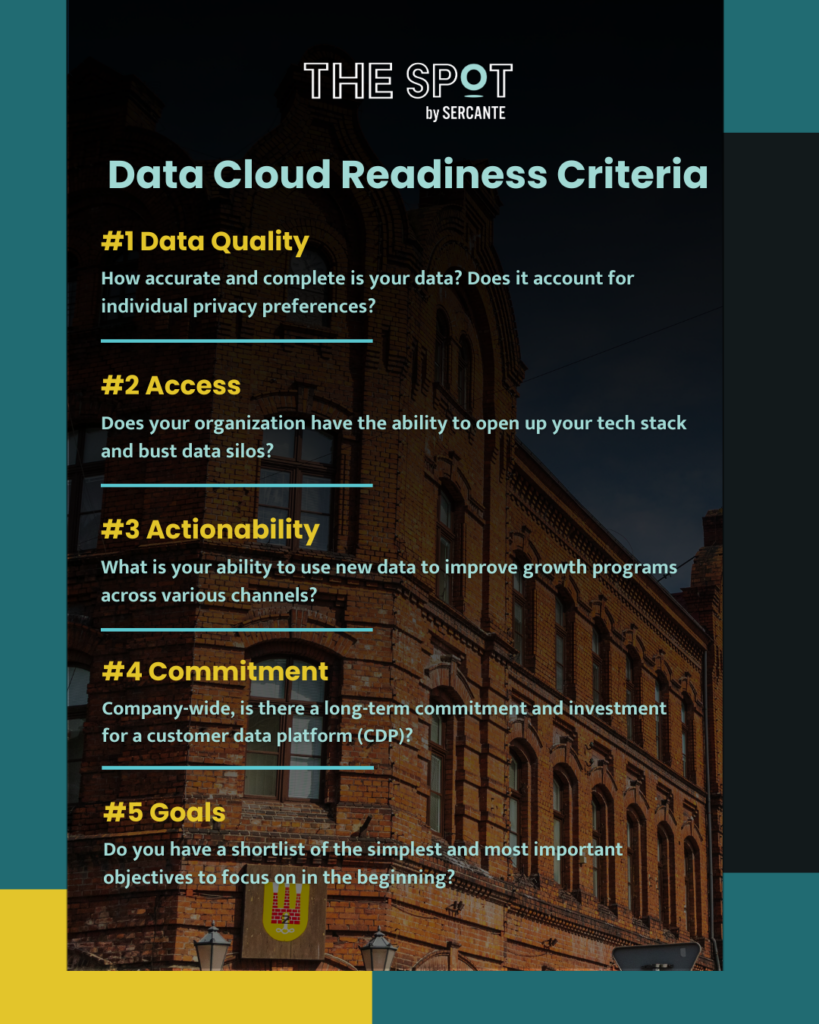
Data Cloud Readiness Criteria

Consider these five key aspects:

  1. Data Quality: How accurate and complete is your data? Does it account for individual privacy preferences? 
  2. Access: Does your organization have the ability to open up your tech stack and bust data silos?
  3. Actionability: What is your ability to use new data to improve growth programs across various channels?
  4. Commitment: Company-wide, is there a long-term commitment and investment for a customer data platform (CDP)?
  5. Goals: Do you have a shortlist of the simplest and most important objectives to begin with?
data cloud readiness criteria

Get a Data Cloud Readiness Assessment

We’re here to assist you in preparing for Data Cloud. Reach out to explore our Data Cloud Readiness Assessment offering so you can be sure your organization is primed for success.

Product Note: Marketing Cloud Growth and Advanced are editions of Marketing Cloud Next and have also been referred to as Agentforce Marketing.

ICYMI: Salesforce dropped a hot product announcement yesterday. And she’s called Marketing Cloud Growth Edition

There was a flurry of blogs and social postings following the official drop of the Salesforce press release, notably: 

To hear some talk, MC Growth Edition is going to instantly change everything and be the best thing in the world. 

On the flip side of the spectrum, I’ve seen some hyper-skeptical commentary around MC Growth Edition. “It’s SMB only”, “It’s going to take years to catch up”, and “You don’t have to worry about this now,” (I’m sensing a twinge of fear/self-doubt intermingled in these statements, though).

Like most things involving extreme opposites, the current reality and answer to “What is Marketing Cloud Growth Edition?” is somewhere in the middle of these two takes.

Let’s dig into some of the nuances here and read the tea leaves. If I could boil this down to a top 5 highlights, they would be: 

1) Marketing Cloud Growth Edition is built on “Core,” and that’s a fundamental advantage for innovation 

Marketing Cloud Growth Edition is built on the Einstein 1 platform — aka the same underlying infrastructure as Sales Cloud, Service Cloud, Experience Cloud, Data Cloud, and recently, Commerce Cloud. 

Marketing Cloud Engagement is NOT on core today (but it’s integrated).

Pardot / Marketing Cloud Account Engagement IS on core… kind of. It’s a blend of on and off-core. Call it “near core” if you need another buzzword for your collection.

Many long-time Pardot customers have been rallying around the vision for “Pardot on Platform” for the last several years. And if you’ve been watching closely, you may have noticed that many of the product enhancements delivered in recent years have been either built-in core, rely heavily on components from core, or had prerequisites of things like enabling SSO with core. 

Why does this “on core” distinction matter, though? The simplified answer is that as new things are released, you can take advantage of those within other “on-core” tools. Examples would include things like Flow for automation, UI enhancements like Path, improvements to Salesforce reporting functionality, etc. These product innovations can be leveraged for the most part across objects and clouds that are built on core. 

So TL;DR — MC Growth Edition being on the Einstein 1 platform means that when enhancements are added to Salesforce and Data Cloud, we don’t have to wait for an integration to come out to use them in the marketing department. We will be able to take advantage of these enhancements immediately, in many cases.

2) The significance isn’t what’s available now — it’s about the vision 

In subsequent posts on The Spot, we’re going to be getting way in the weeds of how MC Growth Edition works and outlining functions and constraints of the current builders. 

There will be edition comparison guides.

Screenshots.

Pros & cons lists.

But amidst all of this, I would emphasize that what’s generally available now isn’t the important thing to look at unless you are actively evaluating a platform to purchase in the next 30 days. The exciting thing about MC Growth Edition is about where the product is headed.

Salesforce has an aggressive vision for this, and looking at the speed with which Data Cloud has grown, I’m betting on them to move FAST.

3) Expect to see a focus on unifying builders & tooling 

A friction point for existing customers is there are usually several ways to do things in different clouds. We have two email builders in Pardot. Another email builder in Salesforce. And an entirely different content builder in Marketing Cloud Engagement. 

Expect to see these tools start to converge, with Marketing Cloud Growth Edition as the first mover for shared functionality. 

One email builder. 

One landing page builder. 

One segmentation engine (built on Data Cloud).

(P.S. The buzzword for this concept is “composable services” — as a new tool is built, expect to see it designed in a way that it can be used and leveraged in multiple parts of Salesforce. We’re already seeing examples of today for more behind-the-scenes things of Pardot/Marketing Cloud, like the backend email sending engine.)

4) This makes AI real 

I’ve been listening quietly to all of the headlines about generative AI for the last year. 

Listening, because as Thumper says, “if you can’t say something nice, don’t say nothing at all.” 

The picture has been painted like this: 

  • You’re working with smart marketing automation tooling
  • You log in and the system can suggest a target audience for you 
  • It can suggest a product offer for you 
  • Heck, it can write your content from a campaign brief 
  • AI tells you when to send your email
  • AI makes it omnichannel 
  • Campaign results come flooding in… and yes, AI analyzes that for you too 
  • We cheers with our Mad Men era old fashioneds because the computers do all of the heavy lifting for us

That sounds nice, but also super unattainable with today’s tooling.

The elephant in the room: No one’s data is that organized. Systems remain super siloed. And the systems most customers are on today don’t solve for that. 

Until now. 

Marketing Cloud Growth Edition is the vision for how we move past that. It’s the beginnings of the shared infrastructure and unified data that get us to the AI-shaped pot of gold at the end of the rainbow.

Bring on the robots.

5) Existing customers are going to see the benefits too… without switching

Customers new to marketing automation, or new to marketing with Salesforce should absolutely evaluate MC Growth Edition.

Pardot and Marketing Cloud Engagement customers should wait a bit before asking themselves “Should I switch?” Largely because they may find they get some of the “good stuff” without having to switch.

We had two team members (one from a Pardot background, and one who’s an OG ExactTarget pro) participate in the pilot of MC Growth. What we saw is that Salesforce is thinking very carefully about how to share the value of the development work being done in MC Growth with its existing customer base. 

Over the next few months, customers will start to see new features you can opt into or just turn on in your org. It’s not going to be a “migration” or a requirement to move anything — just a gradual transformation and growth in the tools that are available to you as more of these composable services are built and shared.

The future looks bright 

One thing is for sure — the next chapter is going to be anything but boring for marketing technologists on the Salesforce platform!  I’ve never been more excited to grow in this ecosystem <3

You don’t have to be a technical person to start thinking like a Salesforce architect. In this article, I will share 5 concepts to bring a little architect-thinking magic to your everyday work.

Salesforce architect reflections from Northeast Dreamin’

In October 2023, I attended the premier ​​Salesforce community event in the Northeast, Northeast Dreamin’. There were plenty of informative sessions about AI, non-profit success, and others. I chose to focus my time on the sessions run by Salesforce Architects. 

But wait, just for Salesforce architects?

I was struck during these sessions, that the concepts are important to have in mind even if you are not a technical person or someone preparing to head down an architect career path. The reality is that everyone, in every position, can use the basic tenets of a Salesforce architect mindset to improve their everyday work and provide enormous value to our companies.

5 switches to activate your Salesforce architect mindset

When setting the stage for architectural thinking, it is important to zoom out and think about the big picture. Sure there are tactical details that need to be considered, but starting at a higher level will enable you to imagine beyond what is in front of you today.

An architect’s mindset is not reactive. It takes in various viewpoints and inputs that can help anticipate what your next move could or should be. No matter your role, the concepts below can help you elevate your thinking.

#1: Get curious

Think about your work in terms of the broader company and even industry trends. Think through a growth mindset lens and expand on what the questions are. With the growth mindset, the possibilities are limitless as we break away from a fixed mindset.

#2: Zoom out

Next time you are in a meeting, think about your mindset in terms of your camera. Your mind is like an aperture, when you open it you let more light in. How does this change your relationship with what is being discussed? When asked to make a change or perform a task, let more light in, zoom out, and ask broader questions to get to the heart of the why behind the ask.

#3: Get creative

Thinking like an architect is only sometimes a straight line. A heavy dose of thinking about the Art of the possible will open your mind and excite your stakeholders. Open a doc or a notebook and write out the wildest ideas you can think of. This is your chance to push the boundaries and turn some heads.

#4: Think longer term

Don’t be like Homer. Think about what the needs of your company might be in 1 year, in 3 years, in five years. What changes? What changes if you layer on a once-in-a-generation industry-shaking change? How would this inform how you build today with an eye toward a scalable and profitable future? You can go fast AND far.

#5: Analytics for the win!

Wherever possible, use data to support your thinking. This is especially important when pitching concepts to your stakeholders. If you and the teams you work with are using Salesforce, then lots of data is available to you. Moreso, if there has been an investment in more advanced analytics tools like Data Cloud and Einstein Analytics or B2BMA. With so much data at our fingertips, why not share?!

Bonus Tips!

  • Be nimble as the needs of your company change throughout the year. Unexpected headwinds could force a change that can be faced head-on by thinking about the work differently.
  • Don’t be afraid to share your work. Especially during fast-moving times, our ideas can really make a difference but we need to share them!

Whether you’re a developer, admin, or even a casual user, adopting an architect’s mindset can transform your work. So go beyond the tactical in what you do. By zooming out, getting curious, thinking longer term, and using data to guide decisions, you could lead to an architect mindset revolution in your organization.

No more posts to show