Category

Real Talk

One of the things I love about the broader Salesforce community (our #Ohana) is the generous knowledge sharing that goes on.  It’s incredible – in addition to their “day jobs,” there are countless Salesforce ninjas who take time to speak at user groups, plan regional conferences, and write blogs about what they’ve built and learned on the platform.

We’re not quite there on the Pardot side of the cloud in terms of volume of content generated and general proclivity for paying it forward.  I’d love to see more from fellow marketing automation enthusiasts (read: those of us in the trenches, not “thought leaders”) so that we can all level up and built smarter, leaner, better marketing programs.

There are a few Pardot rockstars leading the way on this that I get a little “fan girly” over. Be sure to follow them and check out what they’re doing!

1) Jenna Molby

Jenna Molby is one of the most technically savvy Pardot admins I’ve come across. She’s based in Vancouver, and puts the rock in rockstar.  Some of my favorite content that she’s shared includes way to trick out native Pardot forms — especially:

Seriously, how awesome are those tutorials?

Want to follow her?  She’s most active on her blog.

2) Lara Black

Lara Black is the knight in shining armor of the Pardot B2B Marketing group in the Success Community.  She’s lightning fast with answering even the most head-scratching user questions — Pardot support should seriously pay this woman or at least send her a thank you basket full of Pawdot puppies for her contributions.  

I had the pleasure of seeing her speak at Texas Dreamin’, and she’s as genius in person as she comes off online.  

Want to follow her?  Check her out on the Success Community.

3) The Toms

This one is really a combined shout out to two people — Tom Ryan and Tom Hayward from Macram. Together, they run a Pardot agency based in the UK. (How cool is it that they have a company staffed entirely by Toms?  That tickles me.)

The Toms are really supportive and helpful on the Success Community, and they also have a pretty badass blog.

Want to follow them?  Take a gander at their blog.

4) Sara McNamara

Sara is like the Lara Black of Twitter, and comes to the rescue whenever anyone has a support question.  Even the troll-ish ones.

When it comes to detailed knowledge of the Pardot product, Sara reigns supreme — she notices the tiniest changes to the platform instantly and has a really good pulse on what what’s coming down the pipeline.

Also, her GIF game is spot on.

Want to follow her?  The spot to find her is on Twitter.

5) Becka Miller

Becka is a multi-channel Pardot wizard.   She’s active on the Success Community, she’s on Twitter, she runs a User Group, she’s spoken at Dreamforce — can I just say that DANG, this girl can hustle.

Also, she has a German Shepherd, which instantly earns 100 points for Gryffindor in my book:
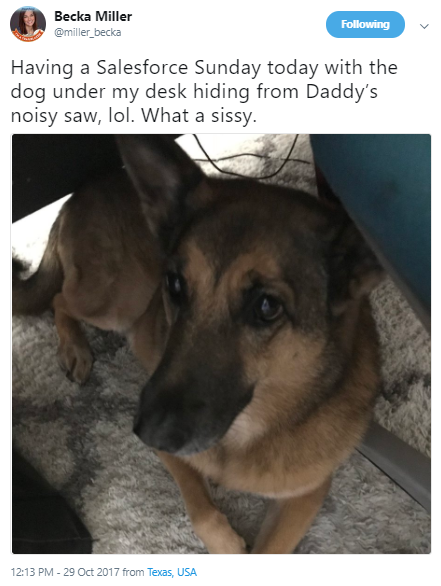
german shepherds of salesforce
Want to follow her?  Check her out on Twitter

Bonus: Pardot Team Members & Consultants

This is a blog about awesome users championing Pardot.  If I expanded it to include detailed explanations of Pardot employees and consultants that are contributing to making this a richer and more vibrant community, this list would get really long.

But really quick… a few Pardot employees that are absolutely worth a follow:

And, there are a few Pardot consultancies/agencies who I really admire and who share great content (technically the competition I guess, but they’re still pretty cool):  

Share the Love: Who’s On Your List?

What Pardot peeps are on your must-follow list?  Who’s helped you succeed on the Salesforce platform?

Give ’em a shoutout in the comments!

Ironic: the farther I get in my career, the less I get to do some of the things I love and get to that elusive “flow state.”

(Alright maybe that’s not really “ironic,” but it at least meets the Alanis Morrisette threshold for the word.)

Flow, according to the all-knowing Wikipedia, is defined as:

The mental state of operation in which a person performing an activity is fully immersed in a feeling of energized focus, full involvement, and enjoyment in the process of the activity. In essence, flow is characterized by complete absorption in what one does, and a resulting loss in one’s sense of space and time

Have you found something like that?  Something that you can just get lost in and pour your heart into?

Don’t get me wrong — I am engaged and stimulated by what I’m working on — but there’s still a tug at the heartstrings for the familiar tasks I really enjoyed early on getting started with marketing.

The work that puts me in the zone

My foray into the world of marketing was as a content creator and strategist. There’s a well-weathered copy of Inbound Marketing signed by Dharmesh Shah sitting on the desk in my home office (the original one that sung the virtues of Digg and StumbleUpon), and it’s the first book that I read that made me think,

“Hey, I might want to do this marketing thing.”

With some practice, I turned into a blogging machine.  

I love writing — both the act of actually doing it, and strategizing around how written content can be deployed in a content marketing and lead nurturing program.

Writing is how I process new information, form opinions, and just generally organize thoughts.  It’s one of the few tasks I can lean into and suddenly wonder where an entire afternoon went.

But as I took on management roles, my ability to do “a few of my favorite things” changed.  And now today, as I’m trying to grow a business, I realize I need to spend a little less time on those tasks, and more time doing things like… sourcing accounting software. And drafting employment agreements.  And creating SOWs.

So how do you preserve that feeling of flow?

This isn’t a rhetorical question.  I don’t have the answer, and this blog isn’t going to unlock flawless tried-and-true secrets (sorry if that’s why you came here.)

But here’s what I’ve tried so far to strike a balance:

1. Call yourself out when you’re using familiar tasks to hide

We gravitate toward things we’re good at.  If you’re brutally honest with yourself, is focusing on the skills you built as an individual contributor sometimes an excuse for ignoring the scary or unfamiliar tasks looming on your ‘to do’ list?

2. Budget time to indulge in your favorite tasks, and stick to it

I give myself 5 hours a week to create content and track my time doing it in Harvest.  When I’m out of time, I’m out of time — and then it’s on to other priorities.

I fudge on this a little by reclaiming “dead time.”  At least half of the blogs on this site were written on my phone in the back of an Uber or commuting on the MARTA.

3. Teach others to do what you love

Be the exception to the “those who can’t do, teach” aphorism.  Share what you love with other people.

I get so much joy from teaching other people about content marketing and marketing automation.  There’s nothing I love more than seeing new team members or clients rocking it out, and getting to live vicariously just a little from their success.  (Hence the decision to go into marketing automation consulting.)

One word of warning when you assume the role of teacher: You may feel an overwhelming pull to micromanage like a total a-hole, because you know your subject matter really, really well.  Resist. Let your “students” find their own way and add their twist to things.  

4. Find new things that are your jam

When you push outside of your comfort zone, when you do the hard work of slogging through the grueling and the unfamiliar, you just might stumble across some new things you love. 

Sales I’m finding I surprisingly really like.  And public speaking — which used to reduce me to a puddle on the floor — is now something that totally triggers a flow state and it’s proved incredibly productive in helping me build a brand for my business.

What are your strategies for finding this balance?

Can you relate to this?  What types of tasks just put you in the zone and allow you to get lost in all the best possible ways?  How do you balance the beloved and the familiar tasks with finding that next challenge to stretch you?

I’m on so many email newsletters.  It’s frankly ridiculous.  But somehow, I can never find it in my heart to scroll to the bottom of the message and hit unsubscribe.  Nay, I will spend years multi-selecting gazillions of pointless pieces of spam and archiving them (not even deleting them, what is wrong with me?!).

I’ve been rethinking this strategy (if you can call it that) lately, in the name of decluttering and minimalism, etc.

One positive side effect of reflecting on this: it’s brought to the forefront what email marketing I actually enjoy and would miss if it were gone.  One of my favorites, hands down, is CB Insights.

What I love about CB Insights

To be honest, I have no idea how I even got on their email newsletter.  CB Insights is a:

“Market intelligence platform analyzes millions of data points on venture capital, startups, patents, partnerships and news mentions to help you see tomorrow’s opportunities, today.”

So basically, their newsletter is for people that are interested in the startup world & M&A.  They have a paid service, but their newsletter is free and is sent almost every day from their CEO & founder, Anand Sanwal.

There are many reasons why I love their email marketing, but to boil down to a top 5, it’s because:

1. Their subject lines are witty AF

A few of their recent ones:

  • what to feed millennials
  • map: international unicorn club
  • ugly dog map

I open these emails even on the busiest of days, because I just have to find out what these are referring to.  It rarely disappoints. (And Anand, obviously, you feed millennials avocado toast… #dudeplease.)

2. Their graphics are beyond

The business of CB Insights is market analytics. But in the course of business as usual, they seem to possess a healthy appreciation for Rule No. 6, often expressed with tongue in cheek “data visualizations” they create or graphs they found elsewhere that you WISH were jokes.

Like this:

1

Or this:

2

Face, meet palm.

3. It sounds like it’s written by someone you’d want to crack open a cold one with

Their copywriting cracks me up. Hilarity on so many levels.

Even though they’re in a serious, competitive B2B space — they have a fun and irreverent tone that I can’t get enough of. In two seconds, they can shift gears from an in-depth analysis of Apple’s product strategy to copy like this:

Is it okay for adults to drink milk in a work meeting? Click to vote.

No, it’s not okay. Ever.

Yes, it’s okay, and I do this

Yes, it’s okay, but I don’t do this

Yes, only if it’s chocolate milk

For the record, the only correct answer to this question is A.

4. They said they love me!

“I love you.”

These three little words are how they wrap up most emails.  

“It was to see if people were reading or paying attention,” Sanwal told Fast Company when asked from where this unsolicited affection flowed.  

It’s definitely worked on me.  (And I love you too, Anand.)

5. It actually generates revenue

CB Insights says that about $1M of annual revenue is attributable to the reach of the email newsletter.  If this isn’t proof positive that a) email works, and b) that B2B doesn’t have to boring, I don’t know what is.   

Who makes YOUR heart throb?

What email marketing are you in love with?  Any business content creators or bloggers you couldn’t live without?  

Share in the comments — I want to check them out!

Not going to call out specific products here, but lately I’ve had a few folks in the Salesforce ecosystem call my attention to new market entrants with an eyeroll-inspiring pitch.

“Have you seen XYZABCD?  It can almost do all of the things Pardot can.”

Not interested in “can almost do.”  Sorry, I’m just not.  The battle between marketing automation has been waged for nearly a decade, and a core four have emerged for a reason: Pardot, Marketo, Eloqua, and Hubspot.

If a new vendor wants to catch my attention, “almost as good as” doesn’t even come close.  

If you’re going to build something new, build us something we don’t already have, dammit. There are plenty of unmet needs and under-served niches where we need your skills and focus.  

Tell us how your product changes some slice of the universe, and then let’s talk.

Pardot Admins are some of the most humble people I’ve worked with.  

“Well, we’re just doing the basics.”

“We’ve probably set it up all wrong.”

“We don’t know what we’re doing.”

On rare occasions, you open a Pardot org and you’re like “what tornado came through here?”  

But much more often, you log in, look around, and there are some pretty cool things happening under the hood.  So what stops Pardot admins from feeling confident about their skills and abilities?

The Impostor Syndrome, defined

Do you ever find yourself gripped with anxiety that someone will suddenly realize that you have no idea what you’re talking about? Or as Mike Myers put it, do you live in constant fear that at any time the “no-talent police” will come and arrest you?”

That’s the impostor talking. It likes to rear its little head at times when we perceive risk — but making yourself feel and look small in these situations serves no one.

If you’ve done the hard work to build your skills as an admin and as a digital marketer, effing OWN THAT.

Don’t say it was easy (you know it wasn’t). Don’t shudder at the atta boys (slash girls). OWN IT!

Why this looms large with Pardot and Salesforce

The Impostor Syndrome spans all roles, all functions, all industries. But I’d posit that it’s even worse in our slice of the universe.

If you only have visibility to your Pardot org, it’s hard to compare or benchmark yourself.  You feel like you’re missing the mark, because it’s unclear where the mark is.  People in your organization might not quite understand what you do — heck, even people on your own team might not even get it.

This all feeds the insatiable Impostor.

To be clear, I’m not an advocate for BSing and pretending that you know something that you don’t.  There are plenty of people in the ecosystem that are on THAT end of the spectrum too.  

But if you’ve done the hard work, you’ve invested blood/sweat/tears into this thing — give yourself some credit.  And maybe other people will too.

How we beat the sneaky bastard

I’d like to hope that the Impostor just goes away on day.  But if Tina Fey, Maya Angelou, and Albert Einstein all feel it, I guess I’m not holding my breath on that one.

So what can we do in the meantime?  Some ideas, for starters:

1. Stop putting yourself down

When someone compliments you, or asks how you managed to do XYZ…smile.  And say “thanks, I put a lot of work into that.”

Not “it was easy.” Not “it was nothing.”

Swallow those words, and take the damn compliment.

2. Join a user group

I have so much love for the Salesforce and Pardot user community.  User group meetings are a fantastic place to do “show and tell” with your org, swap war stories, and connect with people who genuinely understand the challenges you face.  I never cease to be amazed by how helpful and giving fellow admin are in these setting.

In a world where marketing automation and tech roles are often misunderstood, there’s something that’s just so nice about being around people who get it.

3. Keep your skills sharp

Formal training can help supplement on-the-job learning and hush up the Impostor.  Pardot has copious, fantastic, FREE webinars all the time.  Most of them are top notch, and it helps to know that you’re staying on top of what’s new with the product and the industry.

There’s some weird Pardot shit on Udemy.  Don’t use that.  Contact me if you need other training ideas and I’ll point you in the right direction.

Or hey, maybe you can sell Dreamforce to your boss?  The 30 day final countdown is underway…

4. If a cert makes you feel better, do it

I posted a recent blog on whether it’s worth it to get Pardot certified. The short answer: sort of.

If a piece of paper (well, PDF) saying you passed a test makes you feel like you’ve validated your knowledge and can carry your head a little higher — do it already.  I’ll even be your study buddy.

5. Consider working with a consultant to benchmark

Getting an outside perspective on your org can be hugely valuable.  Many consultants will do free health checks (myself included) that basically are a discovery session followed by some complimentary best practice recommendations.  The best consultants know both Pardot and Salesforce, and can share real example of how they’ve seen other organizations leveraging the platform.

I’ll add an astersik here — vet your partners carefully, as they are DEFINITELY not created equal.  (More to come on that in a future blog post.)

How do you manage your Impostor?

Does any of this ring true for you?  How do you tell this insatiable monster to “shut it”?  I want to hear your thoughts — and your story — in the comments!

This is an awesome (but tricky) topic that was suggested by Ian A.  It’s kind of a loaded question.

You meet people all the time who are certified in one thing or another, but don’t know which way is up when it comes to actually applying that “book knowledge.”  

The flipside is actually much more common in the Salesforce ecosystem, though– you see lots of self-trained admins with a wealth of hands-on experience that never bothered to get certified.

There are two Pardot certifications available today: 1) Pardot Specialist, and 2) Pardot Consultant.  You can view the study guides for these and other Salesforce certs here.

So if you’re a Pardot user who has some solid applied knowledge of the platform, is it worth going through the hassle to get certified?  I’d say yes.  And here’s why.

1. It forces you to revisit every detail of the platform

When you implemented the platform or were first getting started as a user, you probably went through a soup to nuts overview of all the features Pardot has to offer.  

Studying for the certification exam makes you go through those all over again — and sometimes you uncover hidden gems you forgot that can improve your marketing program.  Ultimately, I’d argue that the process makes you better at your job.

2. It’s a piece of paper (well, PDF) that demonstrates you know what you’re talking about

Certification is not the “end all be all” indicator of knowledge, but it’s proof positive that you know your stuff.

And sometimes, that proof point is valuable just for you yourself.  Pardot Admins are some of the most humble people I’ve worked with. I can’t tell you how many times I’ve heard:

“Well, we’re just doing the basics.”

“We’ve probably set it up all wrong.”

“We don’t know what we’re doing.”

…but then you look under the hood of their Pardot org and there are some amazing things happening.  Certification helps you own your success with more confidence.

3. It’s super marketable on a resume

In many interviews I’ve been in for Salesforce and Pardot roles, the person on the other side of the table has limited ability to evaluate technical expertise.  Definitely not HR.  Sometimes not even the hiring manager.

So if an employer is looking at two candidates, and one is certified while the other is not — it’s often an unfortunate shortcut that the certified applicant comes out on top.  Sample size of one, but I will also say that the number of recruiters contacting me has doubled since I listed my certs on Linkedin.

By the way — if you’re not job hunting and are staying with your current employer, this marketable skill could also be leveraged to justify a request for a salary increase…

4. The release exams keep you sharp

Once you have your certification, you have to take release exams 3X a year.  NO ONE wants to miss these and have to go through the process all over again.

These maintenance exams are short and painless — but they do force you to read the release notes (which pre-certification I always found myself procrastinating on).  This can be a huge benefit that helps you uncover new features your organization can leverage to improve adoption and efficiency. 

So is it worth it to become Pardot certified?

TL;DR: Yes, I think it is.  

What’s your take?  What are the pros and cons of going through the certification process?  Any tips for folks hitting the books?  Share in the comments!

And, like Ian A., if you have any topic suggestions for a future blog — hit me up at [email protected].

No more posts to show