Many organizations today are discovering that one of the most significant barriers to AI success isn’t the technology itself, but the human factor in AI adoption. To move from siloed experimentation to operationalization that drives real impact, leaders must shift their focus from purely technical requirements to the organizational confidence of their people. This human-centric shift in mindset allows companies to convert technological capability into a strategic advantage by prioritizing the unique journey of every individual involved in the rollout.
The urgency for this human-centric approach is underscored by the current state of AI trends:
- A staggering 92% of organizations admit they do not yet have operational AI (McKinsey & Company).
- Research indicates that 70% of AI project failures are attributed to organizational and human factors rather than technical flaws (Adaptovate).
- Between 70-90% of AI projects fail to scale beyond the initial pilot phase (Forbes).
- Approximately 95% of generative AI pilots fail to achieve their intended revenue acceleration (Fortune, MIT Report).
When these initiatives stall, leaders often mistakenly blame the technology or the lack of data cleanliness. However, realizing true impact requires addressing the human and cultural gaps that keep teams fragmented and unsure, limiting their adoption. Which is why addressing the human factor of AI adoption is the fourth pillar in Sercante’s playbook for scaling AI for success in the report, The State of AI in Enterprise: Closing the Gap Between Investment and Impact. By understanding existing AI mindsets and observing how people actually operate, leaders can apply effective change enablement strategies, built on trust, clear guidelines, and role-based support, to finally unlock the confident adoption necessary for measurable AI impact.

The Human Factor of AI: Three Pillars of Uncertainty
Before your team can master a new tool, they must feel secure using it. AI rollouts can trigger unique psychological barriers that act as inhibitors for AI adoption. There is uncertainty that can swirl around in the thoughts of people, such as being replaced, mistrusting AI outputs, and not knowing what the true end goal is. To ensure a successful implementation, the change enablement approach must confront the three pillars of uncertainty:
- “Am I being replaced?” With major corporations reducing staff, anxiety is high across all sectors as people wonder if it’s due to AI efficiency replacement. The most successful implementations treat AI as a capability amplifier rather than a replacement, focusing on moving humans from transactional work to high-value validation and oversight.
- “Can I trust this data?” Hallucinations and AI-driven misinformation have eroded the fundamental concept of digital truth. Building trust requires formal processes, such as a cross-functional Data Trust Committee, to demonstrate a commitment to data integrity and output auditing.
- “What is our long-term goal?” Initial AI pilots and early experimentations are often implemented without a clear AI roadmap. Without transparency regarding the long-term plan and what the end goal is that is trying to be achieved with the AI solution, teams often become disengaged or fearful of the “next shoe to drop”.

Addressing the thoughts and feelings of uncertainty that people may be having around AI starts to meet people where they are, building trust that supports the human factor of AI adoption. In addition to uncertainty, there are also different mindsets that people can bring to the workplace toward AI that can either strengthen rollout success or limit it.
What is Your Team’s AI Mindset?
Understanding where people stand today around how they view and use AI is another step in meeting them where they are. There are five common AI mindsets, ranging from low to high openness and usage: Skeptic, Quiet Adopter, Evaluator, Enthusiast, and Trailblazer. How they fall on the scale is illustrated below.
| Mindset | Openness & Comfort | Usage Level | Common Behaviors | Change Enablement Strategies |
| Skeptic | Lowest | Lowest | – Hesitant or resistant to AI. – Relies on traditional methods. – Questions AI’s value or accuracy. – Needs proof before adoption. | – Build trust through small, low-risk AI pilots. – Share clear success stories and data demonstrating measurable impact. – Provide step-by-step guidance and support. – Encourage dialogue and address fears openly. |
| Quiet Adopter | Low | High | – Uses AI tools mainly out of necessity. – Quiet about AI adoption. – Focused on practical efficiency gains. – May not explore beyond immediate tasks. | – Offer role-specific training to optimize use. – Recognize and reward efficiency gains. – Provide clear guidelines and best practices. – Encourage sharing of successes to build confidence. |
| Evaluator | Moderate | Moderate | – Experiments selectively with AI. – Pilots new tools before wider adoption. – Comfortable but not fully integrated AI. – Focused on risk/benefit analysis. | – Provide frameworks for experimentation with measurable goals. – Offer mentorship or coaching on AI integration. – Ensure clear criteria for success. – Encourage peer learning and collaborative evaluations. |
| Enthusiast | High | Moderate | – Curious and explores AI possibilities. – Advocates for AI adoption. – Uses AI consistently but not fully optimized. – Prioritizes exploration over impact at times. | – Channel curiosity into strategic initiatives. – Offer advanced training and sandbox environments. – Help prioritize high-impact use cases. – Provide opportunities to mentor others and share knowledge. |
| Trailblazer | Highest | High | – Early adopter and AI advocate. – Drives innovation and integration. – Mentors others and promotes AI transformation. – Regularly experiments and measures results. | – Empower them as change champions. – Provide access to cross-functional projects. – Recognize leadership in AI adoption. – Align their efforts with strategic business objectives to maximize measurable impact. |
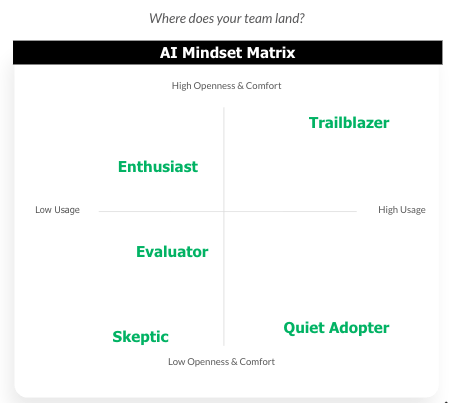
(Source: Sercante, 2026)
Identifying these mindsets within the organization enables leaders to tailor their change enablement plan to address the AI mindsets of the people. For example, a “Skeptic” needs different reassurance than an “Enthusiast” who may already be experimenting with tools outside of the core systems.
To further verify and understand the existing AI mindsets, observe how people are executing the processes today that will involve the AI solution, and listen to what the team is already saying about AI.
Verifying AI Mindsets: Observing the Real Flow of Work
From a technical standpoint, AI solutions need to align with the core processes happening across the customer lifecycle, meaning they need to be designed so that they support how people actually work. From a change enablement perspective that considers the human factor of AI adoption, there needs to be an understanding of where skills and attitudes are today to provide impactful communication and training materials. To do both, consider conducting Day in the Life exercises.
Day in the Life exercises involve sitting with team members to observe how they use AI and other systems to execute core processes. This practice helps to discover the “real” flow of work versus the documented one. By observing these daily habits, skill gaps can be identified along with true AI mindsets, and solution designers can ensure the final AI solution removes friction rather than adding it.
During these exercises, it is important to listen to the people executing the process to understand what they are saying about AI, allowing further verification of the AI mindset and also proactive planning for change enablement materials that will address differing levels of baseline adoption.
Confirming AI Adoption: Listen to the Voice of the User
In change enablement, silence does not imply consent. If people are not providing initial reactions or feedback, find out why. A “Quiet Adopter” might be using the tool out of necessity while still harboring deep skepticism that could eventually lead to disengagement.
Listen to what people are saying about the technology. When AI is brought up in conversations and team meetings, how do people seem to react? If they are not saying anything at first, what does their body language communicate? Paying attention to the words and expressions people are using about AI will support understanding of the current AI mindsets in the organization and further inform how to tailor the change enablement plan to successfully address the human factor of AI adoption.
Considering the Human Factor in AI Adoption: Developing Change Enablement
To address uncertainty, existing AI mindsets, and bridge any skill gaps that would limit the success of an AI rollout, there needs to be an effective change enablement plan implemented. As a starting point, consider this four-phase Change Enablement Checklist:
- Identify & Respond: Perform stakeholder impact assessments to identify unique role-based needs and concerns. Uncover the uncertainties and AI mindsets.
- Define & Design: Collaborate with tech teams to streamline processes before designing the automation, ensuring human expertise and intervention points are clearly defined.
- Listen & Inform: Provide regular, transparent updates that explain the “why” behind the change and the long-term roadmap. Continual clear communication builds trust to ease uncertainty and help shift AI mindsets.
- Prepare & Sustain: Offer role-based training and post-launch support tools. Remember, users only retain about 34% of training within 24 hours (Harvard Business Review). Sustaining AI adoption is where the real value is realized.
Take the Next Step
To take a deeper dive into this human-centric approach, watch the on-demand MarDreamin’ session: Empowering Your People: Nailing Change Enablement for AI Rollouts.

If you need support with implementing a change enablement strategy or conducting team readiness analysis, creating learning materials, or developing your AI roadmap, reach out to the Sercante team today.
Prioritizing the Human Side of AI for Sustained Success
To mature from siloed AI experiments to operationalized processes that power a modern growth engine, the human factor must be integrated into every stage of planning. Taking the time to understand the team’s AI mindset, current usage, and skillset, and tailoring the change enablement plan to meet them where they are with post-launch support, allows the people involved to shift from uncertainty to sustained, confident AI adoption. Gaining measurable business impact with AI isn’t just about the technical or data factors. It’s also about mobilizing the people involved to trust it, master it, and use it to execute the strategy to reach the organization’s growth goals.