Category

Career Development

Whether you’re an experienced Pardot admin or relatively new to the Pardot platform, passing the Salesforce Pardot Specialist Certification exam is a great way to demonstrate your skills and expertise. 

In this article, I share the five steps I took to pass the Pardot Specialist Certification exam – reviewing the exam resources, studying, taking practice exams (like this one from Jenna Molby), harnessing key test-taking strategies, and preparing to meet the exam requirements. In each step, you’ll find tips and strategies plus links to guide you through this process.

Ready to dive in? Let’s do this.

Step 1: Review the Pardot Specialist Exam Guide and Resources

Salesforce provides some amazing resources that outline everything you need to know to pass the Pardot Specialist Certification exam. 

Start by reviewing the Salesforce Certified Account Engagement Specialist exam guide. This will answer all of your administrative questions about the exam like:

  • “How is the exam administered?”
  • “How many questions are there?”
  • “What score do I need to pass?” 

Then, check out the exam outline to see a high-level overview of the exam topics. I recommend reviewing this guide – either by printing out a hard copy or copy-pasting into a separate doc. Then you can highlight any areas where you know you’ll need to focus more of your studying time. It’s ok to highlight most or all of the topics in this list! Your objective here is to understand the scope of what you need to learn so you can use your time wisely.

Step 2: Start Studying

Once you’ve reviewed the exam outline, head over to the Account Engagement Specialist Credential Trailmix. There is a LOT of content here – it’s estimated to take over 14 hours to complete! This just got real. Let’s take a deep breath and tackle this strategically to make the best use of our time and attention. 

Determine what worked for you in the past

Before you dive into studying, think back to your experiences in school. What worked when you were studying for an exam?

When I was in college, my favorite approach was to type up a master document containing my notes from lectures, textbook reading, and labs. A few days before the exam, I’d print out that document and read through it, writing out in pencil or pen anything that didn’t feel like it was sticking. Then, I’d review those hand-written notes the morning of my exam to make sure the trickiest information is the freshest in my mind. This strategy works for me because I create one centralized document for all of the information I need to know and I surface the information that’s hardest for me to learn. And as a bonus, this document becomes a great reference resource after the exam!

Are you the kind of person who likes learning from an instructor, being able to ask questions, and having a group of study buddies? If so, I highly recommend taking Sercante’s Pardot Admin Bootcamp Course. This course provides an invaluable mixture of technical learning, real-world use cases, and hands-on examples. It also provides a weekly structure that can help you stick to your study schedule ahead of the exam. 

Read through the Salesforce Trailmix materials

Work your way through the Salesforce Trailmix materials from the top to the bottom. And give special attention to the sections you highlighted earlier in the exam outline. For example, if Engagement Studio isn’t your strong suit, then make sure you have a good grasp of foundational topics. These include Visitors & Prospects, Syncing Prospects, and Mapping Custom Fields before you read the Engagement Studio documentation. 

Note that it is important to read the secondary documentation. What do I mean by “secondary documentation”? Here’s an example. If you open the Prospects documentation link, make sure you read through that page plus each of the linked documents on that page like “Anonymous Visitors” and “Active Prospects”. 

For any of the trailhead modules listed, notice the phrasing of the questions in the quiz section. Salesforce has a very particular way of wording their questions, so think of these quizzes as mini practice tests. I’d recommend writing down any questions and answers you don’t feel confident on to come back to later. Keep in mind that once you submit your answers, the quiz will disappear. 

Step 3: Take Some Practice Exams

Fortunately, there are loads of practice exams and pre-made flashcard sets available online for the Pardot Specialist Certification exam. Like the quizzes at the bottom of Salesforce’s Trailheads, these practice exams can help you get used to the style of the questions you’ll encounter on the real exam. A good goal is to keep taking the practice exams until you’re consistently hitting scores in the 80s or above. 

Here’s our favorite Pardot Specialist practice exam from Jenna Molby.

A word of caution: you need to be careful about the answers in these practice exams. Not all of them are correct, even in the paid versions! If there are any answers that don’t feel quite right, do a quick Google search or check in your own Pardot instance until you’re 100% confident you have the right answer. 

For the answers you really do get wrong, take a few minutes to dig into the related Pardot and Salesforce documentation in the exam Trailmix and practice in your own org to make sure you understand the underlying concepts and functionality. If you notice yourself consistently getting questions wrong about Dynamic vs Static Lists, for example, then study up a bit more on that topic. 

Step 4: Harness the Power of Key Test-Taking Strategies

Your exam day is fast approaching. Now’s the time to start thinking about your approach to taking the exam itself. Here are a couple of key test-taking strategies you can use to help improve your odds on exam day.

Narrow down the possible answers

If there’s a question on the exam that’s stumping you, first try to eliminate any answers you know FOR SURE are wrong. Sometimes, the incorrect answers can be surprisingly obvious. For example, if the question asks, “Which activity can be used to trigger an increase or decrease in a Prospect’s score?” and one of the answers is, “Printing an email,” you can easily cross that answer off.

From a statistical perspective, eliminating just 1 of 4 answers can increase your odds of getting the question right from 25% to 33%. If you can eliminate 2 answers, your odds go up to 50%.

Mark questions for review

If you haven’t taken a Salesforce Certification exam in the past, it’s important to know that you’ll be able to mark specific questions for review. Before you submit your exam, you can come back to your flagged questions and double check your answers. 

The approach I like to take is to mark any questions I’m not completely confident on for review. By using the mark-for-review feature, you can save brainpower by skipping over answers you know are correct instead of having to double check every answer before hitting the “submit” button.

If you encounter any questions during your review that you STILL aren’t confident about, then leave them in “review” status. Counting up the number of questions flagged for review just before you submit your exam can give you a ballpark idea of whether or not you’re going to pass. 

Step 5: Prepare for the Exam Requirements

Alright. You’ve studied your ass off, taken a boatload of practice exams, and now your exam day is just a few days away. At this point, it’s super important to re-read the section of the exam guide about the requirements for taking an onsite or online exam thoroughly. 

For online exams, there’s a bunch of pre-work you need to complete to meet the technology requirements. It’s a good idea to get this done sooner rather than later so your exam day doesn’t become extra stressful. 

Get ready to take your Pardot Specialist exam

Once you’ve gone through all 5 steps – setting the scope for what you need to learn, studying, taking practice tests, harnessing some key test-taking strategies, and preparing for the exam requirements – you’re ready to take your Pardot Specialist Certification exam! 

YOU CAN DO THIS. 

Remember that if you don’t pass, IT’S OKAY. You can always retake the exam. The most important part of this journey is the work you’re doing to level up your Pardot Admin skills. 

When you’re done taking the exam, I’d love to hear from you in the comments. How did your exam go? Which steps and strategies worked best for you?

Note: This blog was written in Summer 2021.

User roles within Pardot are often discussed from the perspective of capabilities rather than core competencies. A quick google search for “Pardot Admin” will tell you what an admin has access to. Still, little guidance is given around the skills, perspectives and competencies that Pardot Admins need to be wildly successful. 

In our guide to being an exceptional Pardot admin, we talked about perspective, how adjusting how we think, talk, and tackle Pardot can help unlock its full potential. This post will focus on competencies, notably how awesome Pardot Admins can simplify complexity and make Pardot accessible to everyone.   

Remove the jargon

The Pardot Glossary contains 30+ terms; some are familiar, others are intuitive, and some are simply specific to Pardot. Talking about Pardot’s in terms your audience will understand will go a long way in making Pardot more accessible. A simple tip is to create an internal glossary that aligns Pardot terms with your internal verbiage and language. 

  • To help get you started, we have created a Glossary Template with the most common Pardot Terms. Begin working with your colleagues to develop internal translations for each. 

Become comfortable giving live demos

Demoing Pardot live can be a daunting task for even the most experienced Pardot Admin. Still, it’s a competency that every Pardot admin needs. Showcasing features like progressive profiling, scoring & grading, and even reporting removes ambiguity, builds familiarity and paints a clear picture of how those features operate. Here are a few quick tips that have worked for me to build your confidence. 

  • Create a Quick Recording – Tools like Zoom, Microsoft Teams, GoToMeeting, Google meet or Loom all give you the capability to create a quick recording. Doing so gives you a chance to practice and gives you resources you can use again and again. 
  • Build a Resource – Why not create an internal landing page & form for your colleagues to play with? Doing so can help build excitement, familiarity and engagement with the features. 

Use analogies that work for you

Creating analogies forces us to think of features and functions differently. If you can think of relatable and easy to understand analogies, it means you know that feature back to front. 

Metaphors also make things a little more fun and less technical. One of my favorites is that grading is like Tinder; it gives you the ability to swipe left or right. Want to see a real-life example? Check out Lucy Mazalon’s ParDreamin session from last year.

Pardot Admin Mini-Series Workshops

Nurture your Pardot admin skills

Simplifying complexity is a core competency and responsibility for any Pardot admin. Without it, we run the risk of lower adoption, utilization, and overall ROI of the tool. 

Are you looking to enhance your skills? Our Mini Series workshops are consultant-led, short-form, outcome-based session’s designed to empower you to be wildly successful. Whether you’re looking to enhance your reporting, nurture or strategy skills, we provide all of the essential tips, tricks, advice, best practices, guidance and, most importantly, confidence to take your skills to the next level.

In 2004, I received a prestigious award  “Outstanding Achievement in The Field of Excellence.” If I’m honest, it was printed by my best friend — he’s much smarter than I, so I didn’t challenge it. You can win the award as a Pardot Admin using this template… that was an easy guide to write! ????

While I genuinely believe each of you deserve the above award, I must admit that being an exceptional Pardot Admin requires a bit more work. It’s not a destination or an end state; it’s about enhancing and changing how we think, talk and tackle Pardot as power users. So let’s start with changing how we think about Pardot. 

How we think about Pardot

Exceptional Pardot admins think of Pardot as a finite resource. It sounds odd to say. But when we don’t take this perspective, we run the risk of filling Pardot with ineffective, inactive, and wasteful resources. The great news is we can use Pardot to help manage Pardot, below are some of my favorite tools and resources to use

The Prospect Database Cleaning Guide – Let dynamic lists do the work for you and find disengaged or no longer relevant prospects in your database.

13 Spring Cleaning Tips – Game-changing quick tips that will help to keep Pardot moving smoothly!

• Set specific time aside to review your Pardot account, put it in your calendar now..I’ll wait.

Taking these steps helps to ensure we stay within our limitations, utilize features to the best of our ability, and work within Pardot as efficiently as possible.

How exceptional Pardot admins talk about Pardot

Exceptional Pardot admins advocate for Pardot as much more than an automation tool. They talk about it as a communication engine. Changing how we talk about Pardot within the business helps us identify new use cases and areas where Pardot can add value.

Changing the narrative means Pardot can become an integral part of important conversations like renewals, enablement & education, compliance, recruitment, and referrals. Starting those conversations can sometimes be daunting so here are some tips that have worked for me.

  1. Keep your message simple: At its core, Pardot does four main things – measures engagement, models behaviour in terms of segmentation and targeting, moves individuals with automated and personalized journeys and improves marketing with actionable insight and reporting. Use this as a conversation starter with other leaders in the business as to how Pardot might benefit them.
  2. Focus on alignment: Salesforce provides a lot of alignment guidance. This is one of my favorites as it talks about how Salesforce itself works to drive cross-team alignment.
  3. Let Salesforce do the selling for you: Share webinars and Pardot demo sessions like the Pardot daily demo as a way to introduce colleagues to the wonderful world of Pardot.

How Exceptional Pardot Admins Approach Pardot

Exceptional Pardot Admins approach Pardot with a sense of curiosity, a willingness to learn, and a willingness to share. They appreciate that Pardot is continually evolving, innovating and changing. They are excited about the new opportunities those innovations bring and are willing to share their own thoughts, perspectives, and insights with the broader community. Taking on Pardot with any other mindset is an uphill and tiresome battle.

  1. Get Connected : Pardot’s Trailblazer community is a collaborative space where you can ask questions, share insights and get the latest news on webinars and new resources.
  2. Get Involved : Pardot user groups are customer organised groups that meet in person ( when allowed) and virtually to network, share ideas, tips, tricks and advice on how to get the most out of Salesforce

Exceptional Pardot admins can think about, talk about and approach Pardot in highly valuable ways. If the possibilities of being exceptional at Pardot excite you, why not join us for a Pardot Admin Bootcamp? Our 6-week, consult-led virtual course will give you all the practical learning as well as tips, tricks, advice and, most importantly, confidence to become an exceptional Pardot admin.

Ace your Salesforce Certified Pardot Specialist exam by using this practice exam to test your Pardot knowledge. This practice test contains 50 multiple choice questions and covers most of the topics on the Salesforce Certified Pardot Specialist exam, including administration, scoring, lead management, email marketing, and engagement programs.

Quiz: Salesforce Certified Pardot Specialist Practice Exam

Step 1 of 50

What happens to the opportunity in Pardot if it’s deleted from your CRM?
Category: Salesforce Integration

Note: These are the types of questions to expect on the certification exam and they cover the topics outlined in the official study guide, but these aren’t the exact questions you will see on the exam. I highly recommend a combination of on-the-job experience, and self-study to maximize your chances of passing the exam.

Are you already a Salesforce Certified Pardot Specialist? Do you have around 12 months or more of hands-on experience implementing and administering the Pardot Lightning App and Salesforce platform? The next step in your Pardot certification journey is to take the Salesforce Certified Pardot Consultant exam.

In this post, I share how I prepared for the exam, what study resources I used and share the flashcards I created to pass the exam.

How I prepared for the exam

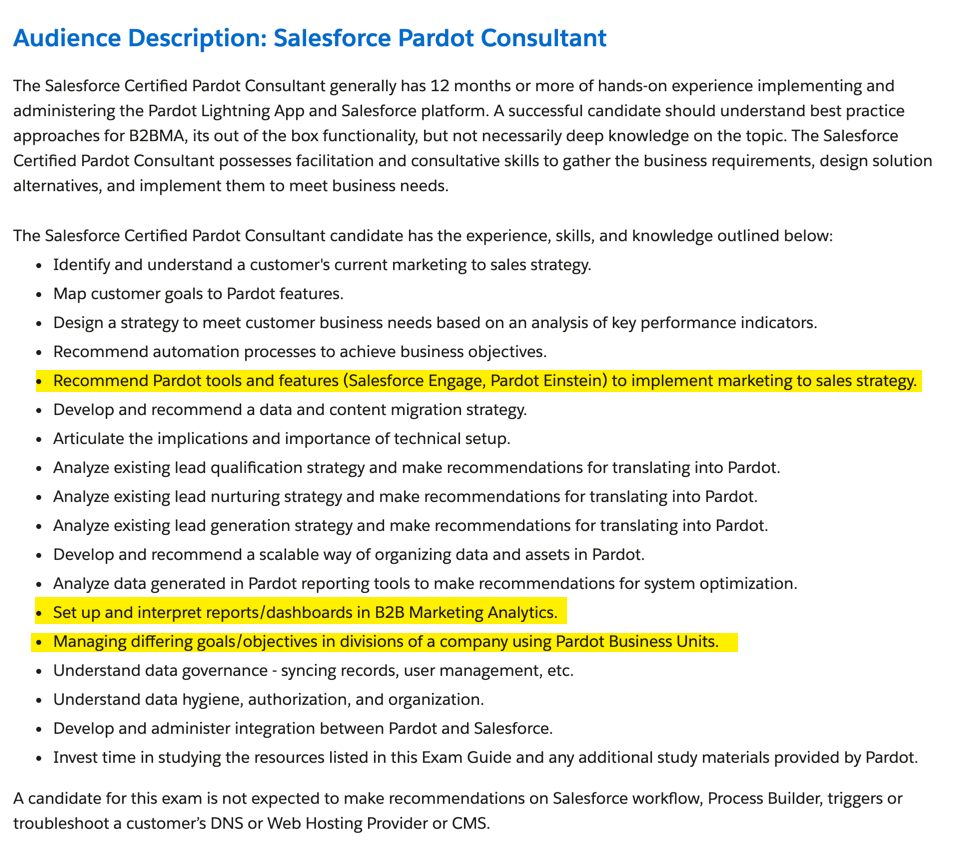
First, I reviewed the Salesforce Certified Pardot Consultant exam guide and highlighted the concepts that I’m not very familiar with.

Once I identified what concepts I needed to study, I put together a list of resources for each topic. These included blog posts, release notes and knowledgebase articles.

B2B Marketing Analytics resources

Pardot Business Units resources

Salesforce Engage resources

Pardot Einstein resources

I read through all the resources and created a flashcard for any term or concept that I needed to study.

Refreshing my knowledge on other core concepts

I also refreshed my knowledge of core concepts that were in the exam outline. I reviewed all the modules within the Prepare for your Pardot Specialist Credential Trailmix again. Since I completed the Trailmix a while ago, there were several new modules. I completed the remaining modules and reviewed all the modules I completed previously. I couldn’t figure out how to view the practice questions at the end of each module since they were already completed, so I opened up an incognito window to view them. I added those questions to my flashcards as well.

Lastly, I skimmed through the Salesforce Help Docs to study any remaining topics that weren’t covered in the Trailmix.

Studying tips

  • Review the exam outline and highlight the topics you aren’t familiar with. Focus the majority of your studying efforts on those topics.
  • Create a list of resources that cover your selected topics.
  • Create your own set of flashcards to study.
  • Review all Pardot Trailhead modules – even the topics you’re familiar with.
  • Review the Pardot Help Docs

How did you study for the Salesforce Certified Pardot Consultant Exam?

Leave a comment below to share your tips and resources.

A few weeks ago, my team posted an offer for a Pardot Admin Bootcamp Scholarship.

The idea was that we’d offer 1-3 spots in our paid training course for marketers who have lost their jobs or are struggling to find work as a result of COVID-19 and are looking to expand their skillset.

We were floored by the response, and it’s clear to us that 1-3 spots isn’t enough.

So we’re changing things up to try to do what we can in supporting the Salesforce and Pardot ecosystem during this crazy time. (more…)

No more posts to show