Learning how to use and customize Salesforce can be a rewarding experience, but it can also present unique challenges for individuals with disabilities. Whether it’s navigating the interface, processing complex data, or communicating effectively with colleagues, users with disabilities may encounter barriers that hinder their learning journey.
It’s a topic that’s near and dear to my heart, and I had the pleasure of presenting a session on this topic at WITNess Success, a Salesforce community conference.
In this blog, we’ll explore the experiences of individuals who have learned Salesforce while managing disabilities, highlighting their strategies, successes, and the resources available to support them.
Emphasizing the importance of accessible online learning modules to learn Salesforce while overcoming disabilities
The Salesforce community includes inspiring members who have shared insights into the experiences of individuals with disabilities learning Salesforce.
Here’s what they have to offer.
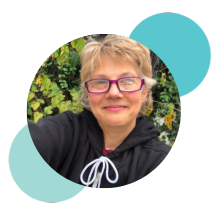
Akasia Parran
Akasia Parran, who has been legally blind for five years, found her path to a Salesforce career through the support of the Blind Institute of Technology and Salesforce’s accessible online learning modules.
Akasia completed her Salesforce Administrator certification in just six months. “I wouldn’t have a career without Salesforce’s continuing efforts to create accessible software,” she shares.
Thomas Frantz, Senior Manager of Accessibility Partnerships and External Communications at Salesforce, emphasizes the role of inclusive design and community support.
He has been instrumental in promoting accessibility within Salesforce and shares how the company’s efforts have helped him and many others thrive in their careers.
His work continues to foster a culture of inclusion and accessibility within the tech industry (Salesforce).
Leveraging Assistive Technologies
A range of assistive technologies is available to help users with disabilities learn Salesforce.
Screen readers like JAWS and NVDA help visually impaired users navigate the Salesforce interface.
Voice recognition software such as Dragon NaturallySpeaking enables users to input data and commands through speech, which can be particularly beneficial for those with mobility impairments or dyslexia.
Alternative input devices, like adaptive keyboards and mice, provide valuable support, allowing users to interact with Salesforce more comfortably and efficiently.
Seeking Personalized Support
One of the most effective strategies for learning Salesforce with a disability is to seek personalized support.
The Salesforce Trailblazer Community is a fantastic resource where users can connect with others who share similar experiences. Local user groups and accessibility resources provide additional guidance and support. By reaching out to these communities, users can access tailored advice, mentorship, and encouragement.
Embracing Universal Design
Inclusive design practices ensure that Salesforce training materials and resources are accessible to users of all abilities. Organizations should advocate for and implement universal design principles, ensuring their training content is user-friendly and accommodating. This includes providing alternative formats for materials, ensuring compatibility with assistive technologies, and creating an inclusive learning environment.
Building a Supportive Community
Fostering a culture of empathy and support within the Salesforce community is essential for empowering disabled users. Encouraging open dialogue about challenges and sharing strategies for overcoming them helps create a more inclusive and understanding environment. Users should feel empowered to share their experiences, learn from one another, and support each other in their Salesforce journeys.
Learning Salesforce with a disability may present unique challenges, but it is possible to succeed with the right strategies, resources, and community support.
Remember, your unique perspective is a source of strength, and your experiences can inspire and empower others on their learning journeys.
Event marketing is a fantastic way to connect with your audience, build brand awareness, and generate leads. However, managing event marketing activities can take time and effort. That’s where Account Engagement can help — in more ways than you probably thought!
Salesforce Marketing Cloud Account Engagement (f.k.a. Pardot) can streamline your event marketing efforts from initial promotions and registrations to post-event follow-up and nurturing. In this post, we’ll explore how you can use Account Engagement for event marketing to ensure a seamless and impactful experience. We’ll show you which out-of-the-box tool(s)we recommend using at what time during the event process so you can maximize your efforts.
Using Account Engagement for Event Marketing: Planning and Promotion
A marketing event is only as good as the planning that goes into it. Ensuring you have your campaigns and other assets created in advance with a clear goal and structure in mind will dramatically improve the organization of your initiatives and enable consistent reporting down the road.
Here’s how to do that.
Set Up Your Event in Account Engagement (Pardot)
If you’re using Connected Campaigns, start by creating a campaign (or hierarchy of campaigns) in Salesforce for your event. This will help you track all marketing activities and ROI related to the event. You’ll then associate all your event assets (emails, landing pages, forms) with these campaigns later.
If you’re not using Connected Campaigns, then we highly recommend you read this blog post to understand the advantages of Connected Campaigns and how to enable the feature. Then, reach out to Sercante if you’re unsure of your next steps.
Create Your Campaign Structure
These are the steps to create your campaign structure:
Navigate to Campaigns and click on + Add Campaign.
Name your campaign using your organization’s standard naming conventions.
Set default and/or custom fields, like cost, start/end date, and type.
If it is a child campaign, select the appropriate parent to create your hierarchy
Ensure your campaign is marked “Active” so it can sync with Account Engagement via Connected Campaigns.
Design Event Registration Forms
Now it’s time to design your forms to collect attendee information such as name, email, job title, and company.
Under Content > Forms, click + Add Form.
Ensure your form includes fields that are crucial for segmenting and personalizing follow-up communications.
Develop Event-Specific Landing Pages
Create engaging landing pages to capture registrations. These pages should highlight the event’s benefits, speakers, and agenda, and include a clear call-to-action (CTA).
Navigate to Content > Landing Pages and click on + Add Landing Page.
Choose a layout template that fits your event’s branding.
Customize the page with relevant content and images.
When prompted, select the form you created in the previous step.
Promoting Your Event
Develop Email Marketing Campaigns
After all, Account Engagement is an email marketing platform! Let’s use that core functionality to promote our event. Next, you’ll create a series of emails to promote your event.
Your campaign will include some form of the following emails:
Invitations
Reminders
Last-chance registration prompts
Follow-up correspondence with attendees
Some emails may be used as List Emails, while others may be automated sends using email templates.
I always recommend my clients have a comprehensive, universal email template on hand in their org. What I mean by that is a repeatable template that has lots of different sections for all types of emails. You’d clone this template, remove the sections you don’t need, and save.
On the right is an example of a Sercante Ultimate Email Template the team built for The Spot. It’s a common request our clients bring to us, so drop us a message if you don’t have a universal email template and want to get one.
Sending One-Off List Emails
If you’re sending a one-off List Email, follow these basic steps:
Navigate to Account Engagement Email > List Emails and choose one of your published Email Templates.
Modify your sections accordingly, while keeping consistent branding.
Craft compelling subject lines and body content that convey the value of attending your event.
Include a call to action, depending on the needs of the event.
Make sure to always test before you schedule or send your emails. There’s a handy QA checklist in this blog post so you can hit the send button confidently.
Go to Prospects > Segmentation Lists and create lists based on criteria such as past event attendance, industry, or engagement level.
Use dynamic lists for criteria-based segmentation (i.e. location, job title, CRM status).
Use static lists for manual segmentation (i.e. adding individual prospects to an invitation list).
Want to go a step further? Use social media connectors
Tap Account Engagement’s social posting capabilities to promote your event on LinkedIn, Twitter, and Facebook. You’ll need to set up your social media connectors under Account Engagement Settings > Connectors and log in to connect your social media accounts with Account Engagement.
Under Content > Social, you can create, manage, and schedule social posts. To complete the circle, you can insert CTAs in your posts that link back to your event landing page.
Managing Marketing Event Registrations with Account Engagement
Tracking Registrations
Forms
Use Forms to ensure all data flows into Account Engagement seamlessly. There’s a handy form style generator here you can use to customize your forms to match your branding.
Navigate to Content > Forms and click + Add Form (or clone one you already have!)
Map your fields to capture all necessary registration information.
Ensure you customize your Completion Actions for autoresponders, assignments, campaign membership, etc.
Automation Rules for Registration Management
If Completion Actions don’t offer the functionality you’re looking for, consider creating Automation Rules to manage registrants.
Automation Rules allow you to automate actions such as adding them to a list, sending confirmation emails, or notifying your sales team when hot prospects or accounts are actively engaging.
Go to Automations > Automation Rules and click + Add Automation Rule.
Set criteria (i.e. form completion) and corresponding actions (ie. add to list, send email, update campaign member status).
Once you’re ready to run it, make sure you “unpause” the automation rule.
Confirmation and Reminder Emails
For this, we highly recommend using Account Engagement’s automated nurture engine: Engagement Studio. This powerful tool comes out of the box with all MCAE editions.
Under Automations > Engagement Studio, you can create intelligent nurture programs to automate follow-up, update records and act immediately on interactions with your prospects.
Sending Confirmation Emails
Ensure that every registrant receives an immediate confirmation email with event details.
Reminder Emails
Schedule reminder emails leading up to the event to keep registrants engaged and reduce no-shows. Create a series of reminders — starting a week before the event, a day before, and a few hours before the start.
Event Marketing Doesn’t End There. Keep it Going!
You’ve made it to the day of your event! While your pre-event promotion is over, and your email invitations and reminders have all been sent, you can still use Account Engagement to engage with your prospects during and after the event, and throughout the sales process.
During the Event
Engaging Attendees with Personalized Content
Use Account Engagement’s dynamic content features to personalize the content displayed to attendees based on their profiles.
Navigate to Content > Dynamic Content and create content blocks that change based on prospect data (i.e. industry, job title, location).
Real-Time Data Collection
Use Account Engagement’s tracking capabilities to monitor attendee interactions during the event, such as session attendance and engagement with event content. You can also implement tracking codes on event-related pages and materials to capture real-time data.
Feedback Forms
Create and send feedback forms immediately after each session to gather attendee insights and improve future events. This is a crucial step that will help your team continuously improve and build stronger relationships with your audience.
Post-Event Follow-Up
Analyzing Event Performance
Generating Reports
Use Account Engagement’s reporting features to analyze event performance, including registration numbers, attendance rates, and engagement metrics.
Navigate to Account Engagement Reports to view detailed reports on your event’s asset performance (forms, landing pages, emails, etc.).
You can filter and export data, or use other tools like Salesforce Lightning Reports or B2B Marketing Analytics for more advanced reporting and data visualization.
ROI Analysis
Calculate the ROI of your event by comparing the costs associated with the event to the revenue generated from leads and opportunities.
Use Account Engagement’s ROI reporting tools under Reports > Marketing Assets.
Nurturing Leads
Follow-Up Emails
Create a series of follow-up emails to thank attendees, share event highlights, and provide additional resources. Use Engagement Studio to automate these follow-up emails for timely and relevant communication.
Lead Scoring and Grading
Update lead scoring and grading models based on attendees’ behaviors during the event.
Go to Account Engagement Settings > Scoring to adjust scoring rules, and use this updated data to prioritize leads for sales follow-up.
Re-Engaging Non-Attendees
Post-Event Outreach
Don’t forget about those who registered but didn’t attend. Reach out with recorded sessions, summaries, and key takeaways to keep them engaged. Use segmentation lists to identify non-attendees and create a specific follow-up campaign for them.
Surveys and Feedback
Send a survey to non-attendees to understand why they couldn’t attend and gather insights to improve future events.
Use Forms to create and distribute these surveys, and analyze responses to enhance your event strategy.
Planning Future Events
Reviewing Your Feedback
Incorporate feedback from attendees and non-attendees into your planning for future events to continuously improve the experience.
Use Account Engagement Reports > Forms to analyze the feedback forms you’ve sent after previous events, and make data-driven decisions and adjustments to your approach.
Early Bird Promotions
Start promoting your next event early with exclusive offers and early bird discounts to previous attendees.
Use Account Engagement Email to create and send promotional emails, and leverage Dynamic Content for personalized offers.
Now you’re an Account Engagement event marketing pro!
Using Account Engagement’s powerful features and capabilities, you can streamline every aspect of your event marketing activities, from initial planning and promotion to post-event follow-up and long-term nurturing. This ensures a seamless and impactful event experience and maximizes your marketing ROI and strengthens your relationships with prospects and customers.
Utilizing Account Engagement for event marketing can lead to more organized, efficient, and successful events, ultimately driving more meaningful interactions with your customers.
Consumers today want personalized experiences from beginning to end. This is why Sercante is thrilled to announce that The Home for Marketers has undergone a transformative name change. We’re marking a new era of comprehensive strategies focused on growth services.
This is more than a rebrand! It’s a reflection of Sercante’s expanded vision and commitment to driving radical business impact across all teams inspired by our recent acquisition by Trilliad. Our new home at dreamforce will be a place for anyone in sales, customer success, and marketing to gather. Without further ado, we are excited to introduce the Growth Lounge at Dreamforce 2024.
Introducing The Growth Lounge
The atmosphere and unique space that the Home for Marketers has offered in the past will still be returning to San Francisco, but we now extend an invitation to friends in sales and service as well. Renamed The Growth Lounge, this space will serve as the central hub for professionals across marketing, sales, and service to gather, spark inspiration, and exchange ideas on elevating customer experiences and through the latest technologies.
The Growth Lounge at Dreamforce is designed to foster deeper connections among these crucial teams. We’re promoting collaboration and alignment that are essential for delivering seamless interactions for consumers across any industry. This transformation reflects the growing recognition that customer experience is a shared responsibility across all departments.
Opening Doors to Sales and Customer Success
The Growth Lounge is dedicated to opening doors for sales and customer success teams. We want to be sure these teams have the tools and support needed to thrive. We believe growth is a collective effort, and by integrating the expertise of these teams, we can drive significant business outcomes.
Sales teams can tap our insights and strategies to identify new opportunities, while customer success teams can enhance their engagement efforts for long-term customer satisfaction and loyalty. This cross-functional approach not only boosts individual team performance but also contributes to the overall growth of the organization.
Why the Growth Lounge Matters
When a consumer enjoys a seamless interaction with your brand, they shouldn’t be able to distinguish whether they are dealing with marketing, sales, or service. They are simply having their own personal experience, and here at Sercante, we strongly believe that it is that consistency that fosters loyalty and satisfaction. The Growth Lounge aims to facilitate the integration and cooperation by creating a safe space to foster new connections, discover tech to level up your game, and receive live support from experts.
Join us at Dreamforce
If you’re heading to Dreamforce this year, make sure to RSVP for your FREE 3-day pass to The Growth Lounge.
This year, we are hosting the lounge September 17-19, 2024 from 8:00 a.m. to 4:00 p.m. each day at Yerba Buena Bar. And that’s not all! There’s so much more to join in on while at Dreamforce 2024.
Marketer’s Meet Up
We have set aside time to mix and mingle with our fellow marketers and we hope you do not miss out! Along with your free pass to The Growth Lounge, Sercante will be hosting a mix and mingle for sales, marketing, and customer experience professionals before Dreamforce even kicks off.
There’s nothing quite like ending a day at Dreamforce than with a Sercante hosted party “In the Clouds.” We will be celebrating cross-cloud collaboration and business growth with all of you, along with a live band and DJ to keep the party going following day one of Dreamforce’s festivities.
RSVP today so you don’t miss out on the celebration.
Tuesday, September 17, 2024
7:00 PM – 12:00 AM
715 Harrison
Our Fellow Sponsors
Not only do you have the opportunity to connect with several Sercante Dragons who will be in attendance, but we would be remiss without calling out our fellow Growth Lounge sponsors. When you stop by The Growth Lounge, you will also have the opportunity to meet up with other like-minded industry experts to discover new tools, tips, and tricks to take your business growth to the next level.
Our sponsors will be hosting live demos, providing free support, and, of course, there will be tons of swag!
Don’t miss out on your chance to be part of a community committed to redefining customer experience through collaboration and innovation. We look forward to seeing you at Dreamforce and working together to take the standards of customer interactions further than ever before.
Do you have an organized brain, enjoy project managing across multiple stakeholders and departments, love visualizing a process, and want to prove it with a new Salesforce certification? Well, then the Salesforce Business Analyst Certification is the right one for you!
Here is our guide to passing the Salesforce Business Analyst Certification exam. Good luck!
Step 1. Review the Salesforce Business Analyst Exam Guide & Schedule Your Test
Quick reminder that there are no longer any prerequisites for the Business Analyst exam! It is helpful to know or have experience with Salesforce and understand platform functionality and terminology though.
According to the Salesforce Business Analyst exam guide, this certification is “designed for Business Analysts with Salesforce experience. The successful candidate understands business needs, captures requirements, and collaborates with stakeholders to support the development of Salesforce solutions which drive business improvements.”
If you are interested in refreshing your Salesforce skills or earning one of the related certifications first, here are two helpful resources:
The exam guide goes into each objective in more detail and also describes the person who is more likely to succeed with this certification (a.k.a. you!).
Schedule Your Exam
Once you have confirmed that this is the certification for you, schedule your test so we have a deadline to study for. Here is the link to make this the easiest step.
Step 2. Organize Your Study Resources
We already established we have well-organized, to-do list, and process-visualization brains so I’ve gone ahead and done the pre-work (Googling) for you to track down our favorite resources, practice tests, and study guides. Plus we’ve included some key topics to revisit based on our experience earning the Business Analyst certification.
This is an essential step for the Salesforce Business Analyst certification! You need to get in the head of the Salesforce test writers to best understand the use cases and user stories they are presenting because at first glance, most of the answers are going to appear correct. However, we want to choose the best process, steps, model, team structure, etc. that matches the specifics of the situation outlined.
Cert Prep: Salesforce Business Analyst – free, there are good practice questions within the Trailhead modules (not the questions at the end for checking understanding, but these are helpful too)
Salesforce certifications are difficult. Lucky for us, there are a ton of welcoming communities that we can reach out to for support.
One of our favorites is co-led by one of our own Sercante team members, the Boston Area Community Group with Jordyn Jaffer. This group hosts annual, virtual certification camps that are run completely by attendees. The attendees work together to present different topics each week to help each other prepare for taking the certification. Jordyn says, “ We are in our fourth year of facilitating these and are tackling the Salesforce Advanced Administrator Certification (for the second time!).” Check out their upcoming camps on their Trailblazer Community page here – Boston Women in Tech.
Topics Worthy of a Second Glance
Know the process chart names and when to best use them based on the use case described. There are specific matches Salesforce will be looking for and there are going to be a lot of lengthy use case and user story questions.
Understand the order of the four phases of the implementation lifecycle.
Step 3. Ready? Pass the Salesforce Business Analyst Certification!
You might never feel ready to take the Business Analyst test – there are endless ways to think about processes and user stories and everything in between. But just like the solutions we are managing and building, there has to be an activation date.
Test-Taking Tips from the Sercante Dragons
Find Keywords
These phrases in the questions can indicate the answer or what you can eliminate as an answer.
Mark Questions for Review & Read Them Carefully
Always refer back to the full question during or at the end of the exam when you are starting to second guess yourself, there might be something key you missed when you first read it.
The correct answers for this exam are going to be very order-dependent so make sure you read them slowly.
Pay Attention to How Questions Answer Each Other
The use cases being described usually highlight a specific title or department so consider that when choosing the correct answer.
Think about how they phrased other questions as that might help you focus on the correct answer for a question you were unsure of.
Don’t Overthink Questions that Seem Easy
There are going to be a lot of questions that sound the same in this exam – don’t get stuck in a second-guessing loop when the answer seems too simple.
Using Synonyms of Words Can Help Answer a Question
For example, “what is the best diagram for this?” One of the correct answers is “the big picture.”
Have a General Understanding of the Main Salesforce Products
There will be questions and answers that list actual Salesforce platforms or functionality by name. For example, “your team/client/customer has this problem, which feature/product would help solve this?”
Good luck, you’ve got this!
Share any resources or problem topics in the comments section to help prepare the next group of Salesforce Business Analyst test takers.
It’s that time of the year again — when marketing, sales, and service professionals from around the globe gear up to reunite in Chicago, IL for the highly anticipated Salesforce Connections 2024 conference!
What is Salesforce Connections and why you should attend?
If you’re new to the ecosystem or never heard of this conference, here’s the lowdown.
This year Salesforce Connections 2024 is happening on May 22 – 23, at the McCormick Center in Chicago, Illinois. This annual two-day conference, hosted by Salesforce, is a must-attend event for anyone who delivers exceptional customer experiences, specifically digital marketers and commerce professionals who use the Salesforce platform. The 270+ sessions at this conference cover topics trending in the general marketing and Salesforce ecosystem like AI, CRM, and data strategies.
Who should attend?
If you’re a Salesforce user or a marketers who use Sales Cloud, Marketing Cloud, and Commerce Cloud, then this event is made just for you. The real magic lies not just in the sessions, but also in the immersive networking opportunities you will find throughout the week that can transform your career.
This is a filtered view of our team’s top picks for the upcoming conference, be sure to add them to your agenda.
Marketing Keynote
Marketing Keynote: Reimagine Personalization with Einstein 1
Description: The AI revolution is here to stay. Keep up by learning how Einstein 1 unlocks new ways for marketers to use trusted data and AI to fuel better personalization, business outcomes, and relationships. Add to your agenda >
AI & Data Cloud
Prep Your Small Business for Using AI in Marketing Description: In this roundtable, we will discuss three ways small businesses can prepare to successfully use AI in their marketing. Be sure to say hi to our VP of Technology, Kirsten Schlau, after the session. Add to your agenda >
How to Elevate Your B2B Marketing with Data and AI (Account Engagement)
Description: Hear how Einstein functionality in account engagement helps marketers save time and scale customer engagement. Plus, learn how to prepare your data and marketing team to realize the full value of AI. Add to your agenda >
Marketing Cloud
Create Connected Journeys for Your Small Business Customers (Growth)
Description: Learn how small businesses can leverage Salesforce flows and data from marketing, sales, and service touchpoints to create connected customer journeys. Add to your agenda >
Unlock B2B Marketing Innovation with Data and AI (Account Engagement) Description: Learn how Account Engagement and Data Cloud can help B2B marketers unlock data outside of the CRM for more personalized journeys. Plus, learn how data and AI are accelerating B2B marketing innovation. Add to your agenda >
Align Sales and Marketing with Account Engagement in Slack (Account Engagement)
Description: Learn how to accelerate lead conversion, enable sales efficiently, and deepen customer relationships with stronger sales and marketing teamwork through Slack and Marketing Cloud Account Engagement. Add to your agenda >
Unlock Data to Power Personalization and Ignite Engagement (Engagement)
Description: Join us to see how we’re helping financial services marketers to make data their competitive advantage in powering relevant engagement journeys at each stage of the customer lifecycle. Add to your agenda >
How to Connect Customer Journeys from Doorsteps to Digital (Engagement)
Description: Learn how top communications service providers are increasing both physical and digital conversion rates with a unified data strategy that enhances their targeting and journey personalization. Add to your agenda >
Marketing Operation Fundamentals
Learn How to Improve Your Email Sender Reputation
Description: Deliverability can seem like a puzzle, but together we’ll break it down so you can set your email program up for success. You’ll develop a strategy to manage, monitor, and understand deliverability. Add to your agenda >
The Three P’s of Migration — Platform, People, and Process
Description: Join Women in Tech Leadership to discuss the importance of a healthy relationship between marketing and IT, associate training, an MVP mentality, building a platform foundation, and value stories. Add to your agenda >
Beyond the sessions: What else should I expect?
Life is more than just work, after all, no Salesforce conference is complete without a little celebration. Last year, we brought you a Wildly Epic Night (check out the gallery), and we are back at it again this year. Come celebrate your achievement and forge new connections with us!
A happy hour to match digital experiences that delight
Join us this year for the Roof Rhythms & Refreshments Happy Hour hosted by Sercante, Stensul, and SalesWings at ROOF. We’re teaming up with Stensul and SalesWings to create an evening as meaningful as the digital experiences we deliver to our clients.
Form real connections with people who get it and dance to a live band playing your favorite hits so you can feel radical impact on the first night of Connections. It’s at the iconic ROOF on theWIT and space is limited, so be sure to RSVP to secure your spot!
Wednesday, May 22, 2024 Time: 7:00 – 10:00 PM Roof Gallery at ROOF on theWIT Register now >
Stay tuned to more celebrations popping up closer to the event.
How to connect with Sercante at Connections
Still undecided? Be sure to follow Salesforce’s social media accounts and website for updates (you may even score a discount). Below are a few opportunities to connect with our team during the conference to explore new opportunities and industry insights.
Join our session “Prep Your Small Business for Using AI in Marketing” with Kirsten Schlau (Sercante) and Charlotte King (Salesforce) Add to agenda >
Let’s chat about career growth – check out new roles at Sercante Browse roles >
See you at Salesforce Connections 2024
Regardless of whether you attend in person or virtually (through Salesforce+), tag us on LinkedIn with your best moments. We’d love to be part of your conference experience.
These are my highlights and key takeaways from Salesforce World Tour D.C. 2024, where the Salesforce community converged to explore the latest in AI, data management, and nonprofit marketing.
From actionable tips on implementing Data Cloud to insights into trusted AI with Einstein Copilot, this recap unveils the strategies and innovations driving success in today’s dynamic business landscape.
Join us as we delve into the transformative power of unified data, organizational alignment, and customer-centricity, shaping the future of Salesforce in Washington, D.C., and beyond.
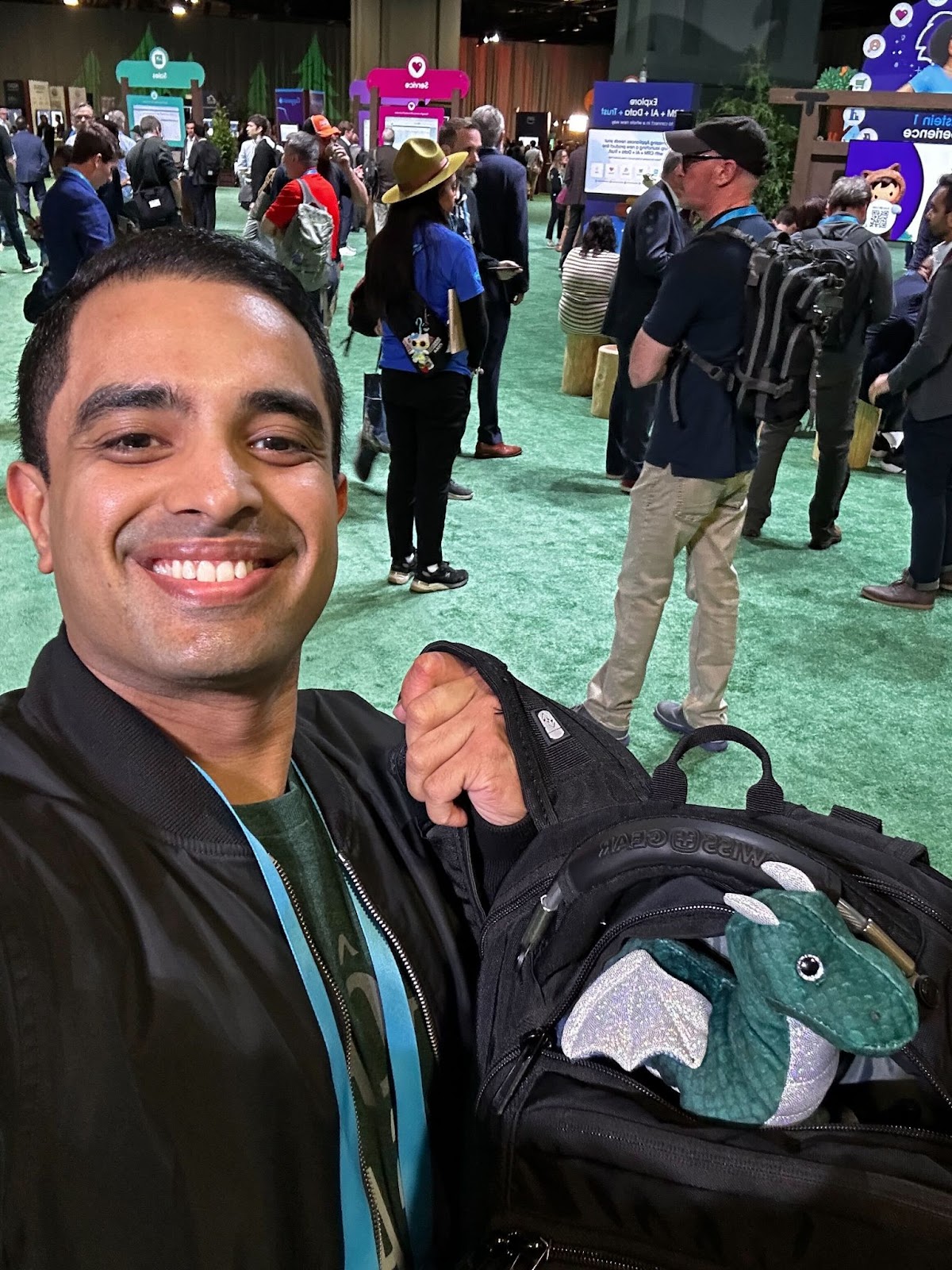
Nick Kanthadai at World Tour D.C. 2024
Salesforce World Tour D.C. 2024 Highlights
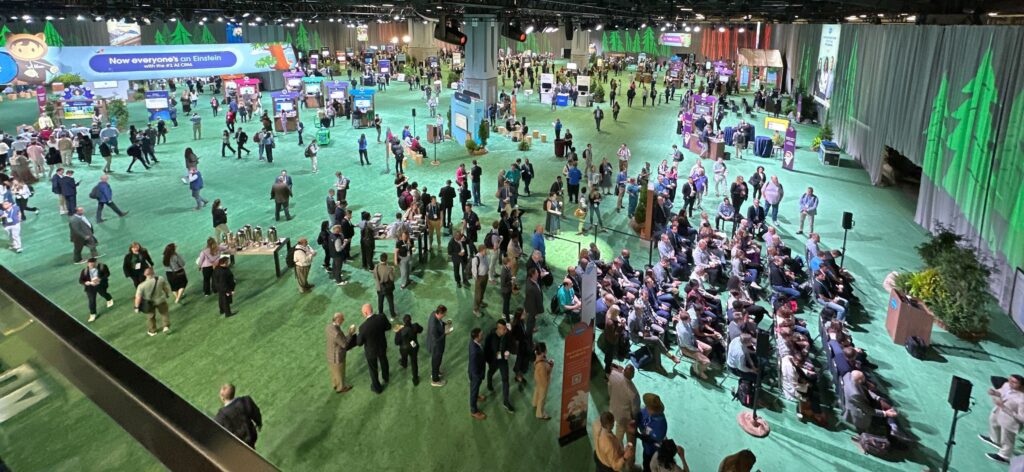
Salesforce checked in for their annual World Tour D.C. on April 10, 2024, at the Walter E. Washington Convention Center.
I had the pleasure of attending and being a part of the growing Salesforce community in the DMV area.
The focus of World Tour D.C. this year just like every other Salesforce event for 2024 was AI, AI, and more AI.
Pro Tip: If you missed the event this time around, you can catch all the main sessions & keynote videos here.
That said, here are my top takeaways from World Tour D.C.
Highlight 1: Top Tips for Getting Started with Data Cloud
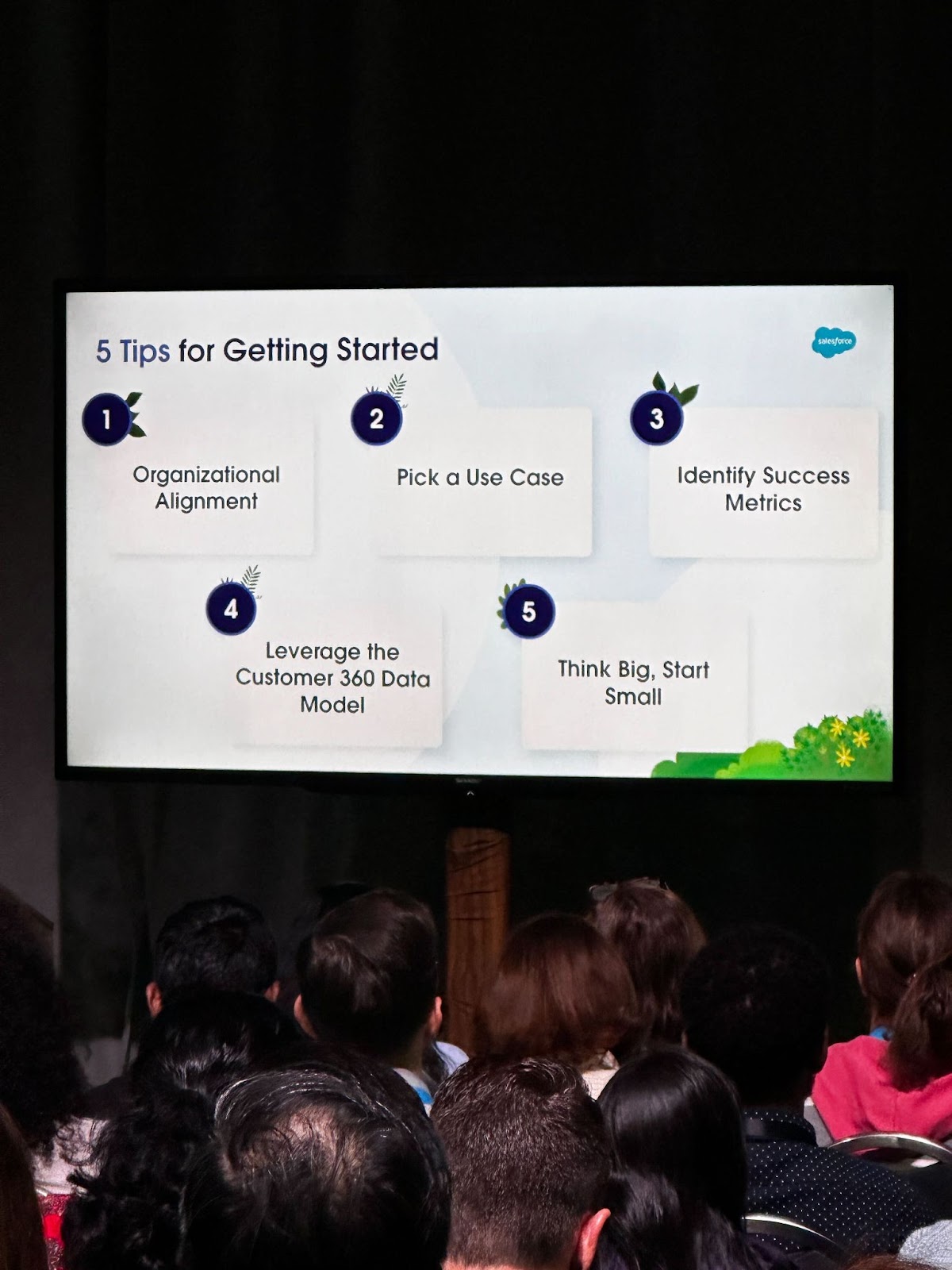
World Tour D.C. showcased the top 5 must-have tips if your organization is thinking about implementing Data Cloud and harnessing the power of all your siloed data infrastructure under one unified SF Data Cloud platform.
Organizational Alignment: Establish a clear owner and get all departments/stakeholders on the same page.
Pick a Use Case: Focus on one or two initial use cases that drive team optimization and deliver tangible results within a reasonable timeframe.
Identify Success Metrics: Define KPIs, establish baseline metrics, monitor data quality, track user adoption, and always iterate to improve.
Leverage the Customer 360 Data Model: You have to walk before you can run. Use the out-of-the-box data models when you’re getting started.
Think Big, Start Small: The platform has growth capabilities so you can scale, but you have to take small bites in the beginning.
My takeaways
The two tips around Organizational Alignment and Think Big, Start Small resonated with me the most as these two tips will surely put your organization on the right track for success.
Getting buy-in from every major stakeholder around defined goals is paramount to achieving the success needed. Shoot for the stars in what you want to achieve with Data Cloud, but start small with a basic use case that can showcase the power of unifying your data and implementing a customer journey that can show value to your organization.
Favorite quote from the presentation
“Customer experiences are only as good as your insight into your customer data”
During the main keynote, Salesforce leaders took to the stage to show how everyone can become an Einstein with CRM + AI + Data + Trust.
Emphasizing Data Trust
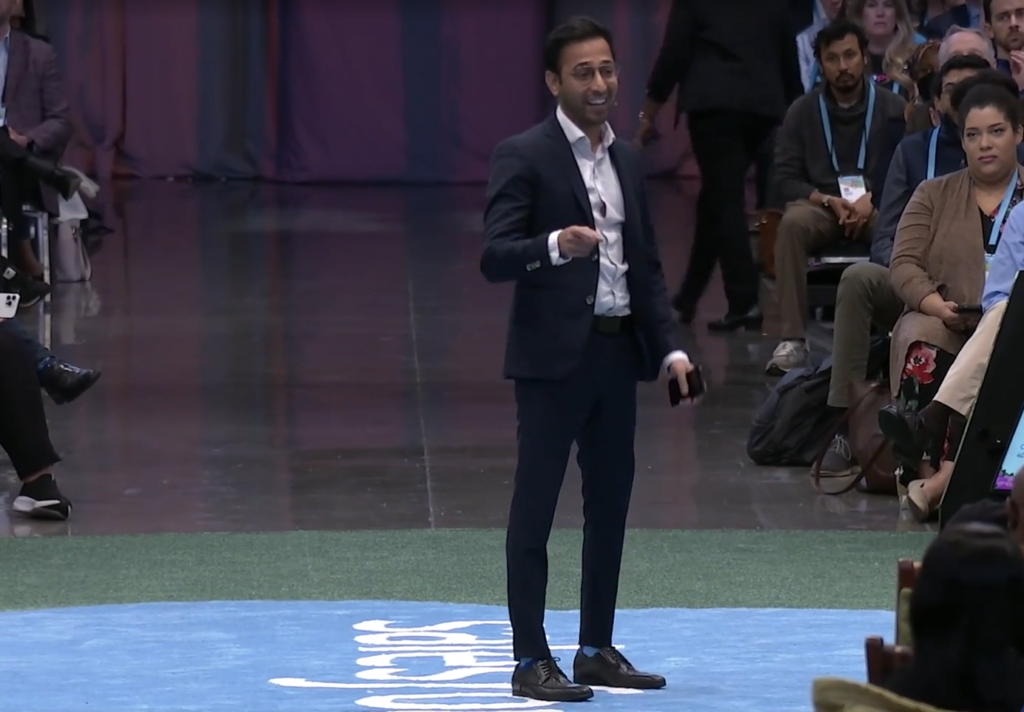
Parth Shah
Parth Shah, Senior Manager for Product Marketing at Salesforce, was on hand to discuss how trusted AI requires trusted data to achieve your organization’s success.
Key Insight from Parth Shah: 81% of IT leaders say data silos hinder digital transformation
Einstein Copilot
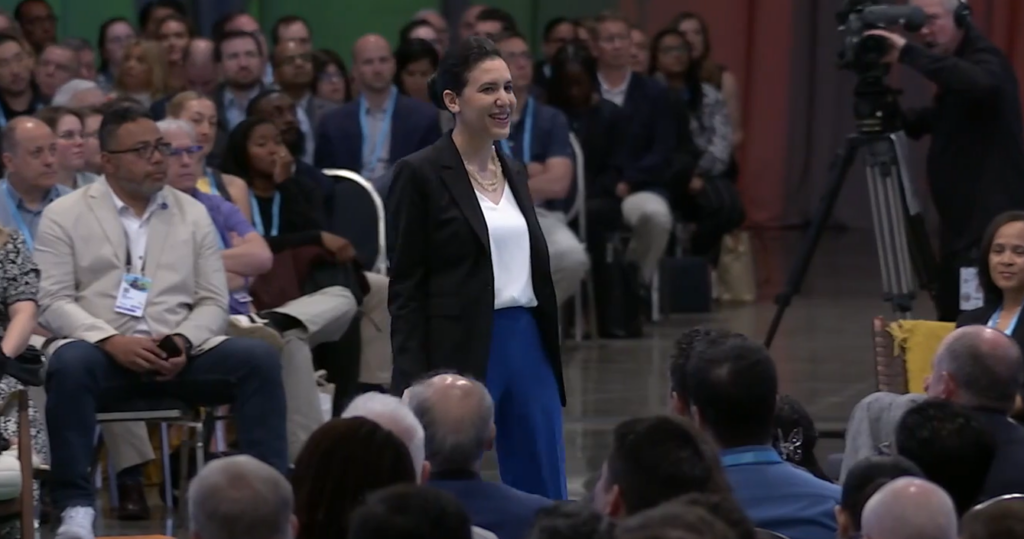
Alice Steinglass, EVP & GM Platform at Salesforce, spoke to all the exciting features of Einstein Copilot. She explained that Einstein Copilot uses trusted AI grounded with your own company’s data, so you can tap into Copilot across every app and reduce repetitive work.
A study from Asana in 2023 found that 62% of work time is lost to repetitive tasks. Why not use the great features of Einstein Copilot to reduce the need for repetitive work by your team? That way, you can focus on what is most important — your customers!!
Alice Steinglass
Highlight 3: How to use Data Cloud for Nonprofit Marketing
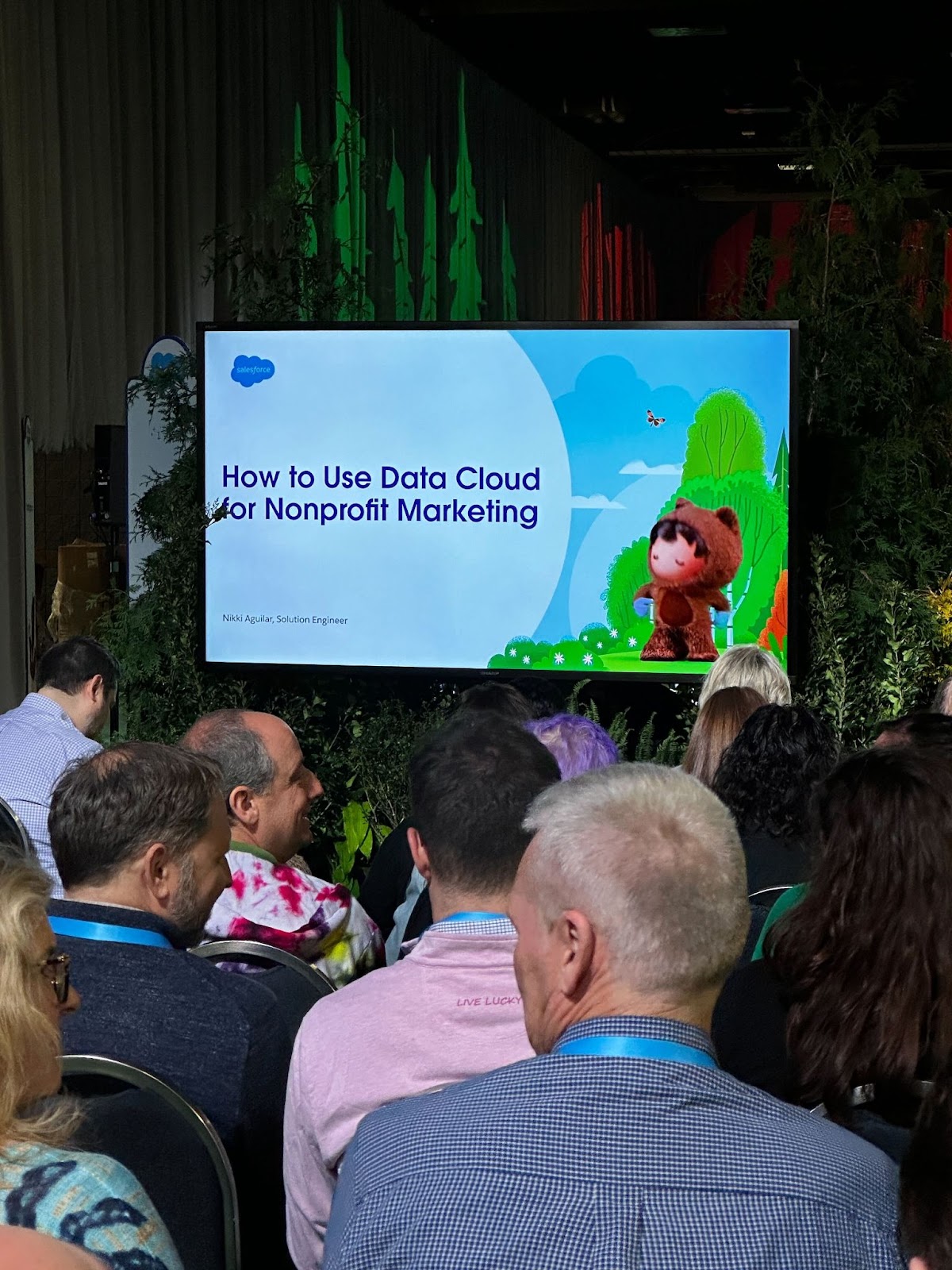
If you are a Salesforce Marketing Cloud user in the nonprofit arena, How to Use Data Cloud for Nonprofit Marketing was a must-see presentation. Nikki Aguilar, Salesforce Solution Engineer, spoke about the reasons unified data matters.
My 3 takeaways for using Data Cloud for Nonprofit Marketing
Increase awareness & collaboration. Collaboration and awareness are the keys to being successful when using Data Cloud for nonprofit marketing. It solidifies trust and facilitates connections across the organization.
Deliver unified, accessible, and actionable data. To support awareness and collaboration at nonprofits, delivering unified, accessible, and actionable data helps with getting resources on board who can elevate the fundraising and marketing experiences.
Create a culture of data as a strategic asset. Your data is a strategic asset for the organization as a whole. Creating a culture where data is a strategic asset helps advance operational and program excellence and establish trust among all stakeholders.
World Tour D.C.: Innovations in AI, data management, and nonprofit marketing
World Tour D.C. April 2024 brought together the vibrant Salesforce community in Washington, D.C., for a dynamic event showcasing the latest trends and innovations in AI, data management, and nonprofit marketing. From insights into leveraging Data Cloud to the unveiling of Einstein Copilot’s capabilities, we left with inspirational tips to take home and share with our teams.
As we reflect on the event, it’s clear that the path to success lies in aligning organizational goals, harnessing the power of trusted AI, and embracing a culture where data drives strategic decisions.
I hope you enjoyed my top 3 takeaways from World Tour D.C. 2024! As always, you can send us a message to chat about your Salesforce org and ways to get more ROI from your technology.