
We’ve all been there: a high-energy workshop, sticky notes covering the walls, and a beautifully documented plan for how marketing, sales, and customer success will finally work in perfect alignment. But then Monday morning hits. Teams retreat to their respective silos, the slide deck gathers digital dust, and the seamless experience promised through stronger alignment remains a myth to your buyers and your teams. To move from just talking about alignment to action requires applying your strategy to the systems your growth teams use daily and approaching your technology with a playbook for sustaining lifecycle alignment.
To get the highlights on how to approach this, continue reading below. To get the full deep dive, watch Part V, Stay Synced: The Technical Playbook for Lifecycle Alignment, of the Built to Buy Series.
The Execution Gap: Trends of Modern B2B Growth Teams
Alignment is easy to talk about but notoriously difficult to operationalize. According to the 2025 Trilliad Sustainable Growth Study, 1 in 3 growth leaders admit their alignment strategy stops at the planning phase. They have the vision, but they lack the technical execution to make it a reality.
This execution gap is often the deciding factor between those who grow and those who struggle. The same study found that twice as many high-performing organizations act on their alignment strategy compared to struggling ones (48% vs. 23%). The winners aren’t just better at planning. They are bringing that alignment directly into the technology their growth teams use every single day, from the CRM and marketing automation to analytics, revenue intelligence platforms, and more.
The Challenges: Complex Tech Stacks. Siloed Data. Limited Resources.
However, there are a few major challenges that growth leaders are facing when it comes to applying their alignment strategy to their technology. For starters, a complex technology stack, where the average large enterprise has 600+ applications (WalkMe Inc.). Historically, organizations have been in the habit of: Have a problem? Buy a new piece of technology. Doing so creates tech sprawl and a tangled web of siloed data spread across disparate systems. Making it more difficult for marketing, sales, and customer success to collaborate across the customer lifecycle.
The other challenge is having the resources needed to effectively approach the technology, so that it aligns with the alignment strategy. Organizations may not have the in-house expertise or bandwidth that it takes for the right setup, and they may not have any documentation on how the system was historically configured to know where to start.
Overcoming these challenges does not happen by attempting to solve everything at once. Progress is made by establishing the end goal, setting the right vision, and then creating a prioritized, actionable roadmap for your teams, data, and technology to result in the desired outcome. Enabling you to action your alignment strategy with an approach that is grounded in business outcomes. This transition from high-level strategy to everyday reality begins with building a technical playbook that turns your theoretical journey into a functional system of alignment.
The Technical Playbook for Sustaining Lifecycle Alignment
To move from “random acts of alignment” to a sustained engine requires bringing your customer lifecycle mapping into your technology. Part I of the Built to Buy Series, Walk Your Funnel Like a Customer, discusses how to approach mapping your customer lifecycle through the buyer’s point of view. Using this customer-centric mindset as a guide during alignment operationalization is critical. Because it keeps the question, “What will this experience feel like to our buyers?” at the forefront, ensuring that alignment processes are being designed for how the buyer will actually engage with the team, to create better buying engagements that build trust and create deeper relationships.

Making the buyer’s stages throughout the customer lifecycle visible in the technology is the starting point of what teams should be thinking about when establishing an operational system that supports sustained alignment, along with a few core automations, feedback loops, and realignment triggers.
Make the lifecycle visible in your technology.
Your lifecycle stages, handoffs, and definitions shouldn’t just live in a slide deck. They need to be represented as actual fields, statuses, and reports within your CRM and marketing automation systems. Not having the customer lifecycle stages represented can result in fumbled handoffs between marketing, sales, and customer success. Leading to mistrust, a lack of accountability among teams, a leaky funnel, and friction in the buyer experience. Therefore, how the stages are implemented is critical to think through when approaching your technology to support sustained alignment.
Consider core automations and AI functionality to streamline processes.
To create a system that is scalable for sustaining alignment, teams should think about which automation and AI functionality they can use to streamline processes. Four foundational automations to consider are:
- Lead Qualification: Scoring and grading to prioritize the right leads at the right time for sales.
- Routing: Automatically connecting qualified leads and accounts with the right owners.
- Status Updates: Moving records through the lifecycle based on triggers.
- Alerts: Notifying the team when a lead has sat for too long or needs immediate follow-up.
Applying these automations makes key transitions in the buyer’s journey smoother and fosters tighter collaboration between teams for seamless handoffs that build buyer relationships rather than erode trust.

Keep open lines of communication with feedback loops.
Sustaining alignment requires capturing the “Why.” Why was a lead disqualified? Why did an opportunity stall? By building “lost reason” or “disqualification” fields, you collect data-driven insights that allow marketing and sales to have objective conversations about shifting lead quality or handoff timing. Empowering teams to be proactive about when they might need to realign or refine a process.
Define potential red flags that would trigger realignment conversations.
Think of these as an early warning system. By building reports that surface “red flags”, such as conversion rates between stages dropping, deals sitting in a stage for too long, or overall pipeline velocity slowing, your system points to problems before they become a major challenge.
Realignment triggers and feedback loops complement each other as methods for fostering meaningful, data-driven conversations between marketing, sales, and customer success that sustain alignment beyond initial execution.
Taking the Next Step: The System of Alignment Checklist
To apply this playbook to your own organization, download the System of Alignment Checklist. It guides marketing, sales, and customer success teams to think through how their alignment strategy is executed in their technology. Starting from having lifecycle stages present to established processes for handoffs and follow-up, through the data-driven mechanisms of feedback loops, realignment triggers, and shared reports that will support proactive conversations for sustaining alignment and stronger collaboration.
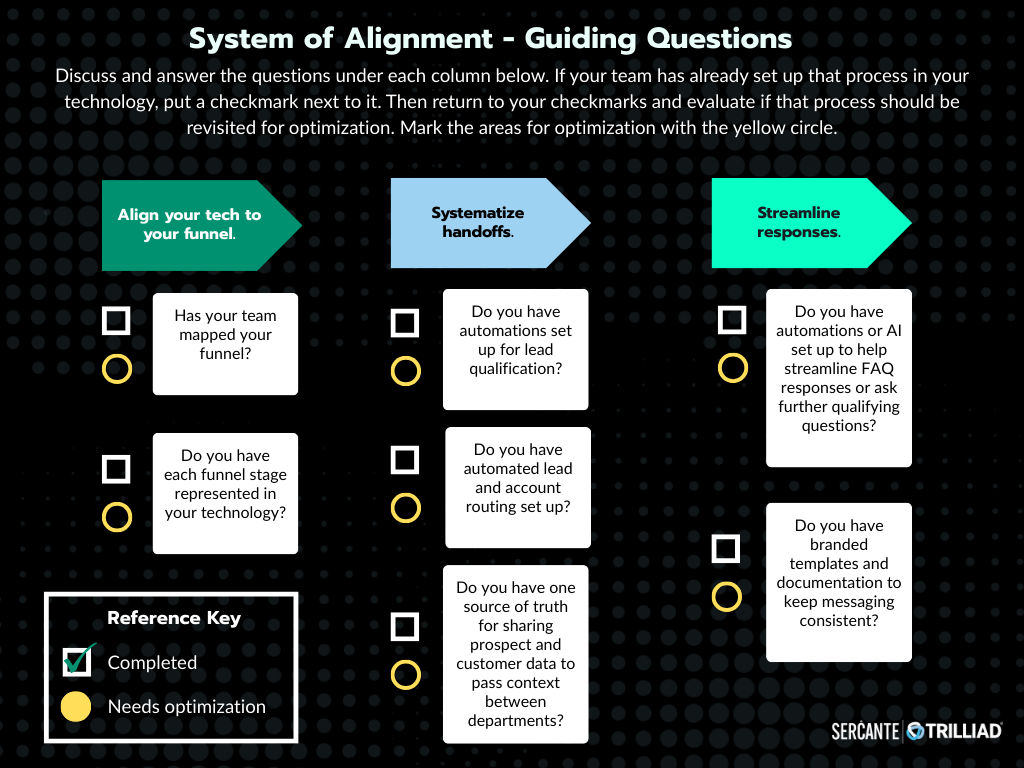
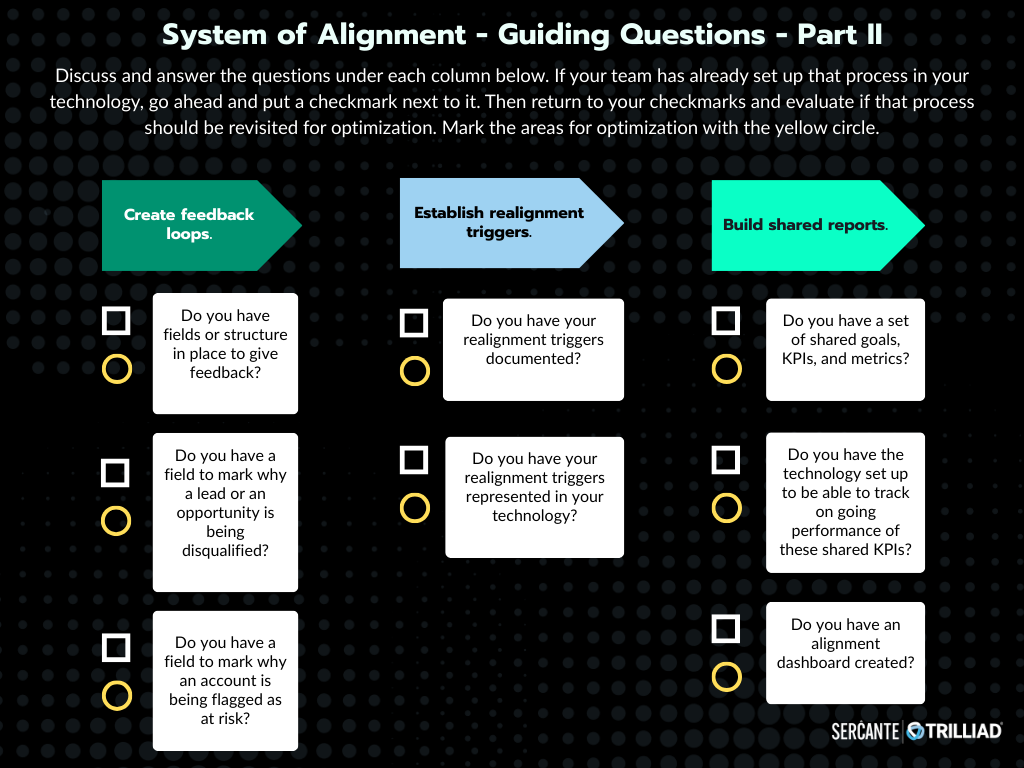
Answering the guiding questions in each area helps teams to identify what they might already have set up in their systems, what’s missing, and what might need revisiting for optimization. The end result provides a clear visualization of the gaps in your systems and a better understanding of the areas that would be the most impactful places to start when creating your roadmap to effectively implement your alignment strategy into your technology.
Executing sustained alignment: a growth differentiator
A major factor separating high-performing organizations from struggling ones is effectively executing the alignment strategy. Doing so requires moving past the planning phase and bringing it into the systems that growth teams use daily, from implementing lifecycle stages to establishing shared reports. Applying a technical playbook to create your system of alignment through an established vision and a phased roadmap is how you successfully take alignment from conversations in a meeting to sustained, successful execution that delivers a seamless buying experience.