Category

New Features

Salesforce winter ‘24 release notes are out! Here are the most important features coming to Account Engagement that marketers should know about.

Winter ’24 Highlights for Marketers

Highlight #1 – Engagement Studio Program wait times less than 1 day!

Marketers have been keeping their fingers crossed for this feature for a long time, and it received over 8k points in the IdeaExchange.

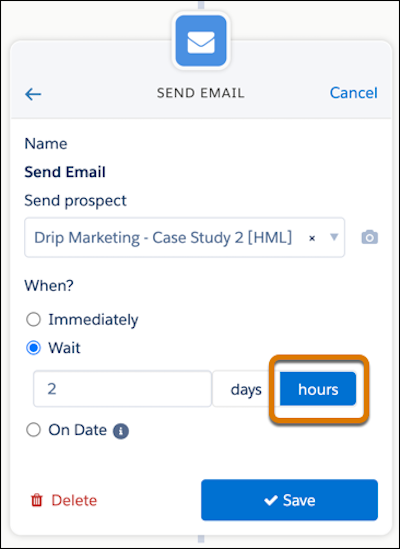
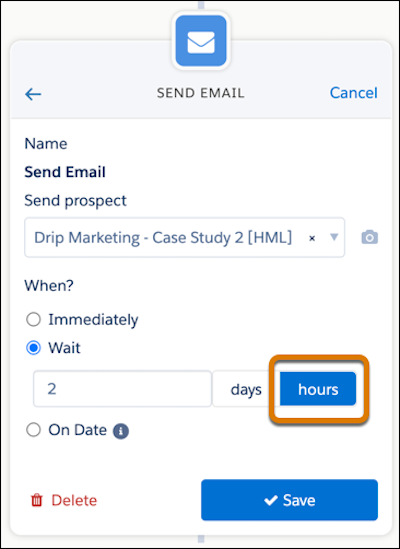
With the Winter ‘24 release, you’ll be able to set Engagement Studio Program wait steps to 2-8 hours. This will be especially helpful if you’d like to give other processes time to run before moving onto next steps or before syncing the Prospect to Salesforce. This feature will be available to all Account Engagement Editions. 

Get an in-depth look at the new feature in this post – Shorter Wait Steps in Engagement Studio Are Here.

Highlight #2 – Sandbox to Production Flow

Details are sparse on this new feature, but it appears orgs will be provided with an example flow that can be copied and used to push Account Engagement Sandbox assets to Account Engagement Production. No details on which aspects of Sandbox will be able to be pushed to Production, but I have a feeling it will be somewhat similar to the Bulk Assets Copy Flow for multiple Business Units. 

Highlight #3 – Review Email Templates with Invalid Senders

New Domain restrictions took effect in the Spring ‘23 release. As a result, you will now be prevented from sending an Account Engagement email with a sender from an unverified email domain. This is aimed to help protect your sender reputation.

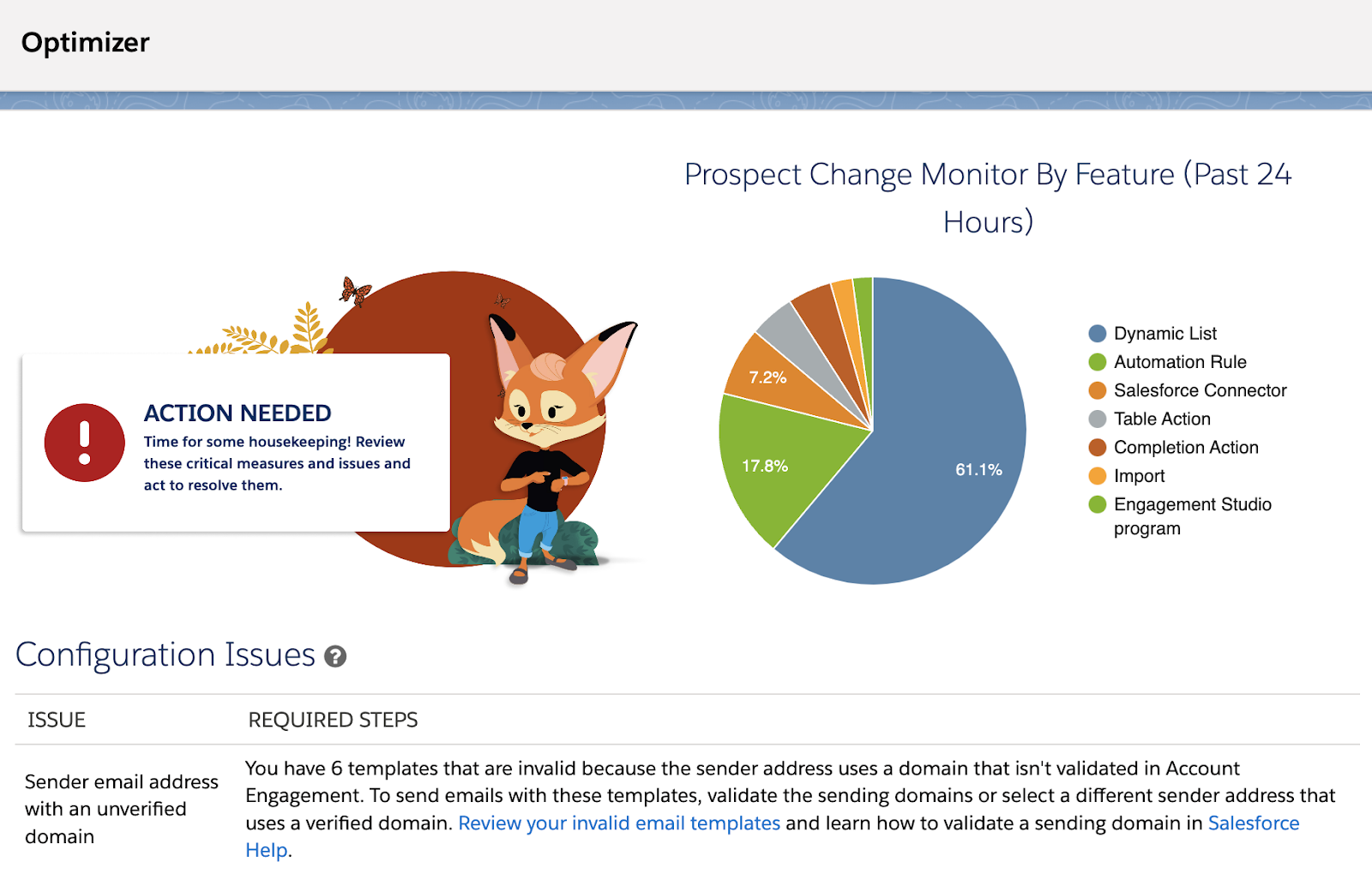
This new feature will allow you to identify which email templates currently have an unverified sender so you can easily update them and keep using the email template. These notifications are already showing up in Optimizer, so may be able to proactively check for this issue rather than waiting until the release is out. To check, navigate to Account Engagement Settings > Optimizer and look for any Configuration Issues with “Sender email address with an unverified domain.”

Highlight #4 – Change Monitor Histogram

Account Engagement Optimizer is also getting a new feature that will allow you to review Prospect changes. Details on this new feature are a little sparse. Optimizer already has a way to view Prospect Changes (discussed in our Everything You Need to Know About the Account Engagement Optimizer blog post), so my guess is this view is going to have new and improved ways to filter and chart the data. 

Highlight #5 – Restrict which domains can iframe Account Engagement Assets

With the Winter ‘24 release you can now restrict which domains Account Engagement assets, such as forms and landing pages, can be iframed on, or restrict iframing assets all together. This helps you ensure your assets can’t be used on websites you don’t own, such as competitors or partners, as well as ensure assets are only iframed on the domains belonging to that particular Business Unit. 

Business Units created after the Winter ‘24 release will have iframing restricted by default.

A Few Other Salesforce Winter ‘24 Updates

Which Salesforce Winter ‘24 features are you most excited about? Let us know in the comments!

Components are a hidden gem in the CRM Analytics (formerly Tableau) toolbox. You can re-use them in any dashboard and then centrally make changes that affect any dashboard where the Component is placed. But before the Salesforce Summer ‘23 release, they had to be identical on every dashboard! 

If you wanted revenue by State on one dashboard and revenue by Country on another Dashboard, you needed two different components. 

Not anymore! Here we provide a step-by-step guide (with pictures) to get you feeling confident and excited about using (and re-using) these amazing widgets. Thanks to the Salesforce Summer ‘23 release, you can now use parameters to make component widgets dynamic.

How to Make Component Widgets Dynamic in CRM Analytics

Ready to get started? Here are the steps to making your CRM Analytics component widgets display dynamically using parameters.

Step 1: Create a Component

There are a few ways to do this. I’ll outline the method that flows best with dashboard creation. But like many Salesforce tasks, there is more than one way.

  1. From a dashboard, drag the component widget to your dashboard.
  2. From the dialog box, select Create New Component.
  1. Add a widget to your new component.
    • In our example, we are using the Account Engagement (Pardot) Prospects and grouping by country.
  1. Save your component

2. Add a Parameter to your component

  1. Click on the Component Widget and choose the advanced editor from the widget menu. 

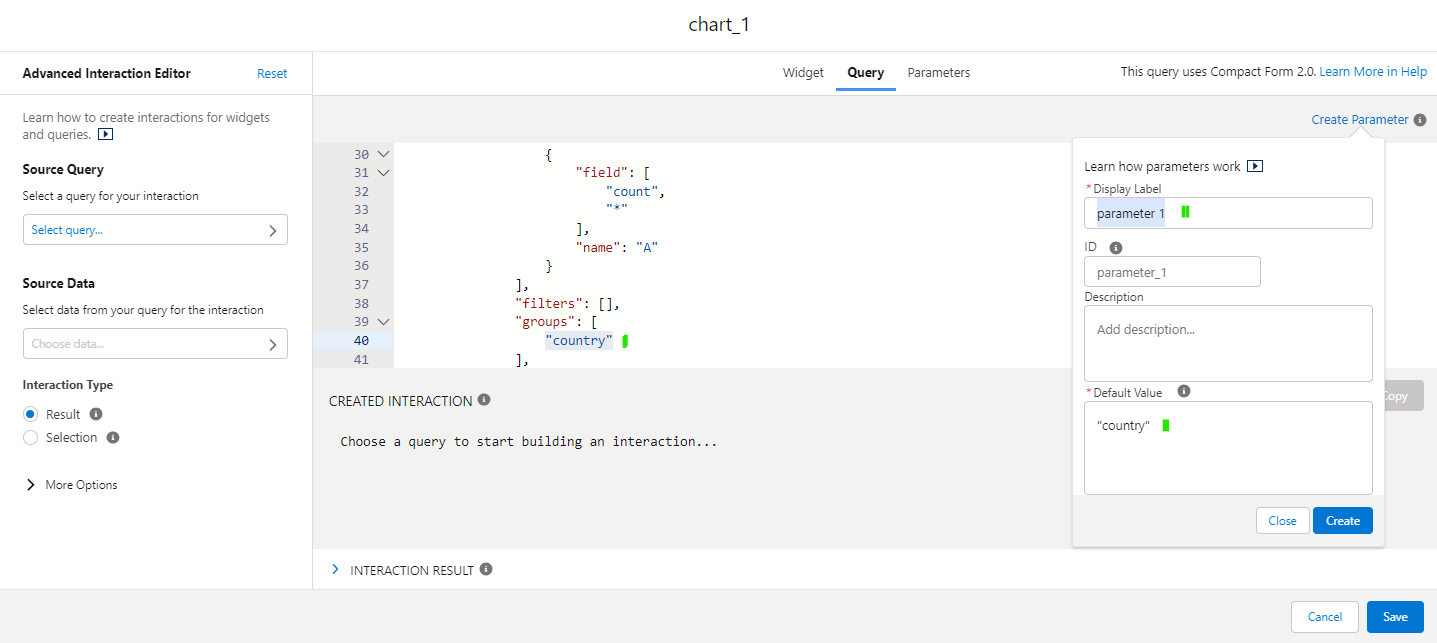
2. On the Query Tab, find the value you want to parameterize. In our case it’s “Country.”

    • Click on the pages icon (next to ID to copy the parameter to your clipboard)
    • Click Create (or update if altering an existing parameter). Note: The value MUST be in the correct case (NOT Country)
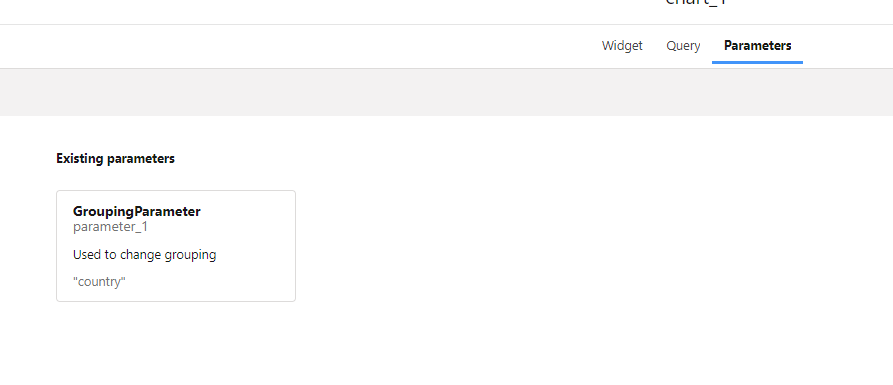
    • Click on the Parameters tab to see what you just created.
    1. Next, change the query to use the parameter. Go to the query tab and replace the group and name with your new filter. Where you see city, replace as shown below for the group and name

    Group:

          "groups": [
              "[[parameter_1]]"
            ],
            "filters": [],
            "joins": [],
            "name": "pdProspect1"
          }
        ],
    

    Name:

      {
            "name": "[[parameter_1]]",
            "ascending": true,
            "filters": []
          }
    
    1. Save your query.
    2. Save your component.

    3. Using the Component on Your Dashboard with the Parameter

    Now that you have your component with a parameter created, let’s add it to a dashboard and change the parameter. This is the fun part!

    Return to the dashboard tab (should be an open tab in your browser), and click on the component widget to select the new component we just created.

    Pro tip: To refresh component content or edit, look for the actions in the right side toolbox when the component is selected.

    Preview the Dashboard

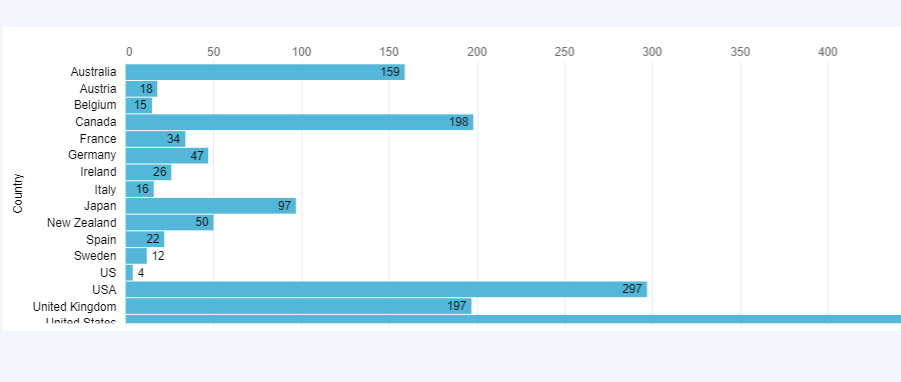
    It looks like this: It’s displaying by Country

    Change parameter

    Now let’s change the parameter.

    1. Edit the dashboard.
    2. Click on the component, and click on Parameters (right hand side).
    3. Click on the parameter you created.
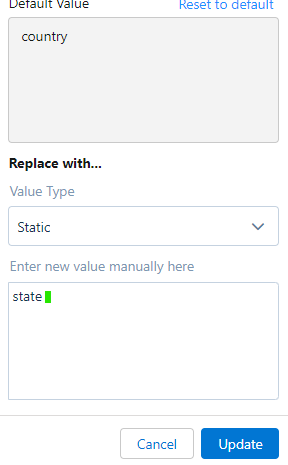
    4. Select Static for Value Type.
    1. Replace country with state. Click update.

    The component now displays State.

    You can parameterize other aspects of the component (filters, etc.), so there are lots of possibilities here.

    What else can I do when I make component widgets dynamic?

    The example in this blog is quite simple. However, it gives you the elements to be successful in creating and using CRM Analytics components. 

    These CRM Analytics enhancements give us opportunities to make dashboards more useful and allow us to finally re-use components effectively.

    Some great use cases:

    • Sales by Group or District
    • Product type filtering (for different dashboard)
    • Scenarios where you have different revenue fields (USD or CAD for example or expected vs actual)

    The Salesforce Summer ‘23 release has given us so many gems. This CRM Analytics update is a big one along with the ones we’re seeing with Account Engagement including the ability to copy marketing assets between business units, and this update to Salesforce user access management

    Need help digging into this super helpful feature? Or wondering how this can fit into your overall marketing reporting strategy? Reach out to the team at Sercante to start a conversation.

    The Salesforce Summer ’23 release includes many changes to the platform, like the ones we’re seeing with Account Engagement that include the ability to copy marketing assets between business units. However, the thing we’re going to talk about in this blog post are two new features that (hopefully) help you simplify user access management for the Salesforce platform.

    First, we’re going to quickly go over the new User Access Policies (Beta) feature and then we’ll talk about setting field-level security in permission sets.

    Salesforce User Access Policies (Beta)

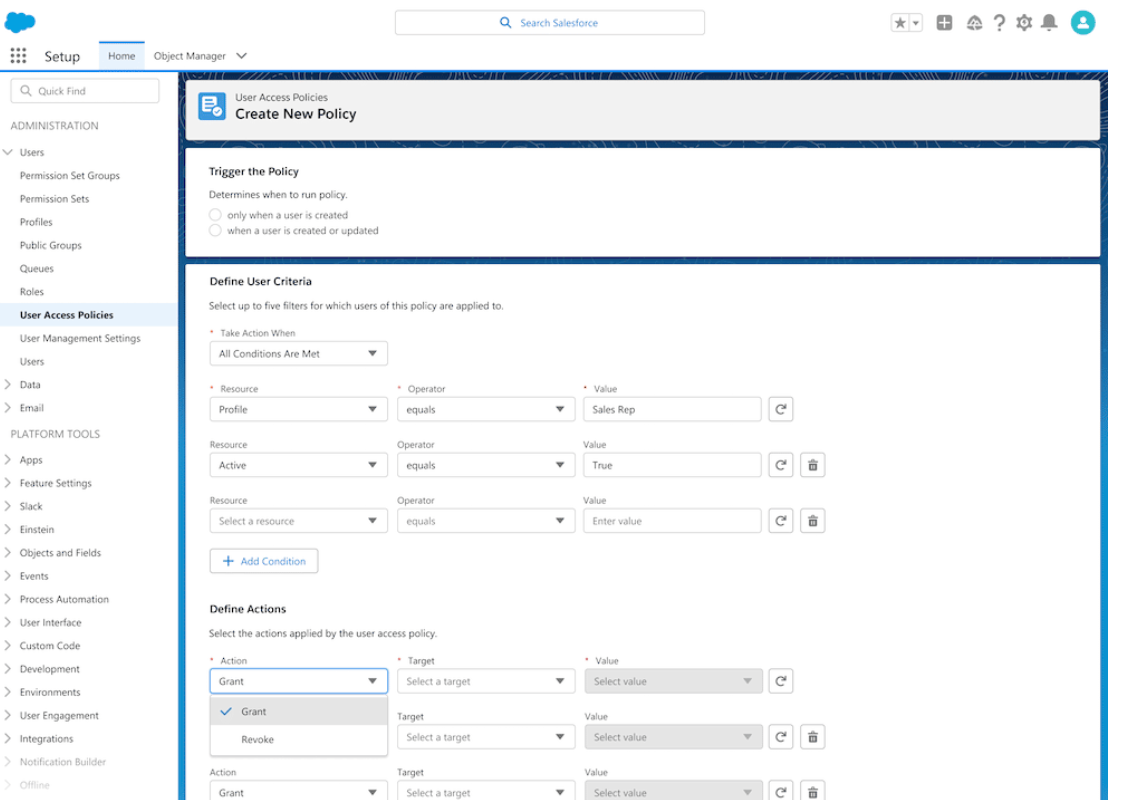
    User access policies are a new feature that allows you to control user access based on criteria such as user roles profile, or other user fields. For example, we can give users different access to the same data, depending on their role in the organization or their department.

    Users can be assigned to permission set licenses, permission sets, permission set groups, package licenses, queues, and groups using user access policies.

    User Access Policies are broken down into two types, Manual User Access Policies and Active User Access Policies. 

    Manual User Policies

    Manual User Access Policies are one-time processes to grant or revoke bulk access for designated users. What this means is that you can identify users by using filters and modify, add, or remove access that you define in the policy itself. 

    Example: You’re migrating permissions for a group of users from profiles to permission sets. You would create filters to identify the users assigned to the profile, then create actions in the user policy to assign permission sets and permission set groups. 

    Active User Policies

    Active User Access Policies automatically grant or revoke user access. An active user access policy runs in the background and is triggered by an event like a created or updated user record. 

    Example: You can have an active policy set to assign a series of permission sets permission set licenses and groups to a user when they are created and have the Sales Manager role, or grant/revoke assignments to an existing user who’s been updated with this role. 

    Sounds like a flow if you ask me…

    Ok, that’s cool Jason. So how do I get to it? 

    • Go to Setup > Quick Find “User Management Settings” then enable User Access Policies (Beta). 
    • Then, Quick Find “User Access Policies” to create or manage user access policies.

    Considerations before enabling User Access Policies

    A couple of things to be aware of before you go and enable this setting in your org:

    1. Each org is limited to 20 access policies in total. 
    2. This feature is in Beta and is subject to change without notice. Be sure to watch future Salesforce releases to find out when this will be made Generally Available (GA).

    Set Field-Level Security for a Field on Permission Sets Instead of Profiles (Generally Available)

    In the past, field-level security could only be set on profiles which, even with the Enhanced Profile User interface, could be extremely tedious. However, in the Summer ’23 release, you can now set field-level security on permission sets when creating a new custom field. 

    What does this mean? 

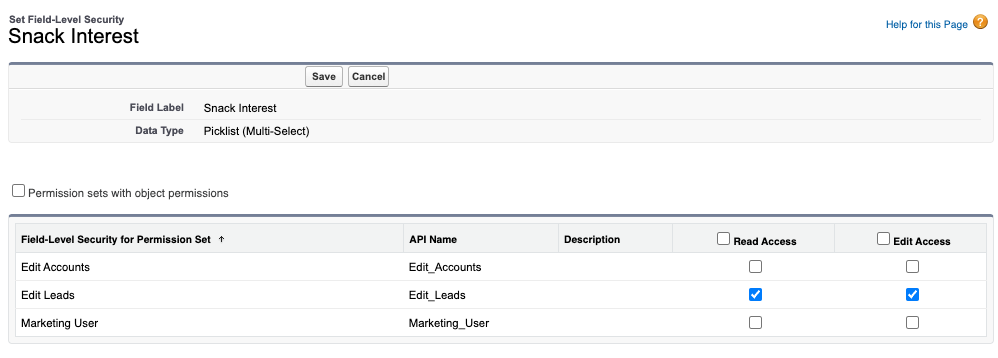
    When creating a field you would normally have a step that would have you pick which profiles have access to view or edit.. 

    Now, once the Set Field Level Security for a Field on Permission Sets feature is enabled, this step (Profiles step) is replaced with something that looks like this screenshot:

    This was originally a beta feature in Spring ’23 but is now Generally Available in Summer ’23

    How do you enable it? 

    • Go to Setup>Users>User Management Settings, then Enable Field Level Security for Permission Sets During Field Creation.

    Considerations for the Set Field Level Security for a Field on Permission Sets feature

    Things to keep in mind when enabling Field Level Security for Permission Sets During Field Creation:

    • Enabling this setting will remove the profile list from view when setting or changing field level security at the profile level. 
    • When you set or change field-level security for a field on permission sets, you can view by permission sets with object permissions, or by all permission sets. 

    Streamlining Salesforce user management today and beyond

    Cool stuff, but how is this going to affect me now and in the future? 

    These changes are all part of Salesforce’s master plan to streamline User Management to make it less tedious, less challenging, and less time-consuming so we can spend more time taking the dog for a walk or enjoying the awesome Pacific Northwest Summers. 

    Eventually, we will see Salesforce sunset Profiles and move solely to controlling record access via permission sets as outlined in this Salesforce Admins Article.  

    If you would like to know more about the future of User Management I encourage you to check out this awesome blog by Cheryl Feldman and the Awesome Admin team over at Salesforce. And reach out to Sercante when you’re ready to talk about how these changes fit in with your overall marketing and technology operations strategy.

    It’s here! It’s finally here! It’s the Account Engagement Business Unit Bulk Asset Copy Flow.

    Marketing Cloud Account Engagement (f.k.a. Pardot) Business Units have become my niche over the past few years. I love setting them up and standardizing them, but I don’t love copying over assets when configuring a new Business Unit(BU). 

    With the Summer ‘23 release, we can now use Salesforce Flow to copy:

    • Custom fields
    • Engagement studio programs
    • Files
    • Custom redirects
    • Email templates
    • Form handlers
    • Layout template
    • Dynamic Content

    Note: This blog post was updated on November 2, 2023, to include the three new Assets types that were recently added to the flow!

    Access the Account Engagement Business Unit Bulk Asset Copy Flow

    During the Summer ‘23 release, your org should have received a new flow called “Account Engagement Bulk Asset Copy Flow.” 

    To find this Flow: 

    1. In Salesforce, navigate to Setup > Flow
    2. Select the Account Engagement Bulk Asset Copy Flow
    3. From the Flow Builder, select Run

    Set up the Flow

    The flow itself is pretty straightforward. It will walk you through selecting your assets and setting the new asset details.

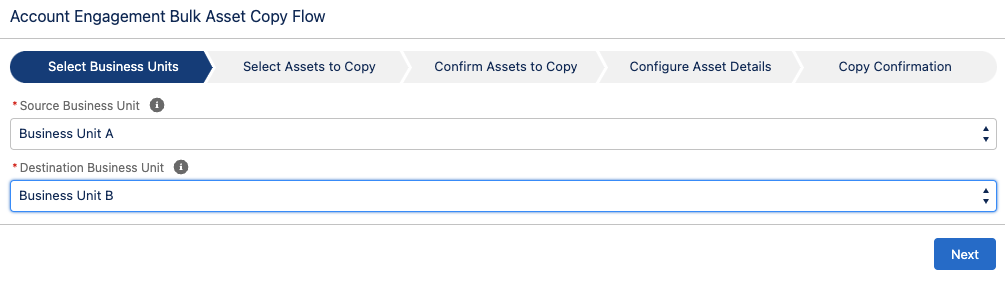
    1. Select your Source and Destination Business Units, select Next
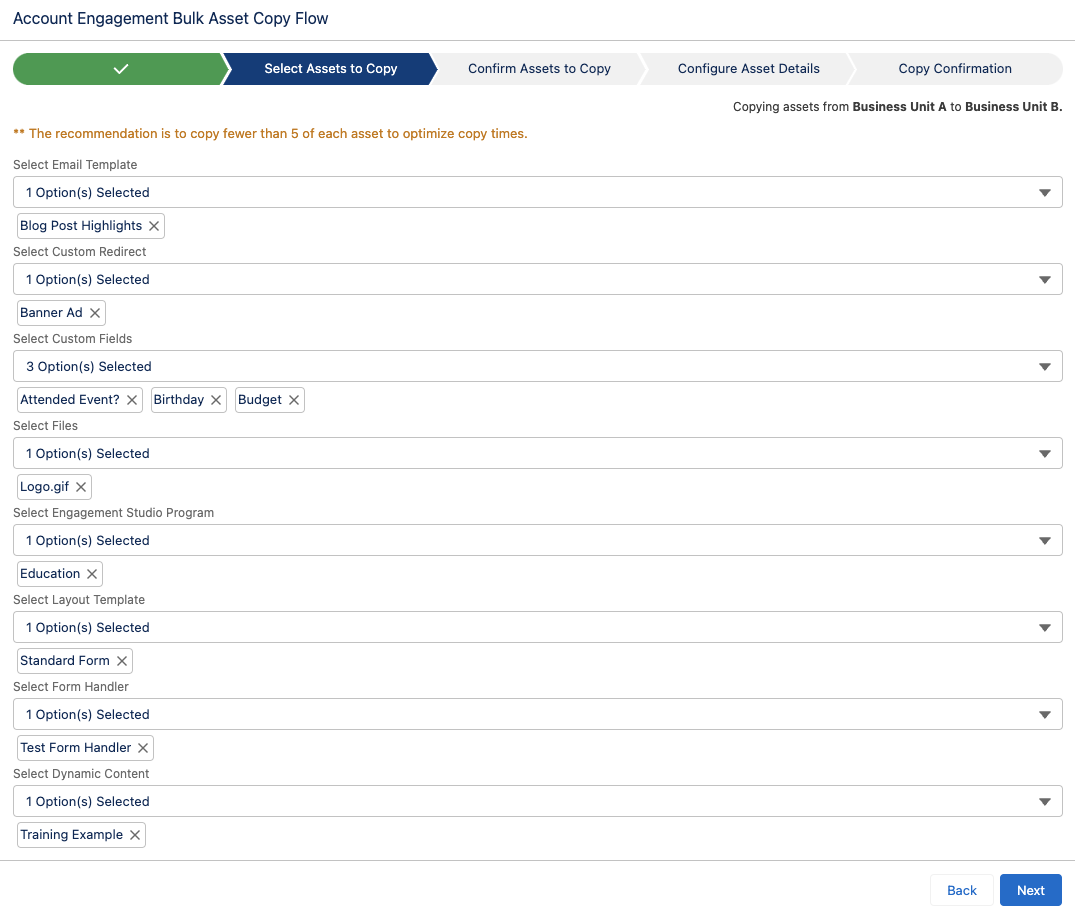
    1. Select the assets to copy, select Next

    Note: Keep in mind, all assets selected here will be copied to the same Folder, will be assigned the same Campaign, and use the same tracker domain. You may want to run the Flow multiple times if your new assets need to have different settings. 

    1. Confirm the Assets, select Next
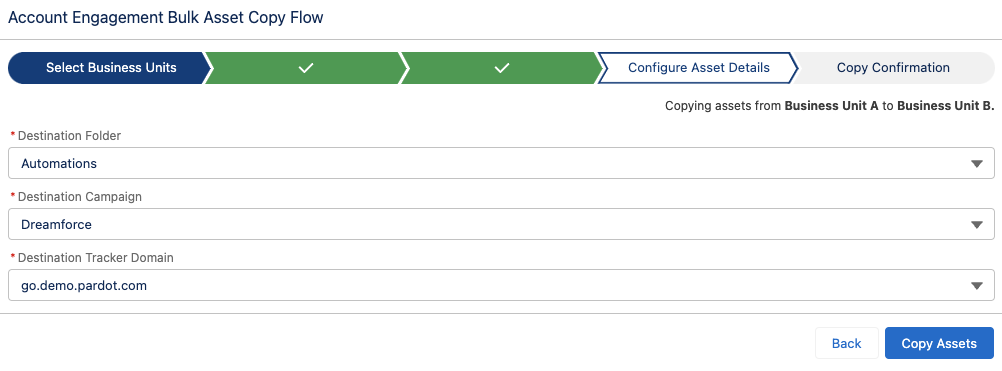
    2. Select your Folder, Campaign, and Tracker Domain for your new assets
    1. Select Copy Assets

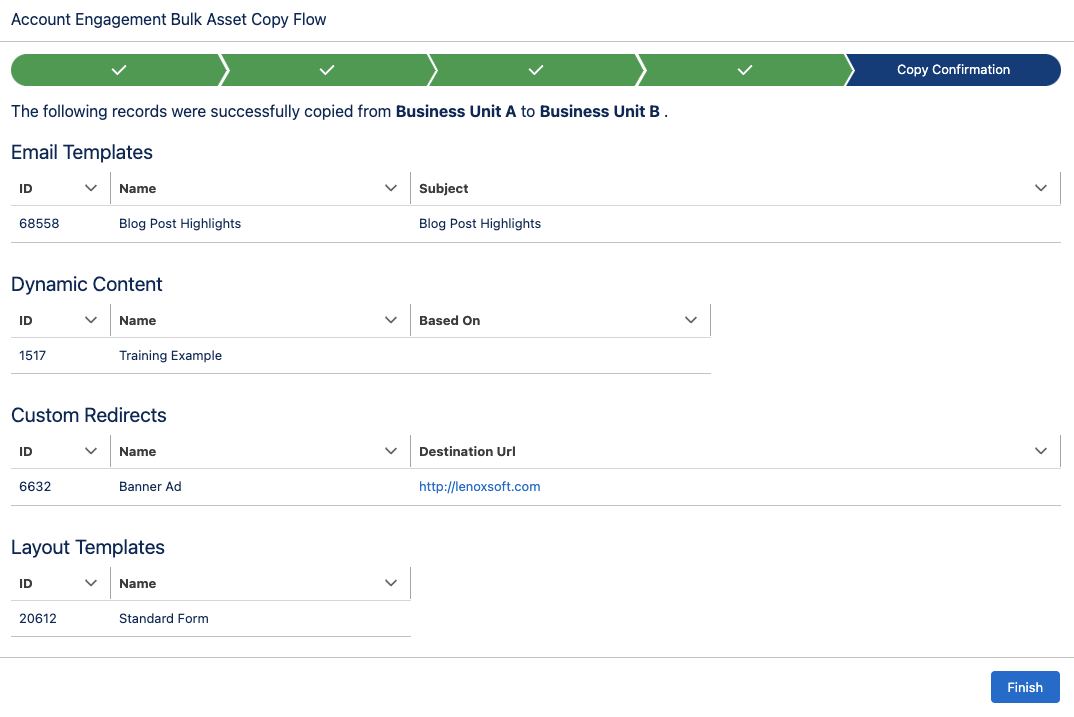
    Bulk Asset Copy Confirmation Screen

    If your action was successful, you will see the list of assets created on the Confirmation screen.

    You don’t get an error message if your action was unsuccessful, but your confirmation screen won’t have any/all assets listed.

    Considerations for Using Business Unit the Bulk Asset Copy Flow

    Since this is a brand new capability for Account Engagement, there are some details and settings that do not come over when copied. I thoroughly tested each asset type and below are the considerations that I found. 

    Custom Fields

    When you copy custom fields from one Business Unit to another, only the following information comes over

    • Field Name
    • Field API Name
    • Field Type

    The field’s mapping to Salesforce, Salesforce sync behavior, predetermined values (for dropdowns, radio buttons, etc.), and optional settings will not be configured.

    Email Templates

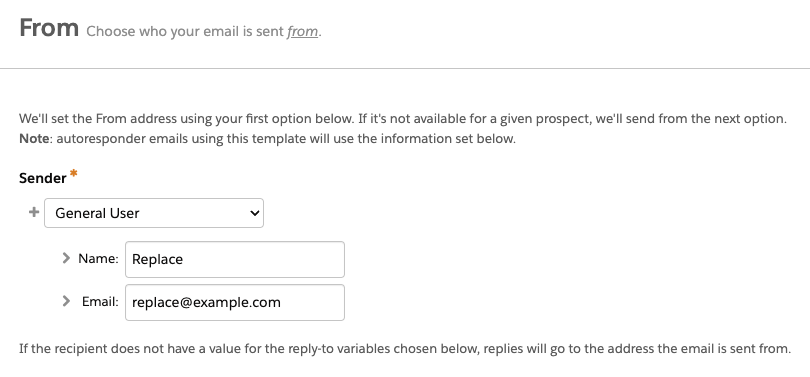
    • When copied, the email sender will be replaced by a General User with the email [email protected]. This applies even if you have a sender hierarchy specified using “Assigned User” and ‘Account Owner.”
    • Email Templates containing Dynamic Content will not copy over.  This is because dynamic content is unique to the Business Unit. Even if you have the same Dynamic Content in each Business Unit, they will have a different asset ID and merge tag. 
    • Watch for email template nuances between BUs. If you copy an email template from Business Unit A to Business Unit B, make changes to Business Unit A’s template, then copy the template from Business Unit A to Business Unit B again, the flow will not update the existing template in Business Unit B. Instead it will create a brand new email template with the updated changes. 

    Files

    During my testing, I was only able to get image files to copy over view the flow. I tested .pdf, .ics, and .css files with and without Completion actions and was unable to get anything but images to successfully copy. 

    Engagement Studio Programs

    • When you copy an Engagement Studio Program (ESP) to a new Business Unit, only the ESP structure is copied. The Recipient List, Suppression lists, Send days/times, and “Allow prospects to enter more than once” settings do not come over and will need to be reconfigured in the new Business Unit.
    • The assets specified in a Trigger or Action node, such as email templates, landing pages, and forms, will need to be reselected in the new ESP. However, the number of wait days specified in the node will copy over. 
    • If an Action node looks at a Prospect field (i.e. Prospect default field “Job Title” is not blank) and that field is in both business units, then the node will be copied to the new ESP with the field and value/settings specified. If the field does not exist in both business units, then the Action node will still be in the ESP but the field and value/settings will need to be reconfigured. 

    Custom Redirects

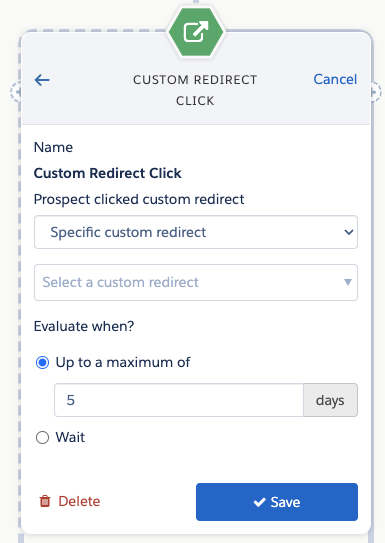
    When a Custom Redirect is copied from one Business Unit to another, the redirect’s Completion Actions will not copy over, however, the Google Analytics Parameter values do.

    Layout Templates

    If you use Dynamic Content within your Layout Templates, keep in mind that the Dynamic Content will not come over when the Layout Template is copied. You can copy the Dynamic Content over as a separate asset, but you will still need to edit the Layout Template in your destination Business Unit to make sure it has the correct Dynamic Content ID. 

    Form Handlers

    If your Form Handler only uses Default Prospect Fields, then all of the fields will come over when the Form Handler is copied. However, if your Form Handler uses any Custom Prospect Fields, only the “Email” field will be present in the Form Handler Copy. In my testing, this was true even if the Custom Prospect Field was in both Business Units. When copied, the Success Location and Error Location details will copy over to the new asset. Completion Actions do not copy over.

    Dynamic Content

    If the Dynamic Content depends on a Custom Prospect Field that is not already in the destination Business Unit, the copy will fail. To copy over Dynamic Content that depends on a new custom field:

    1. Run the Bulk Asset Copy Flow to first bring over the Custom Field
    2. Once finished, run the flow again to bring over the Dynamic Content
      • If you try to create both the Custom Field and the Dynamic Content in the same run, it will fail. 

    Now it’s even easier to work with Account Engagement Business Units

    This new Flow is a huge step toward making Business Units easier to set up and manage. My hope is that the capabilities of this Flow will continue to grow until we can make a near-identical copy of an entire Business Unit. 

    What other capabilities would you like to see in this Flow? Let us know in the comments!

    Before the advent of Data Cloud and Customer Data Platforms (CDPs), businesses strived to integrate their data into their CRM to obtain a holistic view. If you’re considering another expansive platform, there’s an excellent interim solution to consider: the Campaign Audience Builder (CAB).

    Where to get Campaign Audience Builder

    The Campaign Audience Builder is a package on the Salesforce AppExchange developed by Lightblaze. Known for its user-friendly interface, CAB allows you to create audience segments using your Salesforce data, making it an efficient substitute or preliminary step towards a full-scale CDP solution.

    Campaign Audience Builder Ease of Use

    Campaign Audience Builder has a simple point-and-click interface that allows you to navigate and filter data related to the people you are trying to add to an audience.  It simply gets installed alongside your data and has a very short implementation time (I was up and running in 10 minutes).

    Once installed, it really is a 3-step process of getting your first audience created and usable:

    1. Define the Criteria: as a techie myself, this was really the fun part. Connecting data and filtering the right records feels natural and familiar.
    2. Generate the Audience: This is basically running the process based on all the work you did in the previous step to see who matches. As always, it’s a great idea to spot-check that some people you expected to appear were successfully matched!
    3. Populate the Campaign: you have your list of people, it is time to put them somewhere that you can act on. This is when you choose which Campaign to use, how often the audience should be evaluated, and if people should be removed should they no longer meet your criteria.

    Unlike CDPs and other types of data platforms, which require accommodating complex data relationships and aren’t always user-friendly, CAB offers a seamless alternative.

    Advanced Segmentation Features in Campaign Audience Builder

    Looking for Contacts that have Closed Won Opportunities with Products in a certain Product Family? Yep, Campaign Audience Builder can do that. 

    Do you also want to ensure those same people don’t have a Case?  Yep, you can do that too. 

    While not unlimited in its power, there’s no data scenario that you cannot segment with CAB (compared to report builder or segmentation in Account Engagement).

    CAB allows you to select either a Lead or Contact as your audience driver and connect it with any related object. After defining your audience, you can populate a Campaign by creating CampaignMember records. CAB also provides controls on how frequently your audience should be evaluated and whether it should clean records that no longer meet your criteria.

    With your audience defined, you can now use that information to populate a Campaign by creating CampaignMember records. You have some controls on how often CAB should be building your audience and if it should clean CampaignMember records that no longer meet the criteria.

    Integration and Data Security

    CAB stands out with its ability to directly publish the audience into Account Engagement (Pardot) into a static list. This feature eliminates the need to clumsily attach data to the Lead/Contact records for list population.

    A key feature of CDPs is the ability to “act” on the new audience that you’ve created in downstream systems. While CAB doesn’t really integrate with a bunch of other third-party tools, it can call APEX/Flows (where you can do almost anything integration-wise).

    Data security is paramount for Salesforce organizations. Moving data into other systems like data platforms or CDPs can potentially jeopardize these security controls. Since CAB operates within your Salesforce organization, it only accesses the data you can, thereby ensuring data security.

    CAB may be the stepping stone you seek

    In summary, the Campaign Audience Builder (CAB) offers a user-friendly, efficient, and secure way to handle your Salesforce data. It’s a practical stepping stone if you’re considering a more complex Customer Data Platform (CDP) solution. 

    With its easy setup, advanced features, and commitment to data security, CAB is a smart choice for businesses looking to maximize their data management and audience segmentation without taking on a full CDP solution just yet.

    Thinking about implementing CAB in your org? Contact the team at Sercante to learn more about the tool and how it will work with your overall technology strategy.

    Account Engagement (Pardot) Optimizer BETA was released with the Spring ‘23 new features, but it has become “Generally Available” as of the Summer ‘23 release. This new feature promises to help you identify and correct issues that may be negatively affecting your Business Unit’s processing power. In this blog, we’ll dive into everything you need to know to access and use the new Account Engagement Optimizer feature. 

    Accessing the Account Engagement Optimizer

    To access the Optimizer, go to your Account Engagement Settings tab, “Optimizer” will appear as an option on the left-hand menu. 

    Account Engagement Optimizer

    If you are using Default User Roles, only Administrators will have access to the Optimizer. If you are using Custom User Roles, make sure your custom role has the following permissions selected (edit Custom User Roles by going to Account Engagement Settings > User Management > Roles > then selecting the role you’d like to edit). 

    1. Admin > View Optimizer
    2. Admin > View and Edit Pending Table Actions
    3. Marketing > View and Delete Automation Rules
    4. Marketing > View and Delete Lists

    If you opted into the Beta before the Summer ‘23 release, there is nothing you need to do to continue using the Optimizer. If you did not opt into the Beta, the Optimizer should have auto-enabled when your org was upgraded to Summer ‘23. 

    Analyzing Your Optimizer Report Results

    The Optimizer, with the help of Brandy, will provide one of three statuses for your business unit:

    1. Looking Good: No critical issues to address
    2. Pay Attention: There are a few recommended actions to improve your business unit
    3. Action Needed: There are critical issues and you should resolve them right away. 
    Account Engagement Optimizer - Brandy

    Prospect Change Monitor By Feature Chart

    Next to Brandy and your Optimizer Status, you’ll see your Prospect Change Monitor By Feature chart. 

    Account Engagement Optimizer - Chart

    This feature shows you which type of automations have made a change to Prospects in the last 24 hours. You can double click on each slice of the pie to drill into exactly which assets are making changes. 

    Account Engagement Optimizer - prospect change monitor

    Changing Filter Views

    In this view, you can also change your filters to show different date ranges and different views. I like to change my view to “All Processes” and Date Range to “Last 30 Days” to better keep an eye on which automations are running at least every month. 

    This view can be especially helpful in finding automations that may not have been set up in the most efficient way possible, such as an automation rule that is set to repeat every single day. 

    Configuration Issues

    Next in the Optimizer report is your Configuration Issues. This table will show setup problems that are stopping you from full access to Account Engagement’s features. This can be issues like your sending domain not being verified or prospects being paused for bot-like behavior. 

    I tried to see if turning off Connected Campaigns would also trigger an issue here, but no dice. Hopefully, Salesforce will provide a list of all configuration issues that are checked in a future release, but in the meantime you can use our implementation checklist to ensure your Business Unit is configured correctly. 

    Performance Improvement Measures

    Next is Performance Improvement Measures, this table shows you recommendations that will improve your Business Unit’s processing power. This table defaults to “Actionable Measures,” but you can change this view to “All” to see what else is being monitored. 

    Account Engagement Optimizer - performance improvement measures

    This table is broken down into five columns:

    1. Measure: What exactly Optimizer is reviewing.
    2. Status: Whether the measure is in Good, Concerning, or Critical standing or if there are actions that can be taken. “Good” statuses will not show when this table is filtered to only show “Actionable Measures.”
    3. Feature Area: Which Account Engagement Features are involved in this measure.
    4. Recommendation: What next steps, if any, should you take. Most insights will also include links to documentation, which I personally love. 
    5. History: If there is enough data for this measure, you can select the chart icon to see the measures for the last 8 days. These charts also shed light on what the Optimizer considers good, concerning, or critical. 

    Maintenance Resources

    Finally, you have Maintenance Resources. This section links to a few views and reports that can help your Business Unit run in tip-top shape. This includes 2 views we’re already used to: Inactive Automation Rules and Inactive Dynamic Lists, but also 2 new super useful views:

    1. Table Action Manager: This view allows you to pause, prioritize, and cancel actions currently running in the Business Unit. For example, say you recently kicked off an Automation Rule that will update 3,000 prospects, but you are also running a Dynamic List that is needed for an email send going out in 5 minutes. Now you can prioritize that Dynamic List over the Automation Rule rather than panicking if your Dynamic List is going to complete in time. 
    2. Unused Dynamic Lists: This view shows you which Dynamic Lists have a blank Usage table. Now you no longer have to click into each Dynamic List to check if any assets are listed on the “Usage” tab, YAY!

    Account Engagement Optimizer is Available Now

    Now that Optimizer is available for all orgs, I would highly recommend you check the report at least monthly to keep an eye out for any potential issues. If you have any questions or neat tips about the Optimizer, let us know in the comments! Also, if you’re looking for other ways to improve your Business Unit’s processing power, check out our blog post, “4 Things to Clean in MCAE (Pardot) for Faster Processing Times.”

    No more posts to show