
As a buyer, we’ve all been there. You fill out a form, wait to hear from sales, and then maybe you receive a piece of content that isn’t relevant to you, or you find yourself repeating what you shared in the form later on a call. And what happens? You find yourself starting to feel less and less confident about the brand because your experience hasn’t been seamless. What we don’t think about as buyers is what the seller is probably experiencing in the CRM and how the data, or the lack thereof, is impacting their interactions with you.
When the CRM is a roadblock rather than a revenue driver for sellers, it negatively impacts the buying experience in addition to sales performance. In today’s modern era, where buyer expectations are rising and marketing, sales, and customer success teams are under more pressure to drive growth with tighter budgets, it is critical that they prioritize optimizing core functions to deliver the best experience possible for buyers. An essential piece: optimizing the CRM seller experience.
To get the highlights on how to approach this, continue reading below. To get the full deep dive, watch Part III: A Better CRM for Sellers = A Better Experience for Buyers, of the Built to Buy series.

Why the Seller Experience Must Be a Growth Priority
For marketing, sales ops, and revenue teams, optimizing the seller experience isn’t just a nice-to-have operational fix. It is a critical growth lever.
- Impact on Sales Performance: Unfortunately, the majority of a seller’s day is not spent selling. Only about 28% of their time actually is. (Salesforce) The rest of their day is consumed by manual data entry, hunting for siloed information, and navigating non-optimized processes. When the CRM experience is clunky, difficult for sellers to find what they need, not aligned to their sales process, or not reinforcing their training best practices, it slows them down, continuing to hinder the time they do have to sell, acting as a roadblock to their performance.
- Impact on the Buying Experience: Buyers are not thinking: Am I in a marketing, sales, or customer success experience? They see one singular brand experience. When a CRM is friction-heavy, sellers can show up to calls sounding unprepared, while buyers find themselves forced to repeat information they already gave to marketing, making the brand seem not in tune with their specific needs. According to Gartner, 77% of B2B buyers reporting that their last purchase was very complex or difficult, it shows that these experiences are happening more often than growth teams probably realize. Any internal friction added erodes their trust.
To empower sellers to achieve higher performance and deliver the best buying experience possible for customers, optimizing the seller experience in the CRM is a must.
Through the Seller’s Eyes: How Marketing Can Help
The buyer’s experience is everyone’s responsibility, and marketers can play a pivotal role in helping to improve the seller experience. For marketers, when the CRM is aligned to core sales processes and optimized to how sellers actually work, it makes it easier to collaborate, streamlines the marketing to sales handoff, and ensures fewer leads fall through the cracks and more of the right leads form meaningful connections with your brand.
To fully understand what a seller’s experience is in the CRM, the strategy needs to be approached from the seller’s perspective and knowing what matters to them.
To a seller, more data does not always mean more value. When a lead hits their queue, they are looking for clarity on two simple questions: Who are you, and what should we be talking about?
Marketing can significantly improve the seller experience by shifting focus from data quantity to context quality. Instead of throwing more data over the wall, marketing should provide the connective tissue that tells the buyer’s story. This includes:
- Prioritization: Is this a “hot” hand-raiser or someone in an explorative phase?
- Relevant context: What specific content did they consume? Knowing if a prospect looked at a pricing sheet versus a top-of-funnel blog post changes the entire sales approach.
- Laser-focused data: Provide only the key data points needed to frame a strategic conversation rather than overwhelming the seller with noise.
Having a conversation with sales to understand what questions they are asking themselves when a lead comes through, how they prioritize follow-up, and how they are gathering resources and data to create a strategy that will guide future sales conversations can help the marketing team focus on the right data when passing over leads and collaborating with sales to improve the seller experience.
A Strategic Approach to a Better CRM Experience
Aside from the initiatives that marketing can take, optimizing the seller experience in the CRM requires a mindset shift around how the technology is approached. Is it only seen as a database for sellers to enter information about their deals for reporting and forecasting, or is it seen as a powerful productivity engine that can support sellers in their sales process: arming them with insights for impactful conversations, streamlining and automating mundane admin tasks, and reinforcing sales training best practices?
As Siso Ntuli, Senior Engagement Manager at Sercante, puts it: “The goal isn’t just to generate numbers. It’s to facilitate meaningful conversations”.
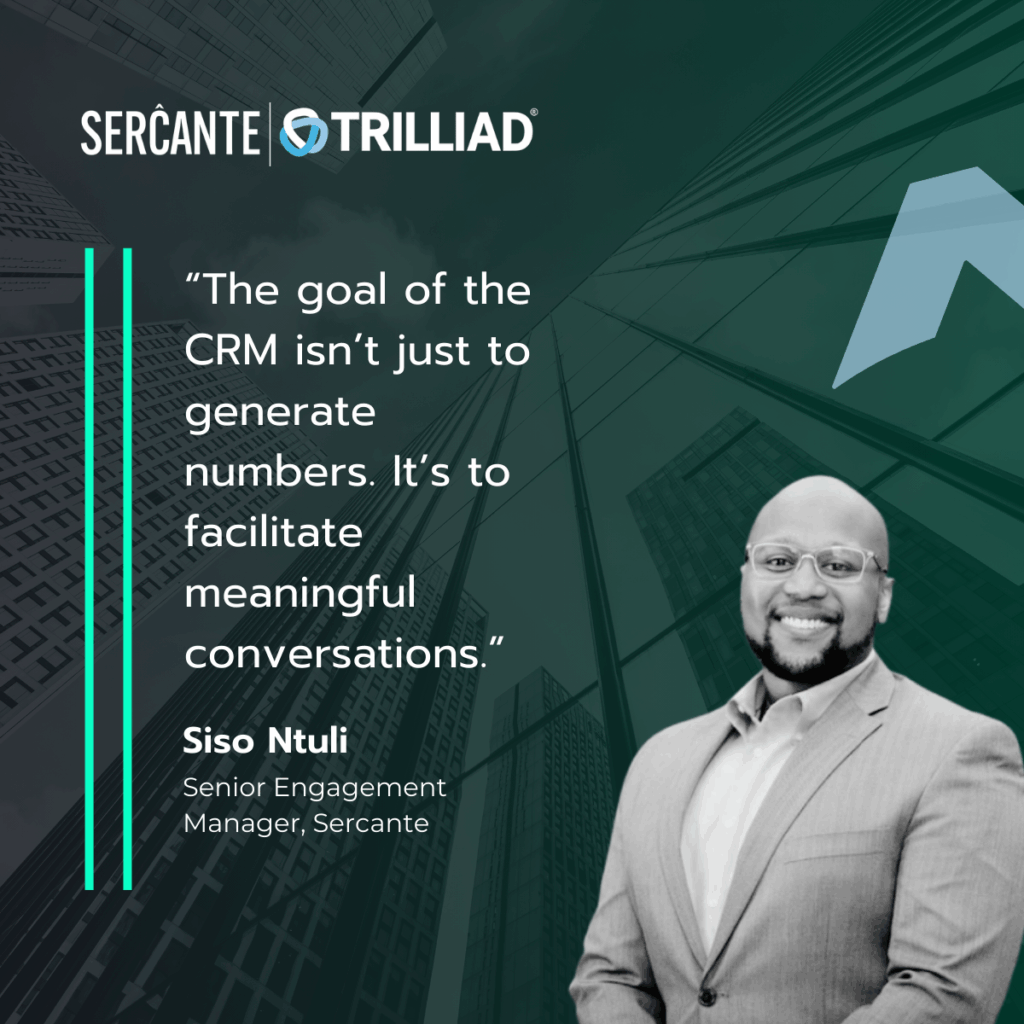
To turn your CRM into a growth accelerator, teams should take the following strategic steps:
- Map the processes: Outline every step of the sales process alongside the buying process to see how it currently aligns with your CRM setup to see where there is misalignment.
- Spot the silos: Identify swivel-chair work: tasks that force sellers out of the CRM and into spreadsheets or disparate systems.
- Identify opportunities for AI & automation: When thinking through the steps in the sales process, highlight the repetitive and mundane tasks that could be streamlined with AI and automation. This can free up time and brainpower for sellers, so they can focus more on the customer.
- Approach with a customer-centric mindset: As the team considers what improvements could be made to the CRM for the seller’s experience, ask: What will the end experience feel like to the buyer? Keeping this in mind will guide CRM optimization initiatives to be designed not just for internal processes, but for the experience the buyer expects.
Shifting the mindset to approach the CRM as a system that can be a revenue driver rather than a roadblock for sellers, and keeping the buyer’s experience at the forefront, is the beginning of optimizing the CRM. The next step is understanding the current state of the CRM seller experience.
The CRM Seller Experience Scorecard
Getting a baseline from your sales team on what their experience and sentiment are with the CRM allows teams to identify in which areas they may want to improve first.
Ntuli introduced the CRM Seller Experience Scorecard to evaluate the CRM across five key criteria:
- Level of Adoption: Is the system easy to use, or do sellers dread logging in?
- Level of Data Visibility: Is the must-have data readily available at their fingertips?
- Level of Automation Use: Is automation being used to eliminate manual tasks?
- Amount of Manual Data Entry: How much manual data entry is being done?
- Data Reliability: Do sellers trust the data in the CRM?
Each area is rated on a scale of 1 – 10. Anything from 1 – 4 is the sign of a roadblock. Anything from 8 – 10 is considered optimized.

Download the CRM Seller Experience Scorecard to do this exercise with your team.
Any area that is identified as a roadblock shows teams where they might want to focus first. To ensure CRM optimizations are effective, Sercante’s Strategy Director, Jenna Packard, and Change Enablement Director, Debra Engels, recommend using a phased roadmap that considers the level of impact on the business, the level of effort to implement, and the effect it would have on the people involved. Tune into Part VI: Tech That Grows With You (Not Against You), of the Built to Buy series to hear their approach.

A CRM Seller Experience That Drives Growth
A CRM that works against your sellers is a CRM that causes friction for your buyers. When sales can easily get what they need in the CRM, spend less time and brainpower on mundane tasks, be supported with reinforced training, and access key insights to have meaningful conversations, they have a seller experience in the CRM that supports meaningful conversations, building real connections that drive lasting growth. Giving today’s buyers the experience they expect.