The marketing landscape has reached a tipping point. As buyer expectations continue to rise and budgets tighten, the need to be more effective with the resources available increases. Marketers are navigating technology that is evolving faster than ever. With data spread across disparate systems, the current trajectory of working to meaningfully engage buyers at scale while churning out campaign after campaign is not sustainable. AI offers the opportunity for a shift, but many organizations have deployed point solutions in an effort to gain efficiency without the feeling of actually getting anywhere. It begs the question: how can marketers maximize what they have while tapping into the latest solutions available, and free up their team’s capacity, so they can be more effective at engaging customers at scale? The solution: a strategic path towards convergence on Marketing Cloud.
A Modern Marketer’s Challenges
Most marketing teams are currently operating in survival mode. Launching campaigns at lightning speed, yet lacking the capacity to actually innovate or slow down to be more strategic and visualize the impact on the bigger picture. Three primary challenges keep marketers trapped in this cycle.
Legacy Systems
For years, the marketing mantra has been: “Have a problem? Buy a technology solution.” This “buy-as-you-go” era has left marketers with a complex, fragmented reality where systems simply don’t talk to each other. Today, the average large enterprise is juggling over 600 applications (WalkMe Inc.), and even mid-sized firms find themselves buried in hundreds of single-purpose tools.
Siloed Data
With critical engagement data and customer information scattered across disparate systems, it makes it challenging for marketers to see which campaigns are truly moving the needle, tailor messaging and strategy to key audience segments, and collaborate with sales and customer success on initiatives that progress deals and expand customer relationships.
Capacity Constraints
Marketers are working to maximize output with tighter resource constraints and have less capacity to be innovative, while mundane tasks such as manually importing and exporting segmentation data or reports are sapping the creative brain power needed to create unique brand experiences that emotionally resonate and set them apart in the market.
To break the cycle, marketers can overcome these challenges with the right strategic approach that leans into the resources they have, while seizing the opportunity that the latest technology presents.
Marketing’s Opportunity to Shift with AI
AI is changing the way buyers engage with brands and how marketers operate. Buyers are turning to AI answer engines for initial discovery and research, engaging in more self-guided behavior before brands ever see a click or a form submission. 50% of searches only use AI summaries. (McKinsey) Meanwhile, marketers can generate whole content assets with a well-crafted prompt in seconds and use agentic capabilities to streamline processes and create interactive buyer experiences. Presenting a great opportunity for marketers to more effectively engage buyers through personalized, two-way conversations at scale. However, the technology is evolving at a speed faster than organizations can operationalize. 92% of organizations do not have operational AI (McKinsey).
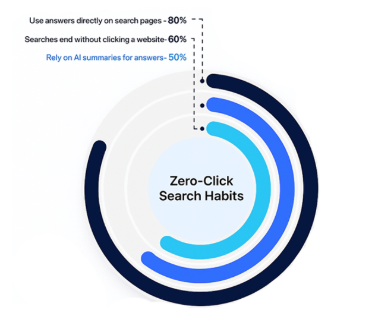
(Image Source: McKinsey, 2025)
AI Efficiency vs. Operationalization
In an effort for marketers to start gaining traction with AI, many have implemented pilots and attempted experimentation in an effort to gain some efficiency. However, these point solutions have been set up outside their flow of work, causing more manual workarounds and presenting further silos that hinder meaningful results.
For AI to be truly operationalized and impact the bottom line, it needs to be embedded within marketing’s core business processes, powered by integrated data, and aligned with how they operate and how customers engage the brand. Empowering marketers to be more effective with AI and take advantage of the capabilities it has to offer, for example:
- Agentic Marketing: Agents embedded within the marketing technology that drive productivity and orchestrate campaign execution with functions such as, generating actionable insights from campaign results and recommending next steps, instantly populating audience segments, and generating personalized messaging.
- Agentic Customer Experiences: Agents that make it easier for your customer to engage with your brand and accelerate the path to purchase with experiences that could entail engagements like instant answers to their service questions or digital interactions where they can see what the product would look like based on their preferred customizations in seconds.
The possibilities with AI pose the opportunity for marketers to shift, operate, and engage their customers in ways they haven’t before at scale, to break the survival mode cycle, reach new levels of growth, and gain a competitive advantage. Therefore, having the right data, technology, and strategic foundation to support this is critical.

Watch AI Roadmap: The Strategy for Driving Growth with AI to hear how the experts approach creating the right strategy and vision map to ensure success with AI initiatives.
Marketing Cloud Next: Agentic + Real-Time Data Capabilities
Marketing Cloud Next (Marketing Cloud Growth and Advanced Editions) gives marketers the ability to tap into real-time, connected data and AI functionality that integrates into their core processes, allowing them to streamline campaign launch, seamlessly segment audiences, easily tailor messaging, and then measure performance to make data-driven decisions.
Marketing innovators who want to start tapping into Marketing Cloud Next capabilities can do so while using the technology alongside their current marketing automation platform. Senior Engagement Manager at Sercante, Cara Weese, shares a few ideas for how Account Engagement customers can get started in her article, Smarter, Stronger Marketing with Account Engagement and Marketing Cloud. However, the journey of how to get there can seem unclear.
Questions marketers may be asking are:
Where do I begin?
What incremental value can I get out of Marketing Cloud Next?
Can I improve the insights I’m able to deliver to my organization?
When does it make sense for my organization to converge onto one system?
Can I even get to one system?
To avoid the repeating cycle of having a problem, buy a solution, strategists are taking a step back to ask, what is the most effective way for us to use this technology while maximizing what we have?
The Solution: A Strategic Convergence Path
The answer: a strategic path to navigating Marketing Cloud Convergence, designed to take the guesswork out of this transition.
Rather than a lift and shift of legacy problems, there is a parallel path that allows organizations to move at their own pace and align with their vision, so they can be confident about heading in the right direction with Marketing Cloud Next.
A clear Marketing Cloud Convergence path includes:
- An Actionable Roadmap: A tailored vision map that prioritizes use cases based on the organization’s unique mix of people, processes, and data.
- High-Impact Use Cases: Use cases aligned with business goals to deliver value fast, for long-term scalability.
- Agentic Value: A defined plan with AI capability embedded to drive productivity gains, connected to core processes.
- Change Enablement: Customized training materials and enablement to ensure sustained and successful adoption across the marketing organization.
Navigating a Unique Marketing Cloud Convergence Path
Each organization has its own mix of people, processes, data, and technology. Therefore, each organization’s path to Convergence will be different from the rest.
An approach that scales to the team’s organizational readiness is recommended. Some teams are ready to move faster than others, and some teams need to go slow at first to then go fast. A strategic path to Convergence should adapt to fit the organization’s needs with an individualized roadmap that guides everyone to success.
The Impact of Marketing Cloud Convergence
Choosing the path of Convergence is a strategic decision to integrate data and the latest technology directly into core marketing processes, while maximizing existing resources. By aligning these tools with overarching business goals, marketers reclaim the cognitive bandwidth and operational capacity necessary for the team to do what they do best. This approach empowers marketers to engage buyers through personalized, seamless experiences at scale, ultimately driving higher conversion rates and fostering lasting customer relationships.
How to Get Started
Depending on where marketers are in their journey, determine the next steps for starting their Marketing Cloud Convergence path. For example, teams in an earlier stage may just want to start learning about the Marketing Cloud Next functionality, while other organizations that are further along could start exploring and deploying.
- Learn & Plan: Understand what Marketing Cloud Next capabilities can do for the organization and start creating a customized roadmap.
- Explore & Deploy: Pick 1–2 low-effort, high-impact use cases to run in parallel with existing marketing systems and take a deeper dive into Marketing Cloud Next.
- Evolve: Continue expanding Marketing Cloud Next usage in alignment with the business goals to progress along the Convergence path.
To get expert guidance on your Marketing Cloud Convergence path journey and where to start, reach out to the Sercante team. They have been a part of the Marketing Cloud Next product development since day one as a part of the pilot team, and partner alongside organizations to provide a clear path for Convergence success.

Leaning Into Innovation to Drive Sustainable Growth
The path to Marketing Cloud Convergence is not a singular event, but a strategic evolution. By choosing to lean into innovation and take the first steps toward Convergence, marketers transition from the reactive survival mode of managing disparate tools and toward a proactive model where data and AI work to drive meaningful impact. Whether the team is just beginning to explore new capabilities or ready to implement agentic workflows, the key is to move at a pace that considers the team’s unique organizational readiness while keeping the long-term vision in sight. With a clear roadmap and a focus on incremental value, marketers can transform their operations from a fragmented collection of tasks into a streamlined engine that engages buyers at scale for real connections that drive sustainable growth.