
Junk data — it’s an inevitable problem in any Marketing Automation system.
I’m talking about the [email protected] prospects of the world and other erroneous records that you just don’t need in your org.
From spambots, to competitors, to prospects who want your content but really don’t want to provide their info, junk data is going to find a way to get into your system. It’s a fact of life.
However, by employing some of Pardot’s native features and setting up dynamic lists to identify junk data, you can quickly and easily give it the boot.
Three very good reasons to tell junk data to hit the road
Why does this matter? For starters, going through this clean up process helps you:
1. Avoid emailing fake addresses
Emailing junk addresses is going to raise your bounce rate and hurt your email sender reputation. The more bounces your incur the more likely ISPs will start sending your emails to spam folders or rejecting the emails outright.
2. Pass good data over to sales
Sales depends on the Marketing team to send over good, qualified leads. If you’re sending over junk to your Sales team, they are likely to start ignoring new leads, missing good opportunities with the bad.
Plus, if the junk data makes its way into your Salesforce system, you now have to clean up two systems instead of one (UGH).
3. Stay under your mailable limit
Pardot has a default limit of 10,000 mailable prospects in an account. You can extend this limit but it is going to cost you, and why spend money just to keep junk?
(PS: Additional tips for staying under your mailable prospect limit can be found in our “7 Ways to Cut Down Your Mailable List in Pardot” article).
The best plan of attack: Keep junk data from entering in the first place
The best way to keep junk data out of your Pardot database is to prevent it from entering in the first place. There is a delicate balance to be struck between being restrictive enough to keep out the junk and not being so restrictive that you also deter legitimate prospects.
A large percentage of junk prospect data is going to come in through your forms and form handlers, so make sure you are employing the built-in features to standardize data and prevent junk form fills.
Tools at your disposal for this include:
1. Adding restrictions to the email field on forms
Pardot forms and form handlers have 3 options for email addresses:
- “Email,” which just requires valid email address syntax
- “Email with valid mail server” requires valid email address syntax, a live domain name, and a receiving email server listed in DNS records
- “Email not from ISPs and free email providers” which requires everything for “Email with valid mail server” plus the address cannot be from a known free ISP (e.g., Comcast, Charter) and cannot be from a free email provider (e.g., Hotmail, Gmail, Yahoo! Mail)
If you click into the Data Format options when adding or editing the field, you’ll see this:

Option one is typically too relaxed as it will accept anything that remotely resembles an email (even “Keyboard smashes” like [email protected]).
Option three can be a little too restrictive, some small businesses use free email providers. Also, some big businesses block almost all outside emails, so their employees may have to use their personal email address in order to fill out a form that emails them a piece of content.
For those reasons, I almost always recommend going with option two, “Email with a valid mail server”.
2. Standardize state and country values
Even if your State and Country fields are Text fields, you can still make these field dropdowns on forms. This will cut down on the country name and abbreviation variations as well as misspelled data.
To configure this, just select the type “Dropdown”, then go to the Values tab and select the type of data you’d like to display.
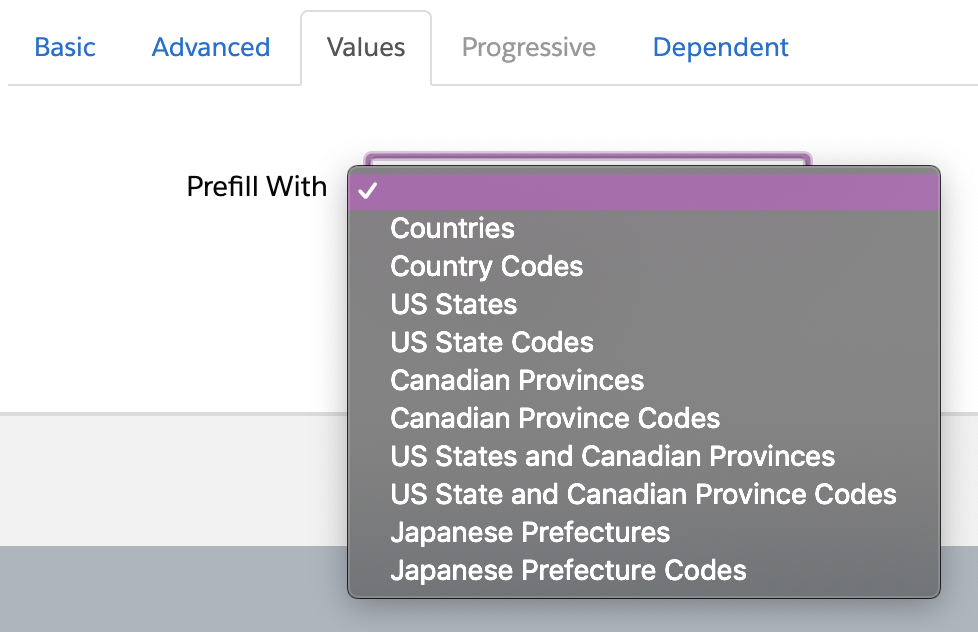
Any form fields that you can make into picklists of predefined values is going to improve the quality of incoming data, so use dropdowns wherever possible!
If you’ve already got it, how to use dynamic lists to identify junk
Dynamic lists are a fantastic way to identify junk data in your system. I typically recommend creating a “Junk Finder” dynamic list for the four fields that are most likely to contain junk: First Name, Last Name, Job Title, and Email.
Creating these lists requires some tweaking to ensure you are catching junk but not actual prospects. For example, if you were to include “Nope” as a phrase to scrub from the email field, you could return Leslie Knope at [email protected]… so run your rules, review, tweak, run them again, review etc.
Once you’re confident in your “Junk finder” dynamic lists work for your org, make sure you review them, clean up the data, and delete junk prospects on a regular basis!
To help you start your “junk finder” dynamic lists, I have compiled all the rules Sercante uses to help identify junk data below. I even broke these out into 250 character chunks using the Creuz Your Data app so you can easily copy and paste the data into your dynamic lists.
Dynamic List: Name junk finder
Prospect Default Field “First Name” begins with: [url]; abc; asd; asdf; fake; hreft; junk; none; nope; xyz; test
OR
Prospect Default Field “First Name” is: aa; asf; bb; cc; dd; ee; Fake; ff; first; Fuck; gg; hh; ii; jj; Junk; kk; last; ll; mm; name; nn; No; None; nope; not; noway; null; oo; pp; qq; rr; Sorry; spam; ss; Test; tt; uu; vv; ww; xx; yy; zz
OR
Prospect Default Field “First Name” contains: 0; 1; 2; 3; 4; 5; 6; 7; 8; 9; !; ?; .com; {; }; @; *; /; &; #; %; ^; +; <; =; >; $; aaa; bbb; ccc; ddd; delete; eee; fff; ggg; hhh; http; iii; inactive; jjj; kkk; lll; mmm; nnn; no longer; ooo; Postmaster; ppp; qqq; retired; rrr; sdf; sss; ttt
OR
Prospect Default Field “First Name” contains: unknown; uuu; vvv; www; xxx; xyz; yyy; zzz; dontemailme; donotemailme; donotcontact; dontcontact; nomail; noemail; unsubscribe
Once you build the dynamic list for “First Name” copy this list and create one using “Last Name”.
Dynamic List: Job title junk finder
Prospect Default Field “Job Title” doesn’t contain: Tester
AND
New Rule Group
Prospect Default Field “Job Title” contains: 0; !; ?; [url]; aaa; abc; asd; asdf; bbb; ccc; ddd; delete; do not use; donotuse; duplicate; eee; fake; fff; ggg; hhh; hreft; http; iii; inactive; invalid; jjj; junk; kkk; lll; mmm; nnn; no longer; none; nope; ooo; Postmaster; ppp; qqq; remove; retired
OR
Prospect Default Field “Job Title” contains: rrr; sdf; sss; test; ttt; unknown; uuu; vvv; www; xxx; xyz; yyy; zzz
Dynamic List: Email junk finder
Prospect Default Field “Email” contains: +junk; +spam; +trash; ;; :; ..; .com.com; ”; (; ); [; ]; {; }; @email.com; @no.com; @nope; @spam; @test.com; @trash.; /; \; <; >; example.com; junk@; junkemail; junkmail; noemail; nomail.; postmaster; spam@; spamemail; spammail; test.de
OR
Prospect Default Field “Email” contains: trash-mail.com; trashemail; trashmail; @junk.; dontemailme; donotemailme; donotcontact; dontcontact; requestnoemails; requestnomail; requestednomail; requestnoemail; unsubscribe
OR
Prospect Default Field “Email” doesn’t contain: @;.
Prospect Default Field “Email” begins with: 111@; 123@; a@; aa@; aaa@; aaaa@; aaaaa; aaaaa@; aaaaaa@; aaaaaaa@; aaaaaaaa@; aaaaaaaaa@; aaaaaaaaaa@; aaaaaaaaaaaa@; ab@; abc@; admin@; asd.as@; asd.asd@; asd@; asda@; asdaa@; asdaasd@; asdad@; asdada@; asdadad@; asdadasd@; asdads@; asdaf@; asdas@
OR
Prospect Default Field “Email” begins with: asdasa@; asdasd@; asdasda@; asdasdad@; asdasdas@; asdasdasd@; asdasdasdas@; asdasdf@; asdasds@; asdasdsa@; asdasdsad@; asdasdsd@; asdasf@; asdasfa@; asdassd@; asdc@; asdd@; asddas@; asddf@; asddsa@; asdekker@; asdf@; asdfa@; asdfad@; asdfadf@
OR
Prospect Default Field “Email” begins with: asdfads@; asdfadsf@; asdfaf@; asdfafd@; asdfas@; asdfasd@; asdfasdf@; asdfasdfa@; asdfasdfas@; asdfasdfasd@; asdfasdfasdf@; asdfasdfasf@; asdfasf@; asdfasfd@; asdfd@; asdfdafs@; asdfdsa@; asdfdsaf@; asdfdsf@; asdff@; asdfg@; asdfgdf@; asdfgh@
OR
Prospect Default Field “Email” begins with: asdfghj@; asdfghjkl@; asdfs@; asdfsa@; asdfsad@; asdfsadf@; asdfsaf@; asdfsd@; asdfsdaf@; asdfsdf@; asdg@; asdga@; asdj@; asdlfkj@; asdq@; asdqwe@; asds@; asdsa@; asdsad@; asdsada@; asdsadas@; asdsadsa@; asdsd@; asdsda@; asdsdd@; asdsds@; asdsf@
OR
Prospect Default Field “Email” begins with: business@; c@; cc@; das@; dd@; ddd@; df@; ef@; email@; example@; fake; fake.name@; fake@; fakeemail@; fakemail@; fakeName@; ff@; fff@; fuck; fuck@; fuckyou@; junk; junk@; me@; my@; myemail@; na@; no@; nobody@; noemail@; nomail@; none; none@
OR
Prospect Default Field “Email” begins with: noneofyourbusiness@; noneya@; requestednoemails@; sdf@; sdfa@; sdfadsf@; sdfaf@; sdfas@; sdfasd@; sdfasdf@; sdfasdfasdf@; sdfasdfsadf@; sdfasfs@; sdfd@; sdfdf@; sdfdfs@; sdfds@; sdfdsa@; sdfdsdf@; sdfdsf@; sdfdsfdf@; sdfdsfds@; sdfdsff@; sdfdsfs@
OR
Prospect Default Field “Email” begins with: sdff@; sdffds@; sdfff@; sdffsd@; sdfg@; sdfgdfg@; sdfgfsd@; sdfgh@; sdfgsdf@; sdfgsdfg@; sdfgsdgf@; sdfgsg@; sdfh@; sdflkj@; sdfs@; sdfsa@; sdfsad@; sdfsadf@; sdfsd@; sdfsdf@; sdfsdfd@; sdfsdfds@; sdfsdfg@; sdfsdfs@; sdfsdfsd@; sdfsdfsdf@
OR
Prospect Default Field “Email” begins with: sdfsdfsdfs@; sdfsdfsfd@; sdfsdsdf@; sdfsf@; sdfsfd@; sdfsfds@; sdfsfdsfd@; sdfsfs@; sdfsfsd@; sdfsfsdf@; sdfsfsdfsdfs@; someemail; someemail@; spam; spam@; spamart@; SPAMER@; spammer@; spampati@; t@; test; test.test@; test@; test1@; test123@; test2@
OR
Prospect Default Field “Email” begins with: test3@; test55@; testDev@; teste@; teste2@; testemail; testemail@; tester@; testest@; testi@; testing@; testing2@; testitnow@; testmail@; testme@; testname@; testonly@; Tests@; testtest@; testuser@; this@; toto@; trash; trash@; xx@
Dynamic List: Role-based email finder
Consider removing role-based emails out of Pardot altogether. Since role-based email addresses often represent multiple recipients, they generate many spam complaints and Pardot doesn’t send emails to these addresses.
Prospect Default Field “Email” begins with: admin@; administracion@; administration@; advisor@; all@; available@; billing@; bursar@; busdev@; ceo@; co-op@; community@; compete@; consultant@; contact@; contacto@; crew@; customercare@; customerservice@; data@; design@; digsitesvalue@; director@
OR
Prospect Default Field “Email” begins with: directors@; directory@; download@; editor@; editorial@; editors@; eng@; enquire@; enquiries@; enquiry@; everyone@; exec@; executive@; executives@; expert@; experts@; export@; head.office@; head@; headoffice@; headteacher@; hostmaster@; hr@; info@
OR
Prospect Default Field “Email” begins with: information@; informativo@; investorrelations@; jobs@; marketing@; master@; media@; office@; officeadmin@; operations@; prime@; principal@; reception@; recruit@; recruiting@; request@; sales@; school@; schooloffice@; secretary@; security@
OR
Prospect Default Field “Email” begins with: theoffice@; usenet@; users@; abuse@; database@; fbl@; ftp@; noc@; post@; postbox@; postmaster@; privacy@; remove@; root@; spam@; subscribe@; uucp@; webmaster@; welcome@; www@
How else do you jettison junk data?
For more tips on cleaning up the Assets in your Pardot org, check out our “13 Spring Cleaning Tips for a Spotless Pardot Org” article!
In addition to the strategies outlined above, there are a number of AppExchange products that can be a godsend for data quality — RingLead, DemandTools, and Lean Data, to name a few.
If you have other tips for your fellow readers, please share them in the comments!